The Forest Station Family House Left Along the Forgotten Tracks
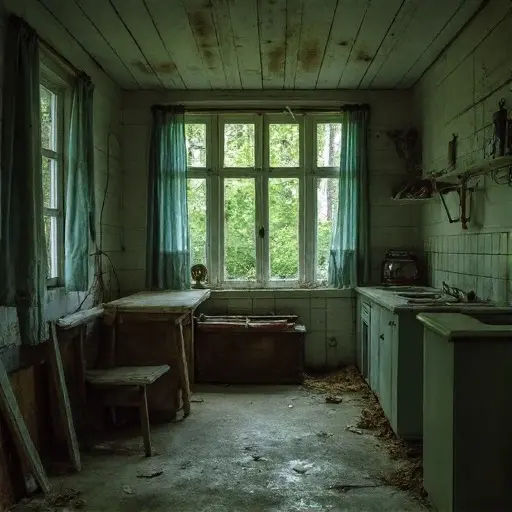
The Forest Station Family House was constructed in the early 1900s during a period of rural railway expansion when small transport stops were often combined with caretaker residences to maintain remote stretches of track The building followed a hybrid typology, merging domestic living quarters with a functional station hall in a single elongated timber-and-brick structure positioned directly alongside the railway line that once cut through the forest Its design reflected pragmatic necessity rather than architectural ambition, using locally sourced timber framing, dark brick foundations, and a gently sloped green-painted metal roof intended to shed heavy seasonal rainfall
The structure was divided longitudinally into two distinct but connected functions The residential half contained modest family living spaces organized around a simple hearth and kitchen area, while the station half opened into a larger waiting hall designed to accommodate travelers passing through the rural line Tall arched windows faced the railway corridor, allowing natural light to fill the hall while providing visibility for approaching trains Over time, as rail traffic diminished, the building’s dual purpose gradually collapsed into a single quiet domestic existence before eventual abandonment
The surrounding railway tracks, once regularly maintained, slowly became overgrown as service routes were discontinued Moss, ferns, and fallen branches accumulated along the rails, partially burying them beneath layers of forest growth while still preserving their linear path through the trees This faint corridor now serves as a visual and spatial reminder of the building’s original purpose, extending into mist and dense woodland where the railway once connected distant settlements Inside the station hall, wooden benches remain aligned in orderly rows facing empty space, and old timetable boards still hang crookedly on the walls, their printed information softened but still faintly legible beneath dust and age
Gradual Abandonment Along the Railway Corridor
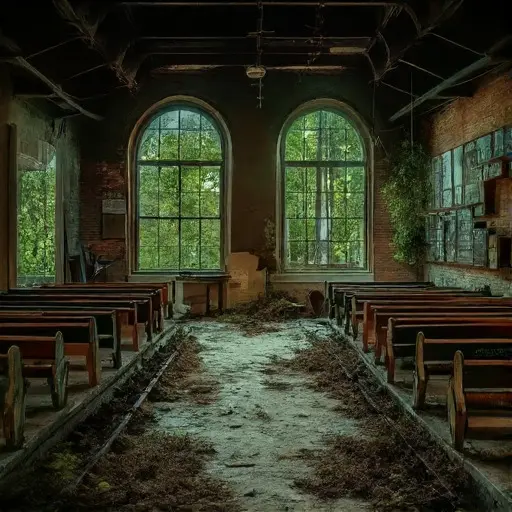
As decades passed and railway operations ceased the Forest Station Family House entered a slow phase of abandonment rather than sudden desertion The surrounding forest did not aggressively reclaim the structure but instead integrated it gradually through subtle ecological processes Vines traced along window frames and structural joints while roots extended into gaps between platform stones without disrupting the building’s stability Moisture from the dense canopy created a persistent softening of materials, particularly in exposed timber sections and faded painted surfaces, but the brick foundation remained structurally intact beneath the accumulated forest floor layers
The house eventually became indistinguishable from the railway corridor it once served as a functional node within The tracks outside continued to define a quiet linear path through the forest even as they fell out of use, reinforcing the building’s connection to a vanished system of movement and transit Inside, domestic and infrastructural spaces remained preserved in a state of suspended quietness, as if waiting for a service that would no longer return
Final State of the Forest Railway Dwelling
<img src=”https://beyondvisit.
com/wp-content/imagecontent/uploads/abandoned victorian house 17640287.webp” alt=”” />
By the final observed state the Forest Station Family House had ceased all functional operation while remaining structurally stable within the forest ecosystem No restoration or redevelopment has been attempted and no return of railway activity has occurred The building persists as a quiet hybrid of domestic life and infrastructural memory where architecture and overgrown transit corridor remain gently interwoven
The Forest Station Family House endures in stillness along the forgotten railway line No trains have returned and no repairs have been made The structure remains a quiet intersection of family habitation and vanished movement absorbed slowly into the surrounding forest