The Final Imprint of Chalk-Shroud Keep
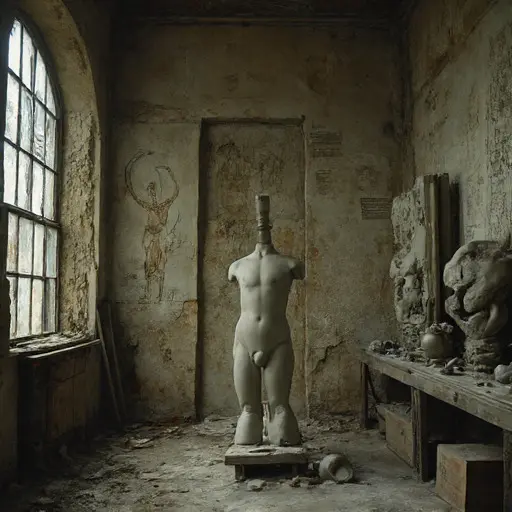
Chalk-Shroud Keep was an architectural statement of obsession with the human form: a massive, symmetrical structure built of pale, smooth limestone, characterized by its numerous large, open studio spaces. Its name suggested a blend of fine, dusty material and a concealing garment. The house stood on a rise, highly exposed to the sun, yet the interior felt unnaturally cold and sterile. Upon entering the main studio, the air was immediately cold, thin, and carried a potent, almost dusty scent of dried gypsum, clay, and a faint, acrid trace of bone powder. The floors were covered in a thick, pervasive layer of fine, white dust that muffled all footsteps. The silence here was clinical and absolute, the unnerving quiet that follows the halt of intense, focused labor. This abandoned Victorian house was a giant, sealed cast, designed to capture and hold a single, perfect mold of humanity.
The Anatomist’s Perfect Form
Chalk-Shroud Keep was the fortified residence and elaborate workshop of Dr. Alistair Thorne, a brilliant but pathologically obsessive anatomist, sculptor, and forensic scientist of the late 19th century. His professional life demanded the relentless study of human decomposition, the creation of accurate anatomical models, and the pursuit of absolute, permanent physical form. Personally, Dr. Thorne was tormented by a crippling fear of decay and a profound desire to make a lasting, permanent impression on the world that could not be eroded by time or death. He saw the Keep as his ultimate mold: a space where he could finally create a perfect, non-decaying replica of the human body, achieving physical immortality through art and science.
The Casting Vault
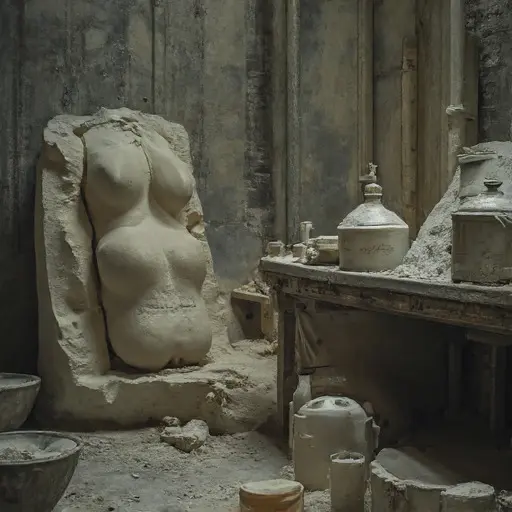
Dr. Thorne’s Casting Vault was the engine of his obsession. Here, he mixed his specialized plaster and chemical stabilizers to create casts that would never degrade. We found his final, detailed Molding Compendium, bound in heavy, treated canvas. His entries chronicled his escalating desperation to find the “Perfect Subject” for his final cast—a human being whose form was so flawless that its permanent preservation was justified. His notes revealed that he had begun to view his own body as the only viable subject, the only form he could fully control. His final project, detailed meticulously, was the creation of a massive, final full-body cast of himself, designed to remain intact for centuries.
The Final Impression
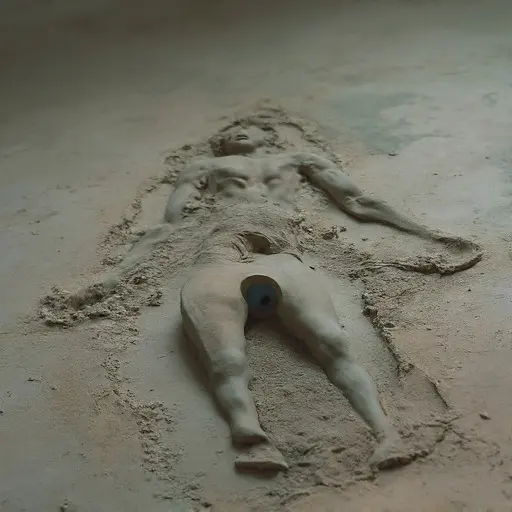
The most chilling discovery was made back in the main studio. The large modeling stand was empty. However, near a massive, recently moved pile of dried plaster bags, the floorboards were severely cracked and yielded beneath us. Beneath them, we discovered a hidden, shallow depression in the hard-packed earth: a massive, body-shaped negative impression left in the fine layer of dust and dried clay. Tucked into the side of the impression, where a hand would have been, was a single, small, hand-painted ceramic eye, perfectly formed and blue. Tucked beneath the eye was Dr. Thorne’s final note. It revealed the tragic climax: he had finally realized that the only way to achieve a perfect, non-decaying cast was to become the mold itself. He had laid down in his final mixture of drying plaster and clay, allowing the earth to make the final, perfect, inverse cast of his body. His final note read: “The form is complete. The impression is all that remains. I am the final evidence.” His body was never found. The final imprint of Chalk-Shroud Keep is the enduring, shallow, human-shaped void in the dust, a terrifying testament to an anatomist who achieved physical immortality only through the perfect, static absence of his own form, preserved within the dust-choked silence of the abandoned Victorian house.}