The Final Glitch of Cog-Mire House
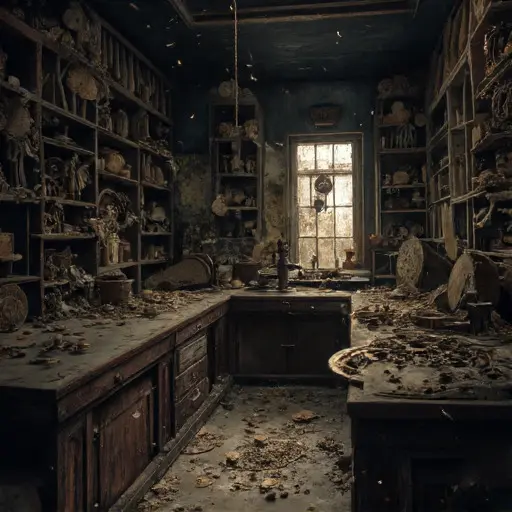
Cog-Mire House was an architectural study in complexity and disarray: a rambling, asymmetrical mansion built of dark red brick and numerous small, tightly packed rooms. Its name suggested the combination of intricate machinery and inescapable mud. The house sat low in a perpetually damp, mossy hollow, where external movement felt heavy and slow. Upon entering the main library, which served as a reception for clients, the air was immediately cold, thin, and carried a potent, almost dusty scent of old parchment, dry wood, and a sharp, metallic tang of fine oil. The floors were covered in thick, dust-laden carpet remnants that muffled all footsteps. The silence here was not natural; it was the intense, mechanical quiet that follows the abrupt failure of a thousand tiny, rhythmic parts. This abandoned Victorian house was a giant, sealed timepiece, designed to achieve and hold a state of perfect, unchangeable synchronicity.
The Chronometer’s Absolute Time
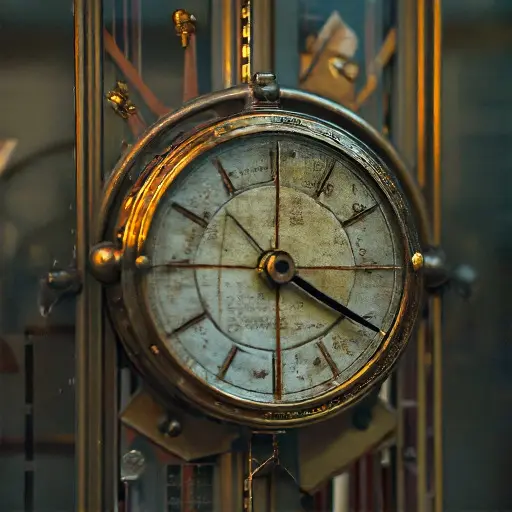
Cog-Mire House was the secluded domain and elaborate workshop of Master Horologist Elias Thorne, a brilliant but pathologically obsessive clockmaker and chronometer engineer of the late 19th century. His professional life demanded the meticulous calibration of timekeeping, the flawless assembly of complex movements, and the pursuit of absolute temporal accuracy. Personally, Master Thorne was tormented by a crippling fear of temporal drift and a profound paranoia that time itself was unstable and leading toward chaos. He saw the House as his ultimate machine: a space where every door chime, every stair tread, and every external clock was synchronized to the second, convinced that he could create a single, perfect moment of absolute, unchanging time.
The Calibration Chamber
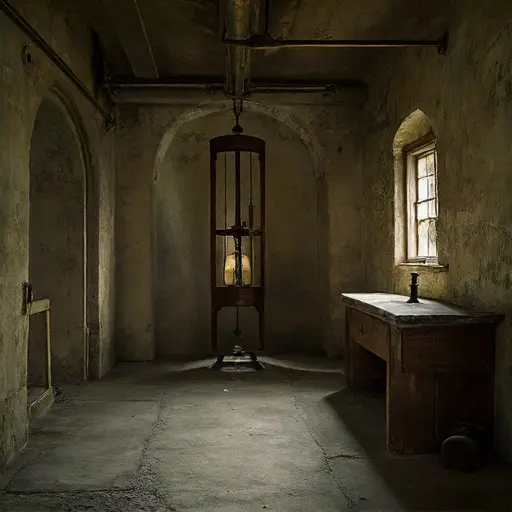
Master Thorne’s Calibration Chamber was the inner sanctum of his obsession. Here, he tuned the frequency of his Master Clock to an impossible degree of precision. We found his final, detailed Synchronization Log, bound in thick, scarred leather. His entries chronicled his escalating desperation to eliminate all external influences on his work, which included dismantling all windows in the house and sealing the doors. His notes revealed that he had begun to view his only surviving relative, his granddaughter Lydia, as the last unpredictable variable—her movements, her heart rate, her very existence represented a fatal temporal flaw. His final project, detailed meticulously, was the creation of a massive, single, ultimate timepiece, designed to stop on a specific, predetermined moment: “The Absolute Now.”
The Master Timepiece
The most chilling discovery was made in the main drawing-room, which Master Thorne had converted into a display chamber. In the center of the room, on a marble pedestal, stood the Master Timepiece. It was a towering, ornate clock, made of polished mahogany and brass. The intricate mechanism was visible behind glass, but the pendulum was frozen. The hands of the clock were stopped at 11:59:59. Tucked into the glass door of the clock was a single, sealed, heavy brass key. Tucked beneath the key was Master Thorne’s final note. It revealed the tragic climax: he had successfully created a mechanism designed to stop perfectly just before the next moment, forever holding the threshold of time. However, upon completing it, he realized the flaw: perfection means no future, no change, no life. He wrote that he had finally understood that the most accurate measurement of time was the one that acknowledged its inevitable, vital movement. His final note read: “The perfect time is a prison. The only true moment is the tick you cannot hold.” His body was never found. The final glitch of Cog-Mire House is the enduring, cold stillness of that Master Timepiece, forever frozen on the brink of change, a terrifying testament to a chronometer who achieved temporal perfection only to find the ultimate, fatal flaw was the end of all movement within the silent abandoned Victorian house.}