The Final Draft of the Pen-Weave
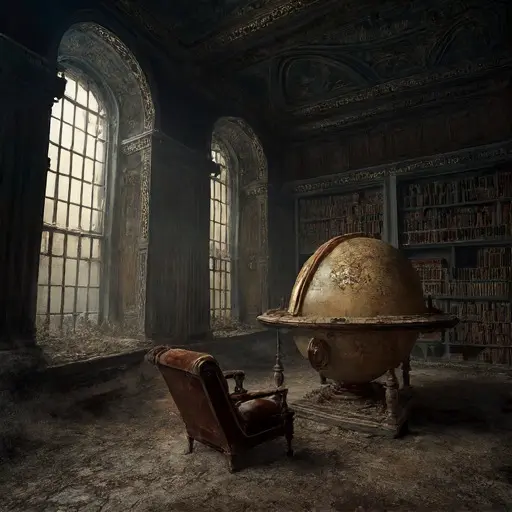
The Pen-Weave, a sprawling, severe Italianate villa of reddish-brown brick and white trim, was built in 1865 for a family obsessed with documentation and legacy. Its broad, severe symmetry and deeply shadowed cornices give it a look of unrelenting gravity. To enter the main hall is to be instantly silenced by the sheer scale of the decay and the chilling presence of the emptiness.
The primary Library, a room of intimidating height and length, stands as the core of the house’s original purpose, now a magnificent stage for entropy. The pervasive silence here is the final, last draft of a family history that was utterly destroyed by a single, catastrophic act of betrayal.
The Obsessive Genealogist, Arthur Finch
The mansion was built for Arthur Finch (1835–1890), a man whose profession was entirely self-directed: the relentless, obsessive pursuit of his family’s genealogy and history. He believed that the value of his life was solely derived from the purity and documentation of his lineage. Socially, he was a recluse, known only for his vast archives and his chilling dedication to historical accuracy.
Arthur married Lydia Thorne in 1860, a quiet, scholarly woman who was initially supportive of his work. They had one child, a son named Henry. Arthur’s personality was defined by his crippling fear of historical obscurity and any stain on his ancestral record. His daily routine was built around cataloging and cross-referencing documents in his vast Library and his most secretive space: a small, fireproof Archive Vault hidden behind a bookcase. His ambition was to publish a definitive, unassailable history of the Finch line; his greatest fear was a final draft of scandal.
The Archive Vault was his true sanctuary, built with a double-thickness steel door, designed to protect the fragile paper legacy from fire, water, and human interference.
The Betrayal in the Archive Vault
The tragedy that caused the Pen-Weave to be abandoned was a betrayal rooted in a secret family lie that Arthur had spent his life attempting to cover up. Henry, the son, was utterly overwhelmed by his father’s obsessive legacy, preferring the chaotic freedom of art to the rigidity of history. He knew of a persistent, whispered rumor that Arthur’s grandfather, the true source of the family wealth, had acquired his fortune through fraud and embezzlement—a fact Arthur had spent decades silently and successfully erasing from the public record.
In 1890, Henry confronted his father, threatening to expose the truth unless Arthur allowed him to leave the family and pursue his art. The confrontation led to a physical struggle near the Archive Vault door. Arthur, desperate, suffered a massive, debilitating stroke, falling against the heavy steel door and sealing himself inside. He was found the next day by his wife, paralyzed and unable to speak, trapped within the vault with his historical lie.
Before he died a week later, Arthur managed only one thing: he pointed a trembling finger at the final, unwritten line of his completed genealogical manuscript, lying on the desk outside the vault, leaving his wife with the final draft of the tragedy.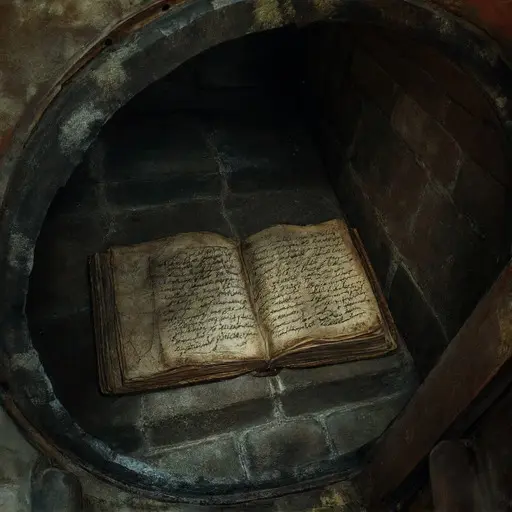
The Unwritten Pen in the Study
Lydia Finch, the widow, was left with a massive house, a ruined reputation (as the secret was finally exposed), and a crippling mortgage. Her son, Henry, consumed by guilt, immediately left the country, refusing to ever return or claim the inheritance.
Lydia saw the house as a mausoleum for a lie. She sold nothing, ensuring the house remained heavy with the objects of her husband’s failed obsession. Her final act of abandonment was a profound rejection of his life’s work. In 1891, she quietly walked out, stopping all tax payments and insurance, ensuring the house would fall into irreversible decay.
In Arthur’s small, formal Study, one object remains on his heavy, empty desk. It is a custom-made, antique silver fountain pen, resting on a small, untouched, leather blotter. The pen is entirely covered in dust, its nib clean and dry, never having been dipped into the ink one final time to write the final draft of the family’s history.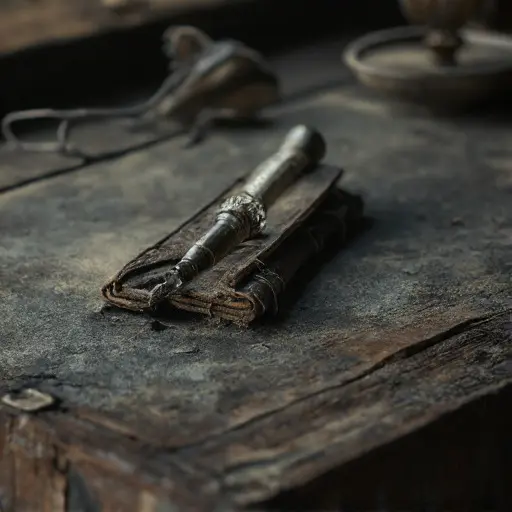
The Pen-Weave remains today, its massive brick façade standing as a cold, imposing shell. Its ultimate silence is the cold, physical fact of the final draft—the last, damning truth that could not be covered up, forcing the collapse of the family and leaving the house to silently mourn its ruined legacy.
