The Final Contour of Pylon-Shear Keep

Pylon-Shear Keep was an architectural statement of structural defiance: a massive, asymmetrical structure built of dark, heavy iron and reinforced concrete, characterized by numerous external buttresses and internal load-bearing walls designed to withstand immense forces. Its name suggested a blend of vertical support structure and the tearing force of stress. The house stood on a remote, exposed cliff edge, designed to resist the constant pressures of the wind and eroding earth. Upon entering the main stress analysis chamber, the air was immediately thick, cool, and carried a potent, mineral scent of aged iron, dry cement, and a sharp, metallic tang. The floors were rough, uneven concrete, amplifying every faint sound into an unsettling echo. The silence here was not merely quiet; it was an intense, structural stillness, the profound hush that follows the failure of a massive, heavily loaded system. This abandoned Victorian house was a giant, sealed fortress, designed to achieve and hold a state of absolute, unchangeable, physical rigidity.
The Engineer’s Absolute Load
Pylon-Shear Keep was the fortified residence and elaborate workshop of Master Engineer Dr. Alistair Thorne, a brilliant but pathologically obsessive structural engineer and material scientist of the late 19th century. His professional life demanded the precise calculation of failure points, the flawless design of complex load distribution, and the pursuit of absolute structural integrity—a building or component that could bear any imaginable weight without deformation. Personally, Dr. Thorne was tormented by a crippling fear of collapse and a profound desire to make the chaotic, unpredictable nature of physical forces conform to a state of pure, silent, permanent strength. He saw the Keep as his ultimate test subject: a structure where he could finally design and assemble a single, perfect, unyielding component that would visually encode the meaning of eternal, static strength.
The Compression Vault

Dr. Thorne’s Compression Vault was the engine of his obsession. Here, he worked to isolate and stabilize his final, most critical components against crushing forces. We found his final, detailed Yield Compendium, bound in thick, heavily treated metal plates. His entries chronicled his escalating desperation to find the “Zero-Deformation Material”—a substance so perfect it would never yield under any pressure. His notes revealed that he had begun to believe the most chaotic element was the internal flaw within the material itself—the microscopic bubble or impurity that guaranteed failure. His final project, detailed meticulously, was the creation of a massive, unique, internal “Master Pylon”—a final, massive, single concrete core designed to be absolutely pure, unyielding, and capable of bearing infinite load.
The Final Column
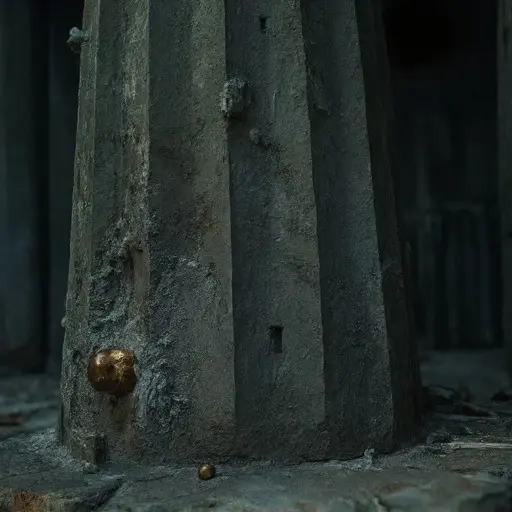
The most chilling discovery was made deep beneath the house, in the central foundation chamber. Tucked directly into the earth, at the very geometric center of the foundation, was the Master Pylon. It was an immense, perfectly formed, single column of unnaturally smooth, pure concrete, stretching from the bedrock to the floor above. The pylon was visibly intact and flawless, a testament to perfect structural integrity. However, running across its base, where it met the bedrock, was a single, clean, visible seam—a deliberate, unsealed point of separation, not fracture. Tucked into this seam was a single, small, tarnished brass plumb bob, used to ensure absolute verticality. Tucked beneath the pylon was Dr. Thorne’s final note. It revealed the tragic climax: he had successfully created his “Master Pylon,” achieving the absolute, unyielding structure he craved. But upon completing the base, he realized that a structure that never yields is one that can never truly be connected to the moving, fluid earth—it must be deliberately isolated to maintain its perfection. He had achieved structural perfection only by accepting a final, fatal, deliberate discontinuity. His final note read: “The Pylon is perfect. The strength is absolute. But the truth of structure is in its connection to the ground.” His body was never found. The final contour of Pylon-Shear Keep is the enduring, cold, and massive unyielding column, a terrifying testament to an engineer who achieved structural perfection only to find the ultimate, necessary flaw was the removal of the very possibility of connection, forever preserved within the mechanical silence of the abandoned Victorian house.}