The Ephemeral Bloom of Gilder-Moss Row
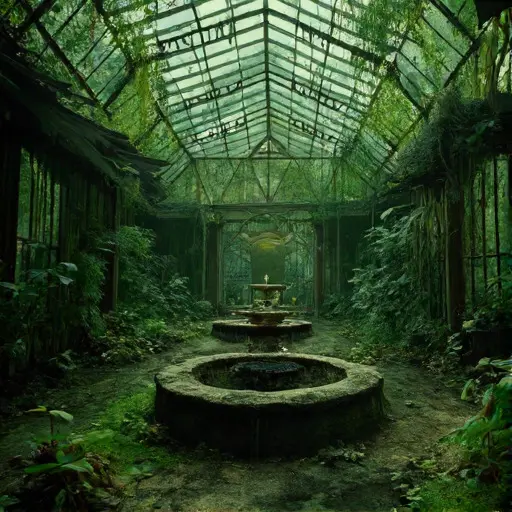
Gilder-Moss Row was a dazzling, improbable mansion built of pale, heavily mortared stone and featuring an extensive glass-house wing. Its name suggested a blend of artificial gilding and natural, fleeting moss, hinting at a forced, delicate beauty. The house was situated in a secluded, perpetually damp hollow. The exterior was startlingly white, standing out against the gloom, but its walls were already heavily streaked with green and brown growth. Upon entering, the air was immediately heavy, moist, and carried a thick, almost overwhelming scent of decaying flowers and rich, loamy soil. The floors were silent, covered by thick, spongy mildew. This abandoned Victorian house felt less like a static structure and more like a biological system that had simply run wild, its controlled beauty utterly consumed by nature.
The Botanist’s Fleeting Perfection
Gilder-Moss Row was the isolated residence and elaborate laboratory of Dr. Alistair Finch, a brilliant but intensely sentimental experimental botanist of the late 19th century. His professional life was spent in the meticulous cross-breeding and cultivation of hyper-delicate, short-lived hybrid flowers, trying to achieve chromatic and structural perfection in bloom. Personally, Dr. Finch was tormented by a profound, spiritual fear of mortality and the temporary nature of beauty, especially after the loss of his young fiancée, Clara, to a sudden illness. He saw the house and its gardens as his final, ultimate experiment: to create a flower so beautiful and so perfectly controlled that its brief bloom would negate the tragedy of its inevitable death.
The Hybridization Room

Dr. Finch’s hybridization room was a small, hot chamber sealed off from the main greenhouse. Here, among the dusty glassware and labeled seeds, we found his detailed, waterproof botanical journal. His entries chronicled his escalating desperation. He stopped naming his flowers by species and began naming them after moments in his lost romance with Clara—“The Kiss of Dawn Hybrid,” “The Lullaby Bloom.” His final project, detailed meticulously in the journal, was a flower he simply called “Aurelia.” He engineered it to bloom with perfect, golden iridescence for exactly one hour before disintegrating into dust. He believed that the perfection of that single hour would be an act of defiance against mortality.
The Wedding Altar
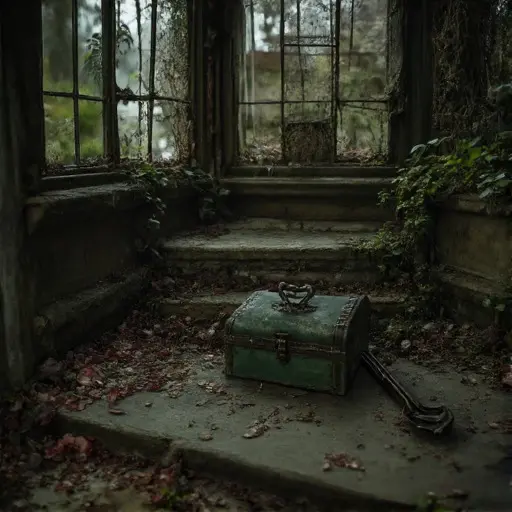
The most poignant space was a small, ornate, stone gazebo built within the center of the vast greenhouse—a space he had originally intended for his wedding to Clara. The gazebo was covered in aggressive, dead vines. Underneath a cracked flagstone, we found a small, iron box. Inside the box was not a ring, but a single, sealed glass slide containing the microscopic, perfectly preserved pollen dust of the Aurelia flower. His final journal entry, found tucked inside the box, revealed the heartbreaking climax: He had achieved the perfect bloom. He watched it for the full, glorious hour in the gazebo, and as it disintegrated into dust, he realized the futility of his labor. He couldn’t defeat mortality; he could only beautifully articulate it. He left the house immediately, never to return. The ephemeral bloom of Gilder-Moss Row is the pervasive scent of decaying flowers and the invisible, chilling perfection of that single, preserved dust on the slide, a final testament to a love that could not accept the tragedy of its short life within the abandoned Victorian house.