The Emerald Terrace Manor of the Abandoned Tea Hills
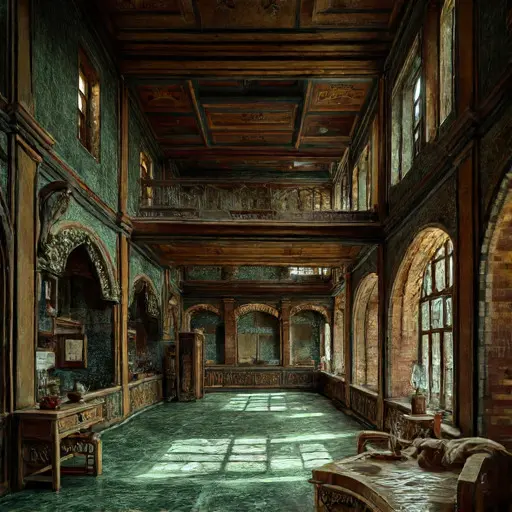
On a forgotten hillside once dedicated to terraced tea cultivation, where stepped agricultural platforms are now overtaken by wild grasses and resilient herbs, stands an Arts and Crafts Victorian manor that appears grown rather than built. Its three-story mass is clad in deep emerald-green hand-laid ceramic tiles, each subtly varied in tone and alignment, creating a living texture across the surface. Bands of burnt sienna terracotta relief panels interrupt the green field like warm geological strata, while warm brass framing traces structural lines with quiet precision.
Unlike formal Victorian symmetry, the manor spreads horizontally along the slope in a softened, grounded composition. Its central mass is slightly subdued, almost compressed, while wings extend outward in uneven balance, following the terrain rather than imposing upon it. The roofline, covered in weathered slate, sags gently in places, as though responding to decades of seasonal rain and hillside movement.
The windows are arranged with deliberate irregularity. Some are tall and narrow with rounded tops, drawing vertical emphasis, while others are broad and shallow, opening wide onto the landscape. These varied apertures are set within subtly curved walls that swell outward in organic rhythms, reinforcing the building’s Arts and Crafts philosophy of harmony between structure and environment.
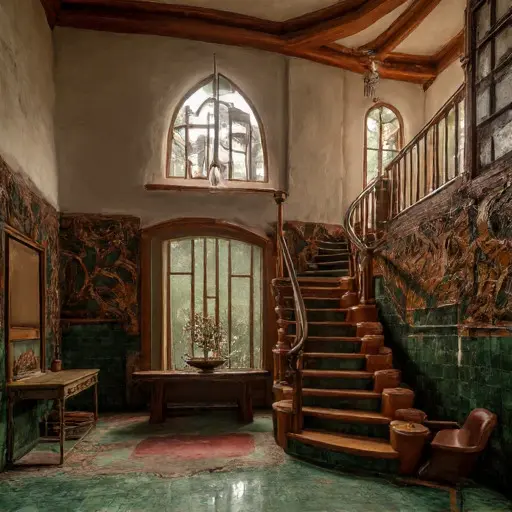
Inside, the manor emphasizes material honesty and craftsmanship. Every surface reflects careful artisanal construction: ceramic tiles laid by hand, brass joints left visibly functional, terracotta panels carved with botanical motifs referencing the former tea plantation. Light filters through irregular windows in soft gradients, moving across curved plaster walls and emphasizing the gentle swelling geometry of the interior spaces.
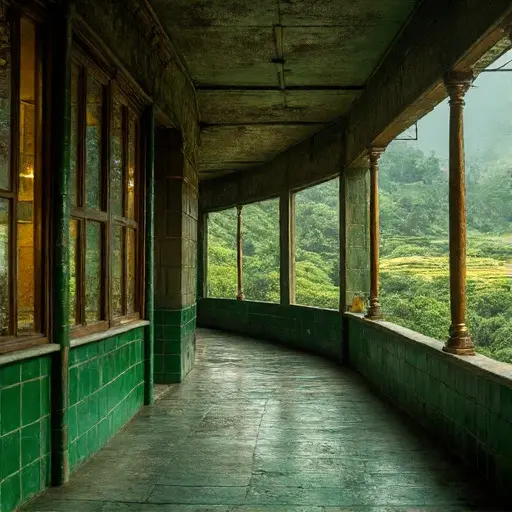
Outside, the abandoned tea terraces continue their slow reclamation of the land. Tall grasses and wild herbs push through the stepped stone platforms, softening the geometry of former cultivation. Near the manor, a rusted iron tea drying rack stands twisted beside a cracked stone water basin filled with rainwater and floating leaves. The building itself remains steady and quiet, its materials—ceramic, terracotta, brass, and slate—aging in place as the hillside gradually reclaims its edges.