The Emerald Gables Family House
Nestled within a peaceful forest clearing where towering beech and oak trees filter soft daylight across carpets of moss and wildflowers, the Emerald Gables Family House remains a quiet reminder of Victorian domestic life. Built not as an extravagant estate but as a refined upper-middle-class family residence, the home possesses a warmth and intimacy that distinguishes it from the grand manors of its era. Although abandoned for many decades, the structure retains an unmistakable sense of comfort, as though it still remembers the laughter and routines of the family who once called it home.
Constructed from smooth pale sage-green painted brick resting upon a sturdy charcoal stone foundation, the house achieves a graceful balance between decorative Victorian Gothic Revival styling and practical family architecture. Crisp white limestone trim frames every corner, window, and gable, creating elegant contrast against the softened green masonry that has faded gently beneath countless changing seasons.
Above the walls rises a richly articulated roofscape of emerald-green slate, its steep cross gables creating an energetic silhouette against the forest canopy. Decorative carved vergeboards trace each gable with remarkable craftsmanship, while ornamental ridge cresting and delicate finials remain remarkably intact despite years without maintenance. Tall brick chimneys capped with weathered terracotta pots punctuate the roofline, hinting at fireplaces that once filled every room with warmth during long woodland winters.
The home’s modest square entrance tower rises only a single story above the surrounding roof, lending vertical emphasis without overwhelming the residence’s welcoming proportions. Rather than proclaiming wealth, the tower simply adds architectural character, serving as a charming landmark visible through gaps in the surrounding trees.
Approaching the entrance, visitors step onto curved brick walkways now softened by moss and woven through flourishing gardens reclaimed by nature. Lavender bushes spill gently across the path, while white climbing roses mingle with foxgloves, blue delphiniums, daisies, and dense emerald ferns that preserve the memory of a carefully tended Victorian landscape.
The broad wraparound porch remains the heart of the exterior composition. Slender ivory-painted turned columns continue to support the timber roof, while lace-like fretwork stretches gracefully beneath the porch eaves, displaying the delicate woodworking so admired during the Victorian period. Time has weathered the paint into soft creamy tones, but every spindle and carved bracket still reflects remarkable craftsmanship.
Centered beneath the porch are the home’s handsome double entrance doors, painted a deep navy blue that contrasts beautifully with the pale green walls. Oval stained-glass inserts composed of ruby, amber, and emerald glass remain in place despite years of neglect, their cracked surfaces allowing muted fragments of colored daylight to shimmer faintly across the threshold.
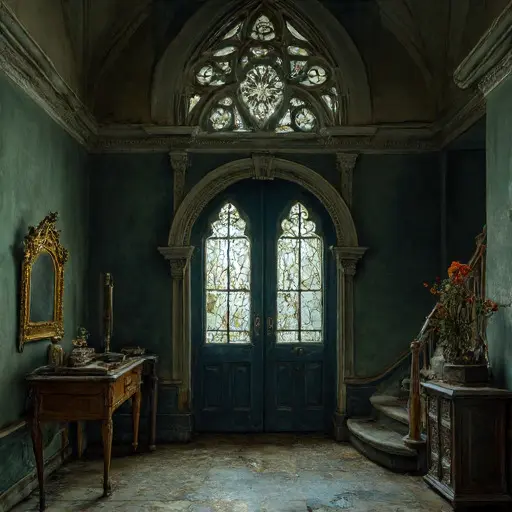
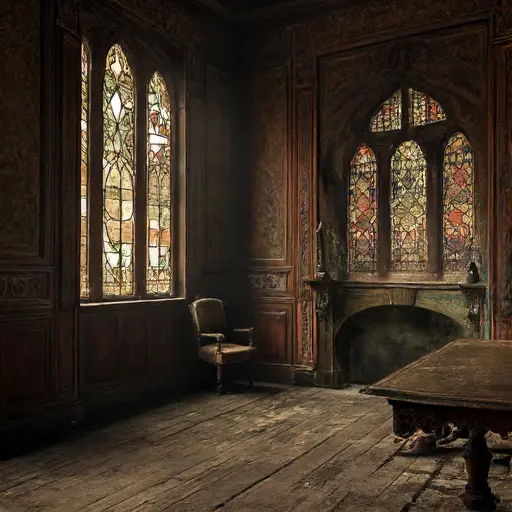
Inside, every room rests in complete silence. No artificial light has disturbed the darkness for many years. Sunlight entering through broken windows softly reveals polished woodwork beneath layers of dust, elegant plaster ceilings, and carefully crafted moldings that continue to demonstrate the home’s original quality. Empty fireplaces, forgotten sitting rooms, and quiet hallways preserve the atmosphere of an ordinary family home rather than an aristocratic palace.
One of the residence’s most distinctive features is its impressive two-story polygonal bay window projecting confidently from the front façade. Beneath its own steep miniature roof, decorative fish-scale shingles painted in muted coral and cream introduce subtle warmth to the otherwise restrained color palette. The textured shingles continue to catch soft daylight despite fading paint and years of exposure to the elements.
Elsewhere, a smaller garden-facing bay window overlooks what was once the family’s favorite outdoor retreat. Narrow Gothic pointed-arch windows appear throughout the house, lending graceful vertical rhythm while preserving the comfortable scale appropriate for a Victorian household.
Beyond the entrance garden, a circular stone fountain rests quietly beneath blankets of moss. Once the centerpiece of the family’s outdoor gatherings, its cracked basin now collects fallen leaves and rainwater, reflecting fragments of emerald rooflines and surrounding tree branches.
An old painted wooden arbor marks the beginning of a forgotten garden path winding gently into the surrounding forest. Climbing roses have claimed its weathered beams, weaving delicate blooms through peeling paint without obscuring the elegant craftsmanship beneath. Beyond it, brick pathways disappear beneath thick ferns and wild grasses, inviting quiet exploration into woodland that has gradually embraced the property.
The forest itself enhances every architectural feature rather than concealing it. Towering beech and oak trees stand respectfully beyond the garden’s edge, allowing uninterrupted views of the house while surrounding it with rich seasonal greenery. Moss-covered stones, flowering woodland plants, and soft carpets of leaves complete a landscape that feels carefully balanced between human design and natural renewal.
The home’s materials continue to age with remarkable dignity. Painted brick has softened into muted sage hues, limestone trim has weathered into gentle cream tones, emerald slate displays subtle patches of lichen, and wrought iron railings carry a rich patina earned through decades of exposure. Every surface tells the story of quiet endurance rather than collapse.
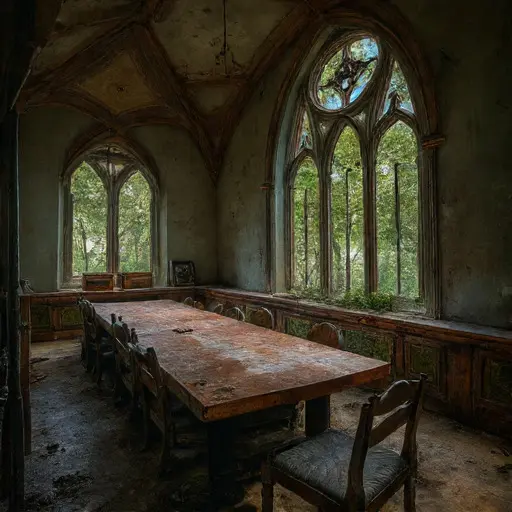
Today, the Emerald Gables Family House stands as a beautiful example of Victorian Gothic Revival architecture designed for everyday family life rather than grandeur. Its welcoming proportions, vibrant yet weathered colors, and lovingly crafted details continue to express warmth despite decades of silence. Surrounded by flourishing gardens and sheltered beneath an ancient woodland canopy, the house endures as a timeless portrait of home, memory, and the quiet resilience of thoughtful architecture reclaimed gently by nature.