The Embankment Line House Left Empty After Track Closure Drift
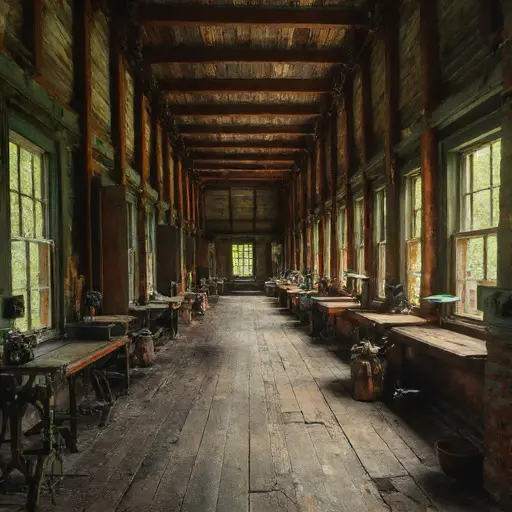
The Embankment Line House was established in 1902 along a long abandoned railway embankment cutting through dense woodland, where the raised trackbed formed a natural corridor above the forest floor. Originally built as a station-master residence, it expanded gradually over decades into an elongated segmented dwelling that retained the strict linear logic of its railway origins.
The exterior combined layered brickwork, painted timber siding, and cast-iron structural elements.
The brick base weathered into deep burnt umber, soot black, and faded rust red, with softened mortar lines overtaken by moss. Above, timber cladding ran horizontally in weathered panels painted in deep signal green, faded cream, and muted slate blue, now chipped and blended into muted gradients. Cast-iron supports remained exposed along structural junctions, darkened to matte graphite with traces of oxidized brown.
The structure stretched along the embankment in a sequence of connected compartments, each slightly varying in width and height. These segments reflected its incremental expansion over time, forming a rhythmic progression of spaces rather than a unified mass. Small projecting bays extended toward the forest side, while the railway-facing edge remained rigid and linear, preserving its infrastructural origin.
Inside, the original station-master quarters evolved into a continuous residence for the Lornefield family, who maintained records of railway activity long after formal closure. Edwin Lornefield documented embankment stability and seasonal forest encroachment, while his partner Alina managed correspondence with regional transport authorities during the line’s final operational years.
Railway decline and isolation
By the late 1920s, the railway line had been fully decommissioned, and embankment maintenance ceased. Tracks were gradually removed or buried beneath vegetation, leaving only sleepers and iron fixtures embedded in the forest floor below. The house, elevated above this abandoned corridor, remained structurally intact but increasingly isolated as access routes deteriorated.
Gradual decline in the household
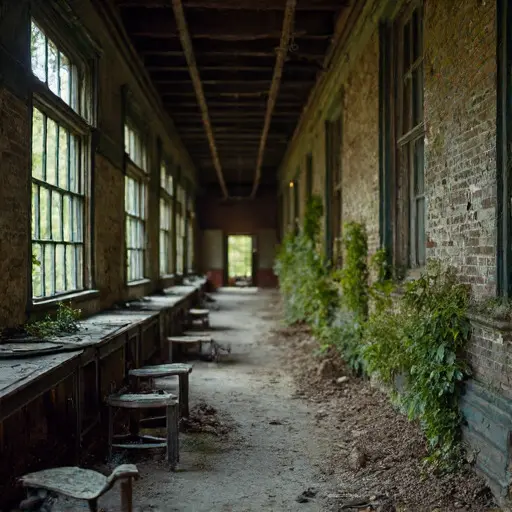
As rail operations ceased completely, the embankment environment began to reclaim the surrounding infrastructure. Forest growth pressed inward on both sides of the raised corridor, narrowing light access and increasing moisture retention along the structure’s base. Maintenance segments closest to former service routes were abandoned first due to access difficulty.
By the early 1940s, the Lornefield household relocated to nearby settlements, leaving only occasional returns for inspection and archival retrieval. The house transitioned from residence to relic of railway infrastructure, slowly absorbed into the forest corridor it once governed.
Final abandonment phase
By 1946, the Embankment Line House was no longer inhabited. Remaining access paths collapsed under root expansion and soil instability along the former trackbed. Without upkeep, timber siding warped unevenly, and moss spread across brickwork in continuous vertical climbs. Iron elements oxidized further into deep matte tones, blending with shadowed sections of the structure.
The house left empty
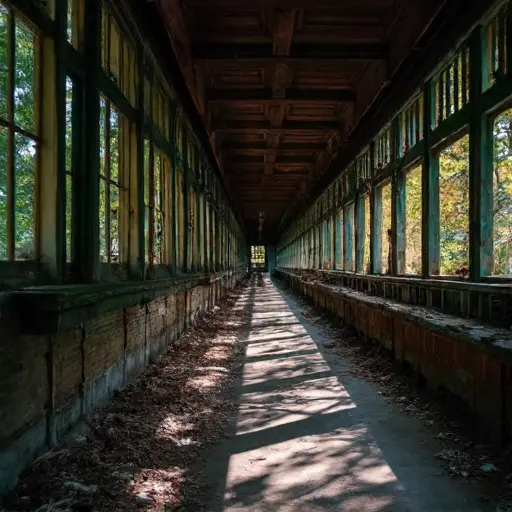
By the late 1940s, no formal ownership or operational responsibility remained for the Embankment Line House. Railway authorities had long dissolved, and no preservation effort was undertaken. The structure remained suspended along the abandoned corridor, slowly reclaimed by forest growth, its elongated railway-derived form fading into the linear rhythm of trees, embankment, and encroaching vegetation.