The Elmwater Irrigation House Left Silent in the Valley Channels
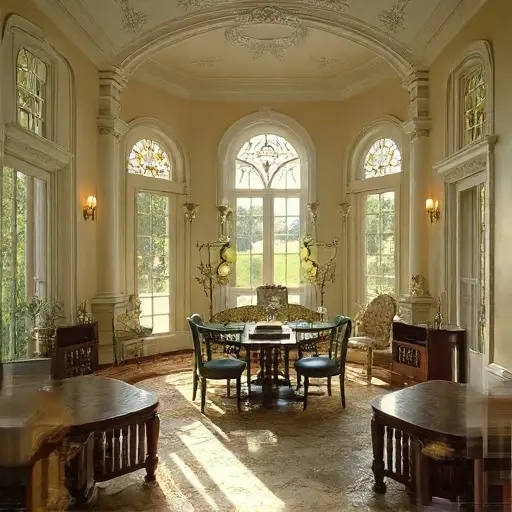
Elmwater Irrigation House was completed in 1899 during a period of agricultural modernization in inland valley estates. Designed for the Harrington family, who managed irrigation and land distribution across a network of engineered water channels, the residence reflected both prestige and utility. Its architecture combined late Victorian structural discipline with emerging Edwardian symmetry, resulting in a confident, balanced composition rooted in landscape management.
The building is constructed from pale buff brick and creamy Portland stone, materials chosen for both durability and luminous visual warmth. Its façade is organized around a central axis, anchored by a semicircular entrance portico supported by paired Ionic columns of restrained detail. Above, a large half-moon window set within a shallow pediment introduces a radial geometry that reinforces the building’s formal composition.
On either side of the entrance, gently bowed bay windows extend across both floors, softening the façade’s symmetry with subtle curvature. The result is a controlled interplay between structure and fluidity, reflecting both architectural intention and the valley’s water-based infrastructure.
Roof and structural refinement
The roof is a carefully proportioned combination of slate and copper detailing. A low central pitch is flanked by slightly raised hipped volumes, creating a layered roofscape that remains visually balanced from all angles. Dormer windows are evenly spaced and capped with small triangular pediments, reinforcing the house’s disciplined rhythm.
Over time, copper elements along the roofline have oxidized into a deep green patina, providing a muted contrast against the pale stone and slate surfaces. Despite weathering, the roof remains structurally intact, preserving its original architectural clarity.
The surrounding irrigation landscape was designed as both function and ornament. Curved gravel paths, circular planting beds, and controlled water channels guided flow through the valley floor. These channels once formed a precise hydrological system supporting surrounding farmland and orchards.
System failure and gradual disengagement
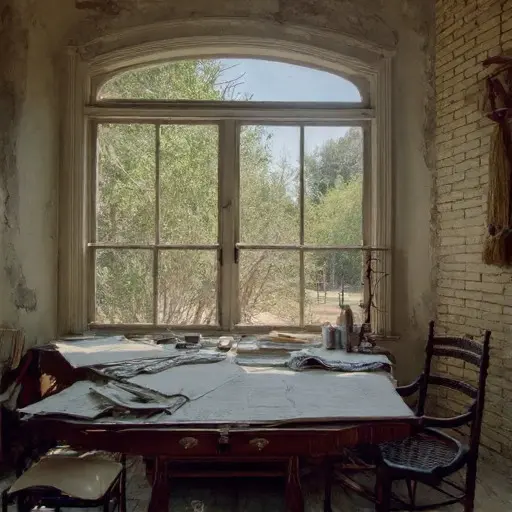
By the 1920s and 1930s, regional agricultural management began shifting toward centralized water control systems. Larger infrastructure projects reduced reliance on localized irrigation networks such as the one surrounding Elmwater House. Maintenance schedules were reduced, and oversight responsibilities were gradually transferred to regional authorities.
As a result, the irrigation channels surrounding the house began to lose operational consistency. Water flow became irregular, and sections of the system were left unmaintained. Although the channels did not collapse catastrophically, they transitioned from engineered infrastructure into passive landscape features carrying only seasonal runoff.
Within the household, operational roles diminished accordingly. Rooms dedicated to irrigation management were used less frequently, and parts of the house were reserved for seasonal occupancy only. The surrounding gardens remained carefully structured but increasingly symbolic rather than functional.
Final abandonment phase
By the late 1940s, the Harrington family relocated permanently to a more centralized administrative center, leaving Elmwater Irrigation House unoccupied. No formal demolition or redevelopment followed, as the structure remained sound and aesthetically valued within the valley landscape.
The house left behind
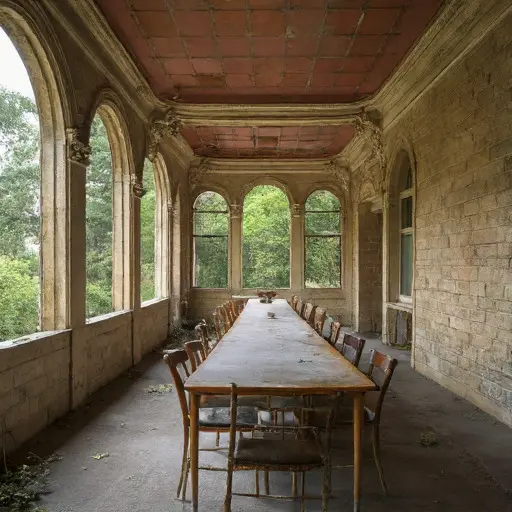
By the early 1950s, Elmwater Irrigation House stood entirely vacant. No restoration or redevelopment was undertaken, and the irrigation network surrounding it remained in a reduced, passive state. The house endures as a refined example of late Victorian–Edwardian domestic architecture—balanced, luminous, and structurally intact—preserved within a landscape that quietly shifted from engineered system to natural recovery.