The Ellersby Loop House and Its Abandonment
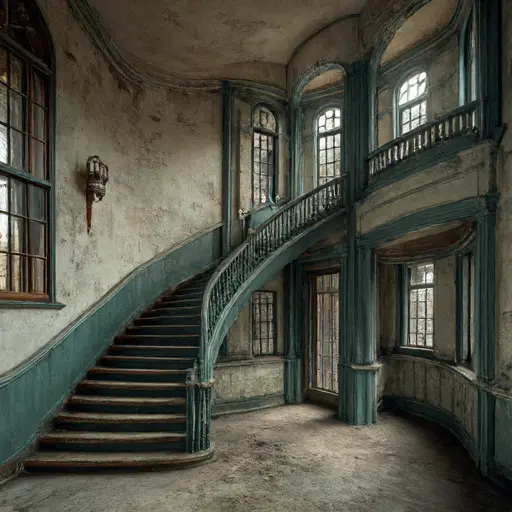
Ellersby Loop House was completed in 1890 for Charles Edmund Halrow, born 1842 in Bristol, a coastal survey engineer responsible for mapping cliffside erosion routes and tidal boundary shifts along irregular shorelines. His work required tracing continuous coastal paths rather than fixed property grids, often producing looping diagrams to represent changing shore access over time.
He designed the house as both residence and working model of continuous shoreline navigation, intending it to reflect the same looping logic he used in his coastal mapping systems.
He lived there with his wife Eleanor Grace Halrow and their son Matthew, who assisted in maintaining survey logs and correspondence stored across the house’s interconnected interior paths.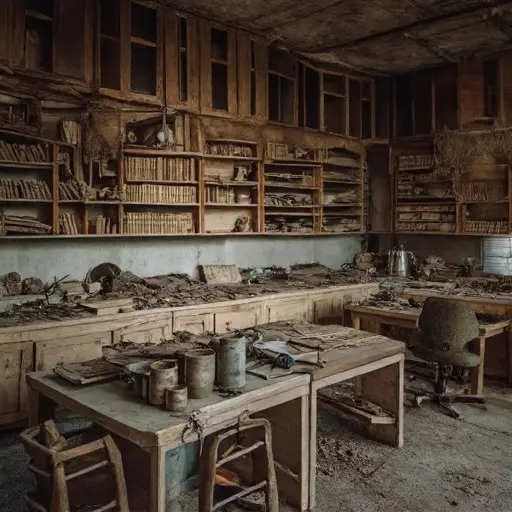
The decline began in 1906 when regional coastal authorities standardized shoreline mapping into fixed linear coordinates, replacing earlier continuous-loop surveying methods used to track erosion and tidal drift. Halrow’s curved mapping systems were gradually deemed incompatible with newer linear cartographic standards.
By 1910, he had withdrawn from active surveying and remained at Ellersby Loop House while attempting to translate his loop-based records into linear documentation formats. Financial stability remained moderate, but professional relevance declined as standardized coastal mapping replaced continuous models. Eleanor maintained the household during this period, though correspondence suggests increasing isolation as the house itself continued to behave like a path that never fully ended.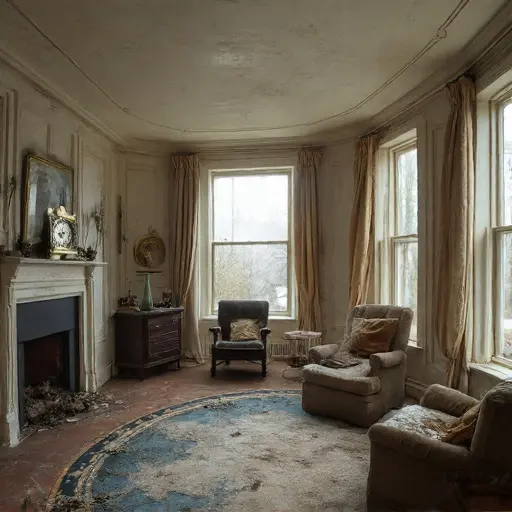
By 1912, Charles Halrow had ceased most surveying work entirely, retaining only occasional correspondence with coastal planning offices. Matthew’s name appears once more in a final archival reconciliation of shoreline records before disappearing from official documentation. Ellersby Loop House remained fully furnished but abandoned, its interior paths preserved as a continuous circuit with no clear beginning or end.
The house still stands on the cliff above the sea, calm and intact, as if it was never meant to be entered—only followed.