The Elarion Ridge House Where Memory Curved Like Stone
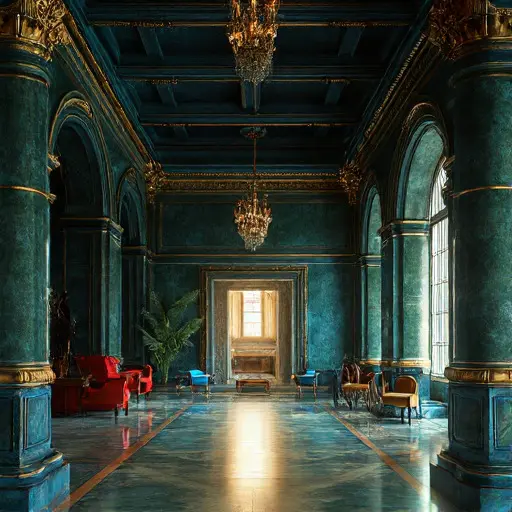
The Elarion House was constructed high along a mountain ridge where wind and silence shared equal presence. It was never intended to be symmetrical in the strict sense, though its original architect insisted it followed a “human logic of imperfection”—a philosophy that shaped its shifted wings, curved façade planes, and irregular window cadence. From a distance, it appeared balanced; up close, it behaved like memory, never repeating itself exactly in any direction.
It became home to Adrian Vale, a structural designer who believed buildings should respond to emotion rather than only gravity, and Selene Arkwright, a botanical illustrator who mapped plants as if they were living sentences. They met not in the house, but during its construction—she sketching wildflowers growing through the unfinished terraces, he adjusting stone curvature to accommodate her paths through the garden. By the time they moved in, the house already felt familiar, as if it had been waiting for their particular way of occupying silence together.
Their life unfolded in soft repetitions: early mornings on the upper balcony watching mist roll through the ridge valleys, afternoons spent adjusting garden mosaics by hand, evenings in the central hall where Selene worked under lamplight while Adrian refined architectural drawings that were never meant for anyone else. Conversations often happened without words. The house seemed to translate what they did not say into form.
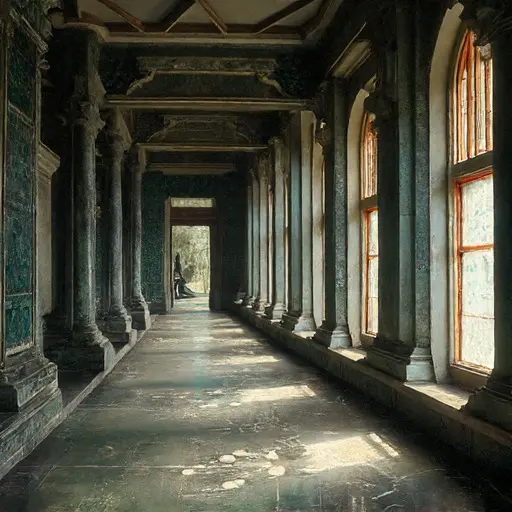
By the late 1920s, distance entered the Elarion House not as absence, but as drift. Adrian’s work began to take him beyond the ridge for longer periods, drawn into large civic structural commissions in distant cities. Selene remained behind more often, tending to the garden terraces and continuing her botanical studies, though her illustrations began to shift in tone—less catalog, more recollection. The house absorbed this imbalance without breaking its rhythm, but its spaces subtly changed their use: fewer shared meals in the central hall, more solitary hours in separate wings that still somehow felt connected.
Their correspondence grew increasingly layered. Letters overlapped, were rewritten, or left unfinished entirely. Some were never sent, yet still placed carefully in drawers as if waiting for a better version of the moment. The terraced garden began to blur at its edges, where electric orange lilies and violet hydrangeas expanded into one another, and fuchsia roses climbed stone arches that were no longer fully visible beneath vegetation. The embracing nature of the estate shifted from design to condition.
At the center of it all, the circular reflecting pool remained unchanged in intention but altered in surface, its black stone edge now softened by moss and drifting petals. The sculpture of the two seated figures—once clearly defined beneath a shared cloak—began to lose distinction where water and vines touched its surface, as if time was gently renegotiating their closeness rather than erasing it.
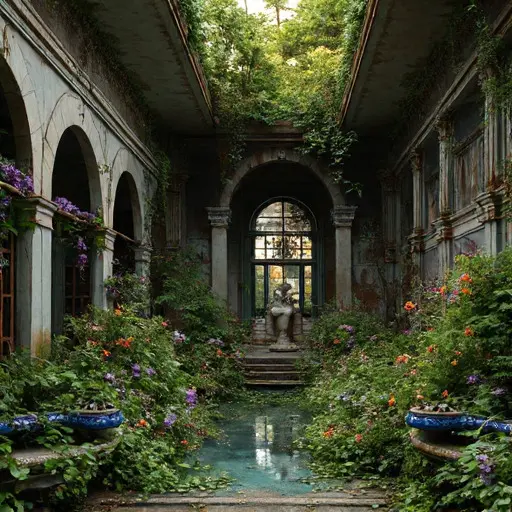
By the early 1940s, after Adrian’s final departure for work that never brought him back to the ridge and Selene’s last unanswered letter, the Elarion House was left without formal closure. There was no recorded sale, no confirmed inheritance transition, only a gradual disappearance of human return.
The structure remained intact, but no longer maintained. The mountain reclaimed its edges slowly, without urgency. Vines followed the geometry of the building as if remembering its logic better than its makers did. The house did not collapse or vanish; it simply ceased to be visited. And in that absence, it continued holding the softened shape of two lives that had once built their closeness into stone, glass, and garden—without ever fully letting it end.