The Eerie Zielinski Butcher’s Block and the Cut Left Waiting
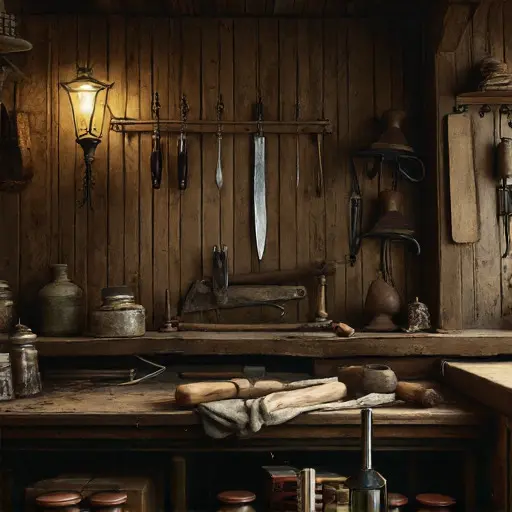
In the Butcher’s Room, the block’s surface is scrubbed smooth, though shallow grooves remain like softened memories of practiced cuts. A stopped kitchen clock stands on a side shelf, its pendulum still. A linen towel droops over the handle of a hanging ladle, dampness long faded to a dry curl.
Beside the block, a heavy cleaver leans against a whetstone, misaligned by a hair—enough to hint at a hesitation that marked the room and never resolved. No disorder screams here; just an unfinished act circling in the quiet.
Daily Routines of Stanisław Piotr Zielinski, Butcher
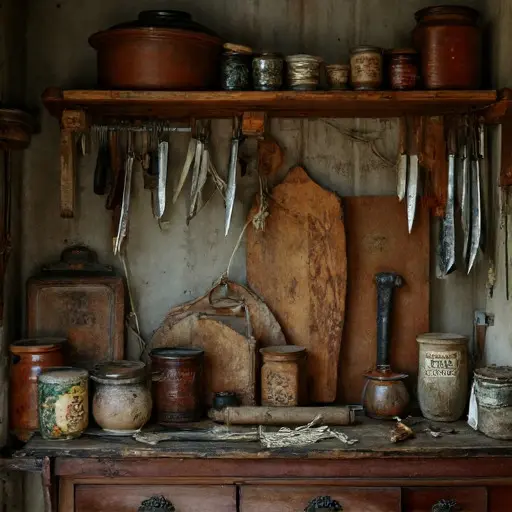
Traces across these furnished spaces shape the outline of Stanisław Piotr Zielinski, born 1871 in Kraków, trained in modest market stalls before taking private commissions. In the Pantry Nook, rows of Polish-labeled spice tins—jałowiec, majeranek—stand precisely grouped. A sharpening steel with a carved, regional pattern rests near a set of knives wrapped in waxed cloth, each blade accustomed to slow, careful honing. His routines seem steady: dawn trimming, midmorning jointing, evenings spent wrapping parcels at a steady rhythm.
In the Dining Parlour, a set of wooden boards—unused but wiped with beeswax—indicates care and something like pride in presenting work neatly. A folded apron on a chair bears faint impressions of its former wearer’s motions, and a recipe slip written in Polish script lies beneath a bowl of coarse salt. Everything suggests a man deliberate, restrained, and quietly protective of his craft.
Signs of Strain in His Measured Practice
Subtler tensions mark the adjoining rooms. In the Upper Washroom, a cracked jar of rendered fat leaves a pale ring on the washstand—uncharacteristic for someone fastidious. A folded notice from a health inspector, its crest blurred by moisture, lies beneath a bar of soap. In the Guest Alcove, a travel coat slumps over a chest, pockets filled only with dulling knives awaiting sharpening stones that were never fetched. A small ledger (kept closed, by rule) lies beneath a towel, corners dog-eared, as though consulted in uneasy calculation.
Near the Side Storage Cabinet, a hook meant for a blade stands empty, its dust outline crisp. A faint indentation on the butcher’s block suggests he set down something weighty—then changed his mind. Nothing confirms turmoil, yet each object leans toward uncertainty, as though external pressures—perhaps licensing troubles or disputes over quality—had begun to erode his composure.
A Cleaver Tilted Away From Its Line
Back in the Butcher’s Room, the misaligned cleaver beside the whetstone becomes the room’s keystone. The block’s grooves shift subtly near its edge, revealing the start of a cut never carried through. A trussing needle lies out of place on the floor, its arc whispering of a startled gesture or a tense reconsideration. Even the apron folded on the stool seems off-center, as though replaced by someone whose hands trembled ever so slightly.
A faint ring of moisture stains the block’s far corner—recent enough, in the house’s timeless hush, to imply a final moment of doubt. A spool of butcher’s twine unravels toward the baseboard, its loose end forming an accidental loop, delicate yet unsettling.
Behind the butcher’s block, tucked between wooden slats, lies his final attempt: a carefully trimmed joint paused mid-preparation, its edges smoothed but never portioned. A tiny chalk mark on the block wavers, trailing off where certainty should have continued. No message explains the falter—only the stillness of a craftsman who measured each cut until one day the line refused to hold.
The house records nothing more, and it remains abandoned still.
