The Eerie van der Meer Regulator Cabinet and the Hour Unkept
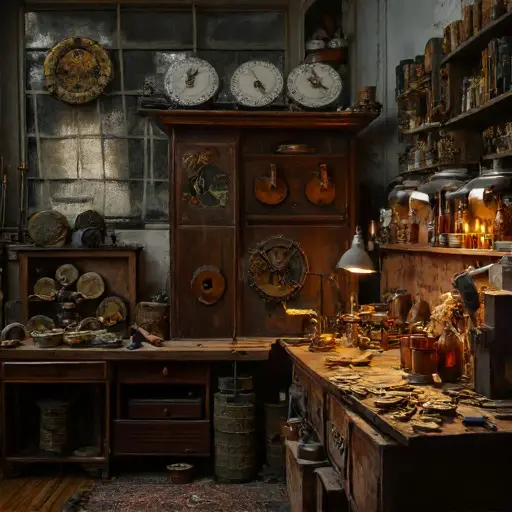
A breathless hush drapes the Clockmaker’s Workshop, where the regulator cabinet’s glass door reflects dim amber from the lamp. Its pendulum hangs motionless, weights resting at an uncertain midpoint, neither fully lowered nor raised. A coil spring lies on the floor, shaped like a question that has uncurled itself too far.
The faint smell of machine oil lingers, mingling with cedar dust. On the central bench, a movement plate bears a faint fingerprint smudge, as if the last attempt to steady a fine-edged tool faltered mid-touch. Nothing screams disorder, yet everything feels paused on a tight hinge between precision and doubt.
Precision and Restraint in Hendrik Willem van der Meer
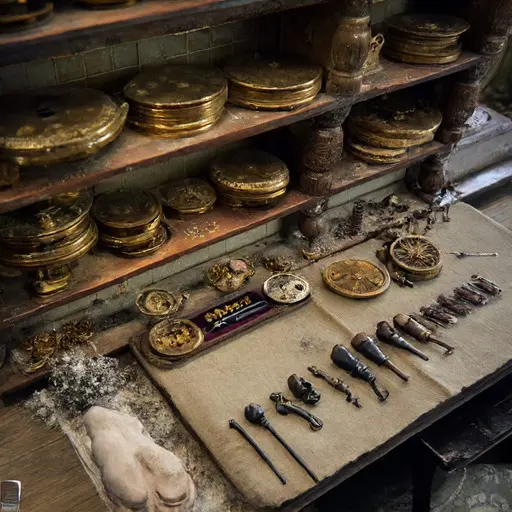
Traces across the furnished loft speak of Hendrik Willem van der Meer, born 1870 in Haarlem, trained in modest Dutch ateliers that prized meticulous steadiness. In the Escapement Nook, Delft-blue tins hold bearings sorted by diameter; tiny vials of horological oil sit aligned on a cloth. Each tool’s placement reveals long discipline—broaches decreasing by gauge, files resting tip-outward for quick reach, mainsprings wound into perfect spirals.
Hendrik’s days may have begun with calibrating escapements by candlelight, followed by meticulous polishing of pivots for wealthy patrons who trusted him to restore their mantel clocks. In the Side Parlour, a pair of ornate Dutch longcase chimes stand silent, pendulums wrapped in linen bands to preserve alignment. His temperament seems patient, even reverent—moving through time as though it were a fragile material he could coax into order through diligent touch.
Subtle Disturbances in His Long Practice
Signs of uneasy shift appear in unexpected corners. In the Upper Washroom, a cracked Delft soap dish holds a toothbrush stained with metal filings—evidence of late-night work carried beyond the bench. A folded note from a Rotterdam client sits water-warped, its seal broken, its tone unreadable. In the Guest Cot Room, a travel satchel waits with only winding keys and two spare dials tucked in its lining; no clothes, no provisions.
A stoppered bottle of fine oil lies on its side near the hearth, its contents forming a small crescent stain on the boards. Such carelessness contrasts sharply with Hendrik’s known precision. Perhaps financial pressures built; perhaps a misaligned escapement caused a dispute; perhaps an unseen tremor nudged his once-steady hand. The rooms offer implication, not verdict.
A Gear Misplaced at the Edge of Intention
Returning to the Clockmaker’s Workshop, tension gathers around a single gear lying just outside the usual tool arc. Its teeth bear a faint scoring, as though he attempted a correction that went subtly wrong. The regulator cabinet’s pendulum rod shows a smudge where it was steadied—or hesitated over. A half-empty vial of oil stands uncorked, its dropper resting at an odd angle, hinting at interrupted focus.
Even the vise’s grip on the escapement anchor feels wrong: tightened too much on one side, too little on the other. A slender file lies perpendicular to its usual direction, its handle dusted with filings that form a wavering line across the bench. Something in Hendrik’s surety thinned just enough to shift the room’s quiet center of gravity.
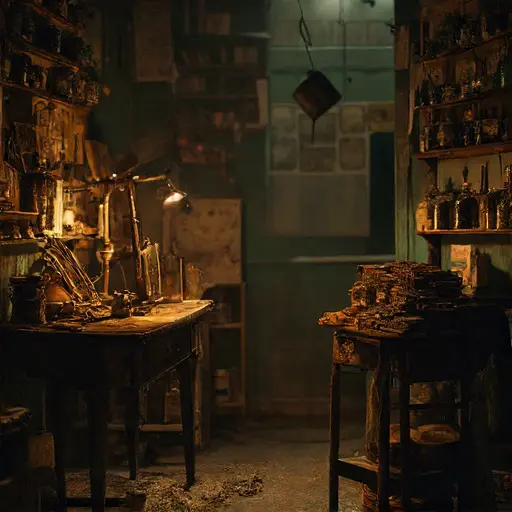
Behind the regulator cabinet, wedged near its rear panel, lies his final attempt: a tiny assembly of wheels and levers, its balance spring bent just shy of true. The final screw sits half-threaded, its slot misaligned. No note clarifies whether the fault was in the mechanism or in Hendrik’s confidence. The rooms hold the question gently but do not answer.
The house remains still, and it remains abandoned still.
