The Eerie Stillness of Harrowgate Folly
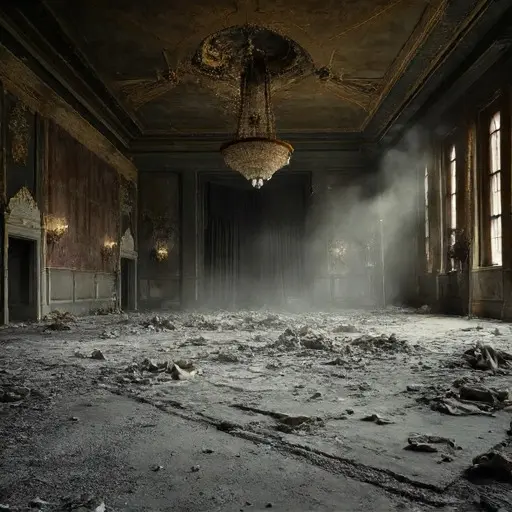
The atmosphere inside the Harrowgate Folly is profoundly cold, an absolute, heavy silence saturated with the dry, sharp scent of antique wallpaper and decaying wood. The Main Entrance Hall is an immediate declaration of arrested time. A massive, intricately carved hall table stands near the sweeping staircase, upon which rests a bronze tray holding a scattering of brittle, yellowed calling cards, their corners curled.
The entire house serves as the silent, unedited chronicle of Lord Alistair Harrowgate, a man whose life was defined by his obsession with social status and his final, catastrophic emotional withdrawal.
Lord Harrowgate’s Vain Pursuit
The proprietor who sealed the house’s fate was Lord Alistair Harrowgate (1855–1921), a wealthy, title-obsessed landowner who inherited a vast, debt-ridden estate. His profession was the maintenance of his family’s historical, albeit tenuous, nobility; his personality was defined by intense social ambition, an unshakeable belief in aristocratic superiority, and a profound emotional coldness. His social role was the ultimate snob and climber, living with his long-suffering wife, Lady Eleanor, and their two adult children. Alistair’s single, all-consuming fear was the loss of his title and social standing—the ultimate public humiliation.
The house, completed in 1912, was his final, extravagant attempt to secure his position. The Ballroom and the Formal Drawing Room were built on an immense scale to host society events that he could barely afford. The house’s tragic decline began in 1918 when his primary source of income—agricultural land—was effectively seized by the government under eminent domain for war efforts. His response was to retreat entirely into a feverish state of denial. He started spending hours alone in the Second Floor Trophy Room—a space filled with ancient, tarnished family crests and dubious ancestral portraits—compulsively polishing the metalwork, a futile, physical attempt to restore his tarnished pedigree.
The Stack of Unpaid Bills in the Study
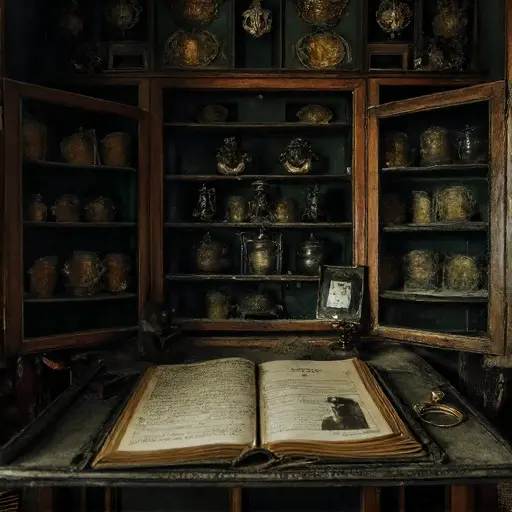
The financial evidence of Alistair’s ruin—a direct result of his fear of public disgrace—is found in the Ground Floor Study. On the heavy, carved oak desk, a small, dark leather wallet lies open, its contents spilled out: a scattering of brass coinage and, more importantly, a thick stack of tightly rubber-banded unpaid bills for basic household services (coal, gas, water) dating back several years. The bills, covered in a permanent layer of dust, are a silent testament to the extreme financial precarity he hid while maintaining his grand public facade.
Eleanor’s Note on the Writing Table
The final, catastrophic rupture occurred in the spring of 1921. Eleanor, unable to endure the suffocating debts, the cold house, and her husband’s emotional cruelty, made a decision. Evidence of her silent departure is found in the Morning Room. On a small, delicate writing table rests a single, neatly folded piece of white linen paper—a final note to Alistair. The note, written in an elegant, steady hand, states simply that she was leaving the house with the children and would not return, citing his “unyielding pursuit of what is already lost.” Lord Alistair Harrowgate, reading the note found on his desk, suffered a sudden, fatal cerebral event in the Study that same evening.
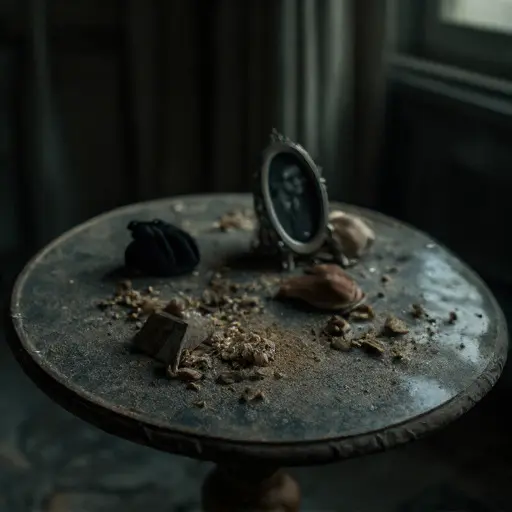
Lady Eleanor retrieved only the most essential personal items and immediately left the county. She refused to deal with the debt-ridden estate. The bank seized the Harrowgate Folly in 1922 but, due to the house’s massive scale, the complexity of the title, and the overwhelming debts, it was deemed legally unsalable. The receivers simply secured the imposing doors and walked away. The Harrowgate Folly stands today, every room holding the material record of a life consumed by its own overweening, devastating fear of social disgrace, forever silent and abandoned.
