The Eerie Silence of the Cairnwood Hold
The Cairnwood Hold is less a house and more a small fortress, a Gothic Revival structure of dark, rough-cut stone and imposing turrets, built high above the river gorge in 1895. Its massive scale and somber facade create an immediate impression of unyielding permanence. To enter is to immediately encounter the cold, suffocating weight of history.
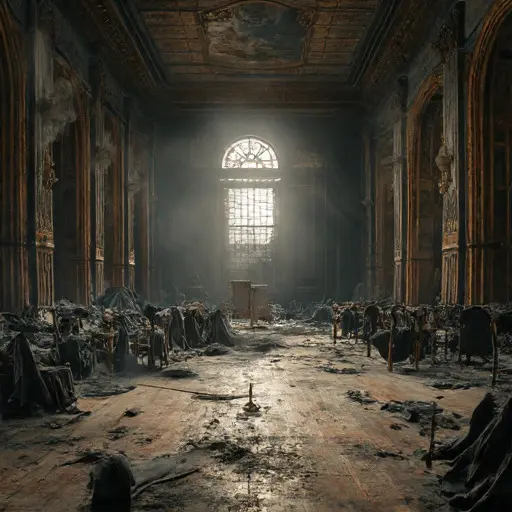
The grand ballroom, intended to be the jewel of the estate, is now a cathedral of decay. Dust lies inches deep, muffling all sound, enforcing the profound, eerie silence that has reigned here for generations. This silence is the lasting legacy of a single, sudden moment of human failure.
The Relentless Ambition of Herbert Vance
The Hold was the ultimate expression of Herbert Vance (1850–1920), a man who rose from poverty to become a titan in the regional coal mining industry. His profession was extraction—of coal from the earth and profit from his endeavors. Socially, he was a domineering autocrat, accustomed to immediate compliance.
Herbert married Esther Blackwell in 1875, and they had one daughter, Florence. Herbert’s personality was characterized by relentless drive, impatience, and an obsession with perfection. His daily routine was built around controlling every minute aspect of his vast business empire from his imposing, mahogany-paneled study. His ambition was total: to elevate his family to the untouchable status of American aristocracy.
The construction of the ballroom was the capstone of this ambition. It was designed to host the wedding of his daughter, Florence, to the son of a Boston financier, a union Herbert believed would irrevocably secure the Vance name for all time.
The Tragedy of the Coal Dust and the Contract
The downfall of the Vance family was a direct result of Herbert’s ruthlessness. In 1918, during a period of intense labor strife, Herbert made a decision to ignore critical safety measures in his deepest mine shaft to meet a lucrative wartime contract deadline. The result was a devastating, widely publicized cave-in that killed dozens of workers and severely injured many more.
The public outcry was immense, and the subsequent legal and financial fallout crippled his empire. The massive cost of the lawsuits and the public shaming left Herbert Vance a shell of a man. The great ballroom, meticulously prepared for Florence’s elaborate society wedding scheduled for October 1919, was never used. The wedding was quietly, humiliatingly canceled by the Boston family.
Herbert Vance suffered a rapid decline, dying of a massive heart attack in his study in early 1920.
The Unfulfilled Vow in the Linen Closet
After her father’s death, Florence Vance, bitter and emotionally exhausted, refused to touch the estate. She inherited the property, but she viewed it as a monument to her father’s avarice and her own ruined prospects. She packed a small trunk and moved into a rented room in the city, using the small remaining trust fund left by her mother, Esther.
Florence never sold the Cairnwood Hold. Like Catherine Atherton before her, she maintained the tax payments for decades, determined to keep the house empty, refusing to allow anyone else to profit or celebrate within its walls. She did not want the eerie silence broken. The house was her private shame, preserved and contained.
Before she left, she had made one peculiar, final act. In the vast linen closet on the second floor, she carefully cut up her immense, untouched wedding gown—yards of silk and lace—into small, neat squares. She placed the pieces into an empty cedar chest, sealed the chest, and locked the closet door, tossing the key down the well outside.
Florence Vance died childless in 1968. The legal entanglements resulting from the subsequent estate challenge were insurmountable, leaving the Hold in a state of permanent limbo, its value eroded by time and legal neglect. The Cairnwood Hold remains today, its eerie silence unbroken, a massive stone shell holding the secret of a ballroom that never heard its music and a wedding dress intentionally destroyed.
