The Eerie Silence of Carveth Manor
The door, heavy with ornate, blackened ironwork, groaned a sound of protest against the hinges as it reluctantly opened. It was a sound that had been waiting decades to be made.
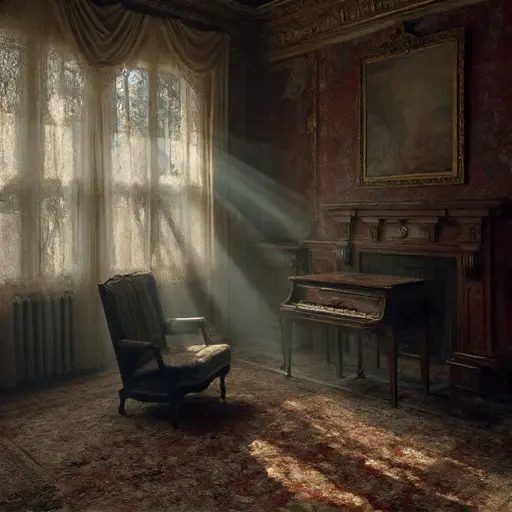
Stepping over the threshold of Carveth Manor was not entering a house; it was entering a suspended moment in time. The air was thick, tasting faintly of dried flowers, old leather, and an ineffable, profound silence. Sunlight, fractured by leaded glass and layers of grime, illuminated the central hall in dusty, golden columns. Each beam highlighted the infinitesimal motes of history swirling—the dust of decades. The floors underfoot—rich, dark mahogany—emitted a faint, melancholy creak, as if the house itself were sighing with the burden of its memories.
It felt less like exploring and more like being observed. The house didn’t welcome; it endured.
The Reclusive Doctor’s Obsession
Carveth Manor was once the domain of Dr. Alistair Finch, a physician renowned not for his cures, but for his reclusive personality and obsessive dedication to cataloging the fading light of the world. He was a collector of moments, specifically the moments before things changed forever. After the sudden loss of his young wife, Clara, Dr. Finch retreated fully into the house, abandoning his practice. His grief manifested in a meticulous, almost scientific approach to preservation. He didn’t simply live; he entombed his life with her.
He believed the objects surrounding them—the porcelain figures, the heavy tapestries, the handwritten notes—could retain the emotional residue of the person who last touched them. His tragic fate, a sudden, silent decline within the walls he so desperately guarded, left the house perfectly preserved, a museum of his intense sorrow.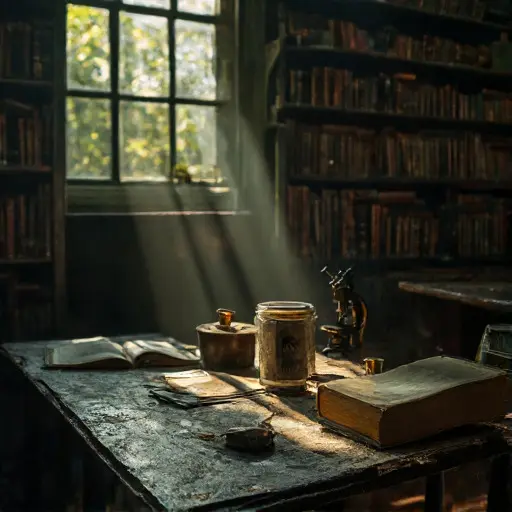
Fading Echoes in the Conservatory
The house had many secrets, but the deepest were held in the Conservatory. This room, once a riot of tropical life and Clara’s favorite retreat, was now a crystalline tomb. The glass roof was cracked in places, allowing rivulets of decay to streak down the tiled floor. Here, among the skeletal remains of ferns and dried climbers, was the physical evidence of Dr. Finch’s final years.
Tucked into a broken terracotta pot, half-buried under sand and mildew, was a small, leather-bound notebook. It was Dr. Finch’s final diary. The last entry was brief, written in a shaky, almost illegible hand: “The light… it is all fading now. I cannot hold it, and soon, nothing will be left but the silence. But I hear her, still. She is in the dust.”
This was not the tale of a ghost but of an overwhelming memory, so potent it had permeated the structure. Dr. Finch’s presence was preserved in the tension of the air, the unread books, and the terrible stillness that followed the brief, echoing sounds of a floorboard shifting under the weight of an unseen thing.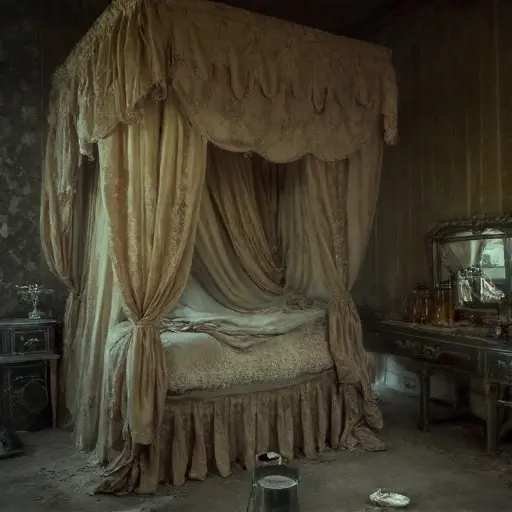
The silence was absolute, yet it seemed to be composed of countless tiny sounds that refused to die—the faint echo of a woman’s laughter, the scratch of a forgotten pen, the closing of a door in a distant, unseen wing. Carveth Manor was a heart that had stopped beating, but whose final, drawn-out sigh was still resonating through the cold, empty rooms.
