The Eerie Scrolls of the Singh Cartographer’s Chamber
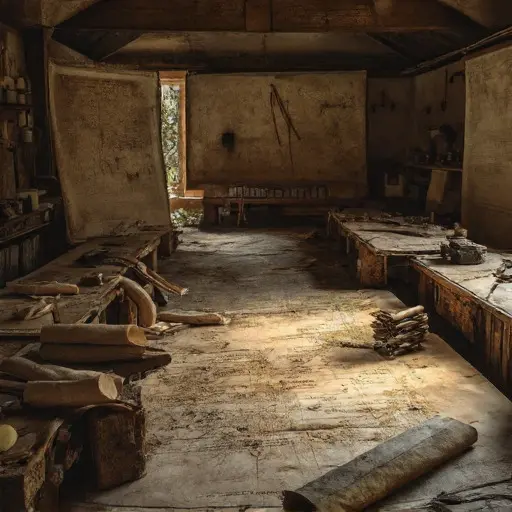
The Cartographer’s Chamber holds the hush of unfinished journeys. On a table, penciled contour lines for a mountain range trail off mid-sweep. Every ruler, compass, and parchment embodies meticulous work abruptly paused, the rhythm of mapping frozen in quiet anticipation.
Life in Lines and Landscape
These tools belonged to Arjun Singh, cartographer (b. 1884, Jaipur), trained in Indian royal surveying offices and skilled in topographical and military maps. Ledger entries document commissions for princely states and trading companies. A folded note references his assistant, Ravi Singh, “deliver region map Thursday,” reflecting strict daily routines of measuring, drawing, and annotating executed with careful precision.
Instruments of Precision
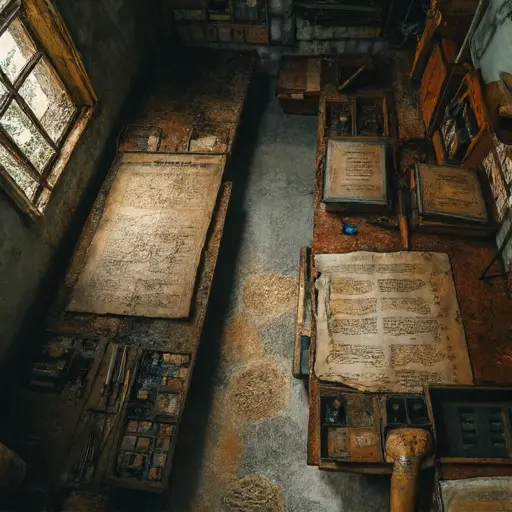
Drafting tables hold partially drawn maps and scattered instruments. Compasses, rulers, quills, and ink pots lie stiff with dried ink. Rolled maps rest on nearby shelves, some curling. Arjun’s ledger, weighed down by a brass ruler, details client names, coordinates, and elevations. Dust settling over instruments emphasizes abrupt cessation of repeated, exacting motions, the silence thick with halted exploration and unfulfilled surveys.
Signs of Fading Accuracy
Later ledger entries reveal misaligned contour lines and repeated corrections. Margin notes—“Ravi questions river course”—are smudged. Compasses show uneven wear, quills brittle, rulers nicked. Arjun’s failing eyesight and tremor subtly distort measurements. Pencil notations trail off mid-calculation, quietly recording declining skill and unfinished cartography.
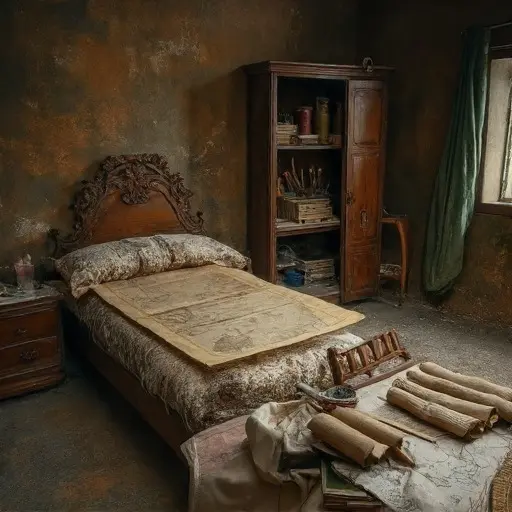
In the Chamber’s final drawer, Arjun’s last map ends mid-contour, a penciled note—“verify with Ravi”—abruptly stopping.
No record explains why he abandoned his work, nor why Ravi never returned.
The house remains abandoned, maps, tools, and instruments awaiting hands that will not return, the quiet heavy with unfinished exploration and lost mastery.
