The Eerie Manuscripts of Whitford’s Library Nook
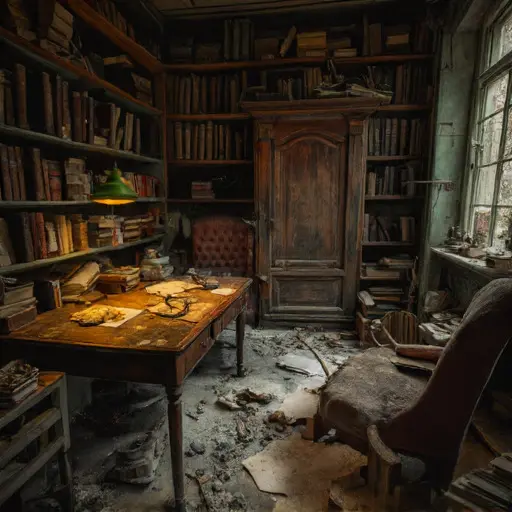
The Library Nook hums with quiet expectation, the manuscripts open mid-thought, passages half-written, and notes left alongside careful citations. Nothing is displaced; books lean in ordered ranks, inkpots poised, and quills balanced on their stands. Silence carries the weight of absence: a scholar’s mind once busy with text now entirely gone, leaving every page and manuscript suspended in the act of creation.
Texts and Scholarship
The room belonged to Margaret Whitford, philologist, born 1872 in Edinburgh, educated at the University of St Andrews, specializing in Old Norse and Gaelic texts. Her profession shaped the interior: dictionaries, annotated folios, scrolls of transcriptions, and reference texts stacked on side tables. A framed photograph of her father, Alastair Whitford, rests on the desk alongside a brass inkwell. Her temperament was meticulous and disciplined; her days were consumed by reading, copying, translating, and annotating in manuscripts. Each object bears the marks of habitual scholarship, leaving the space intimate, structured, and quietly unsettling.
Unfinished Translations
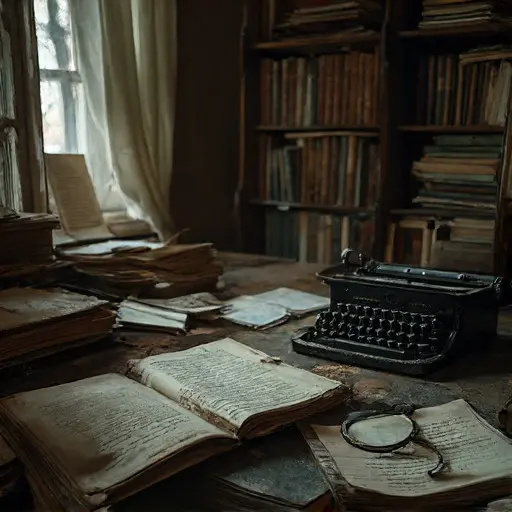
Whitford’s last manuscripts reveal increasingly halting notes, words smudged with trembling hands, references left incomplete. Decline came from progressive arthritis affecting her fingers, eroding the ability to handle fragile pages and carefully write annotations. Research projects remained unfinished, translations incomplete, and correspondence unopened. One shelf of rare texts remains untouched, labeled but ignored. Work ended quietly, leaving the library charged with absence rather than chaos. Even the reading lamp remains lit, as if waiting for hands that never returned.
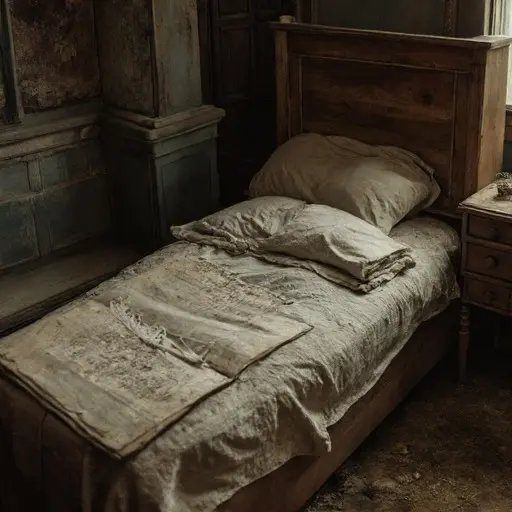
No explanation accompanies her sudden withdrawal.
Margaret Whitford did not return to the library nook.
The house remains abandoned, manuscripts untouched, books unread, inkpots unmoved. The library nook preserves the memory of a life devoted to language and scholarship, ended when fingers failed, routines indefinitely suspended, leaving philological work unresolved, eerie, and haunting through absence.