The Eerie Makris Repoussé Room Where the Reliefs Faltered
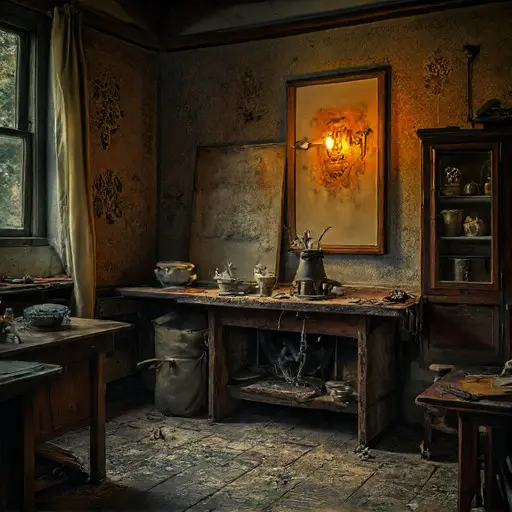
The room holds a patient silence. A broad floral panel rests on the central bench—its left half alive with tight, confident repoussé, its right half sagging into shallow, uncertain strokes. A pitch bowl cools beside it, surface mottled as though stirred and abandoned before the metal could be set again.
A tracing stylus lies crooked near a malformed vine motif, its tip clouded with tarnish. No violence, only craft interrupted precisely where certainty dimmed.
A Silversmith Who Lived by Rhythm and Pressure
This repoussé room once belonged to Nikolas Stavros Makris, silversmith and relief artist, born 1873 in Thessaloniki. Raised among modest traders, he studied under a traveling metalworker who taught him the steady cadence of hammer taps, the necessity of softened pitch, and the delicate shaping of thin silver sheets. His sister, Eleni Makris, endures here in a faded braid of blue thread tied beneath a punch rack.
Nikolas’s days unfolded in patient repetitions: dawn warming of pitch, midday sinking of floral curves, dusk deepening shadows in silver under a single lamp. His tools remain aligned—hammers sorted by weight, punches grouped by pattern, brushes ready to sweep filings into tidy mounds. Collectors once praised the clarity of his reliefs, their edges crisp as leaves in a breeze.
When Confident Strokes Lost Their Firmness
In earlier seasons, the room shimmered with steady labor. Silver sheets arrived from coastal merchants wrapped in linen. Pattern guides hung in tidy rows. Finished panels waited on low stands, each blossom rendered with depth and effortless curvature.
But subtle disturbances emerged. A vine scroll droops where it should rise. A petal edge flattens without definition. One hammer bears a fresh burr. His commission ledger lists a wealthy household’s name scrawled, crossed out, rewritten, and finally smeared. A short Greek note at the margin reads: “They say the relief is false.”
Rumor spread that a patron accused Nikolas of altering a ceremonial emblem—claiming he distorted a heraldic flower without right. Others whispered he refused to replicate an imported pattern fashionable among high clients, prompting quiet retribution.
The TURNING POINT Imprinted in Softened Metal
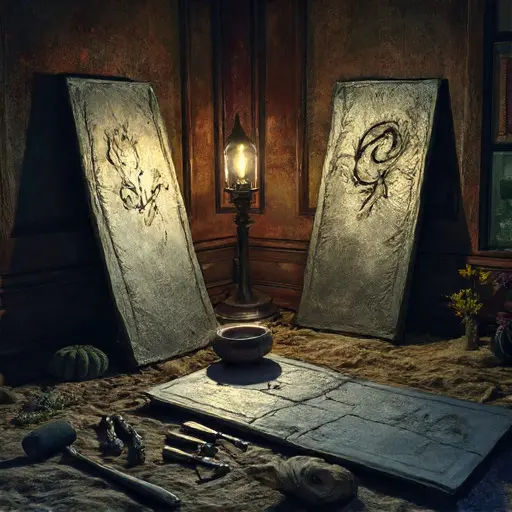
One night revealed quiet fractures. A grand commissioned panel lies on its sandbag cradle, its central emblem deeply formed, but its outer ring buckles in awkward patches. A chasing hammer sits with its handle cracked. A pitch ladle lies overturned, darkening the bench with cold residue.
Pinned beneath a distortioned vine template is a scrap bearing hurried handwriting: “They insist I damaged their family symbol.” Another fragment, blurred by pitch stains, reads: “Compensation beyond reach.” The ink trails thin toward the bottom, lines wavering. Even the pattern punches—once arranged in exact rows—scatter slightly, some tipped as though brushed aside mid-thought.
Across the table, a floral guide shows multiple revisions, each fainter than the last, as though he attempted corrections he no longer trusted.
A Recess Concealed Behind the Tool Cabinet
Behind the tall cabinet storing punches, a panel slides aside. Inside rests a small silver relief: the beginning of a star-shaped bloom, exquisitely raised at the center, yet left shallow around its edges. Next to it lies a folded note in Nikolas’s tenuous script: “For Eleni—when the shape steadies again.” The final word thins into pale graphite, as though he withdrew strength mid-stroke.
Beside the relief waits a pristine silver sheet, untouched and gleaming with soft potential.
The Final Quiet Contour
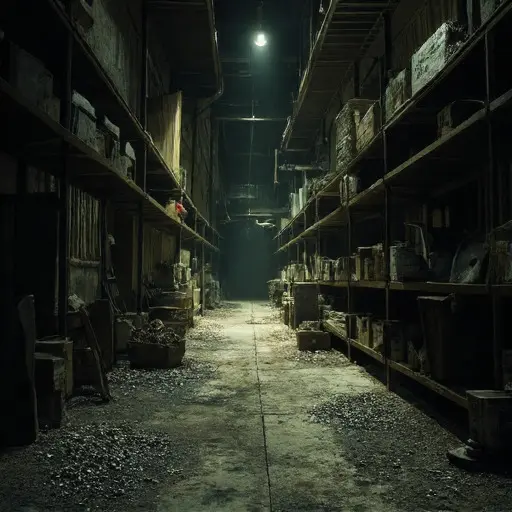
Inside a shallow drawer beside the shaping stand rests a test strip of silver: one edge crisply raised, the next collapsing into a faint, uneven slope. Beneath it Nikolas wrote: “Even form fails when confidence softens.”
The repoussé room sinks back into its resin-scented stillness, reliefs waiting in halted shimmer.
And the house, holding its abandoned silversmith’s chamber, remains abandoned.
