The Eerie Loom of Nakamura’s Weaving Chamber
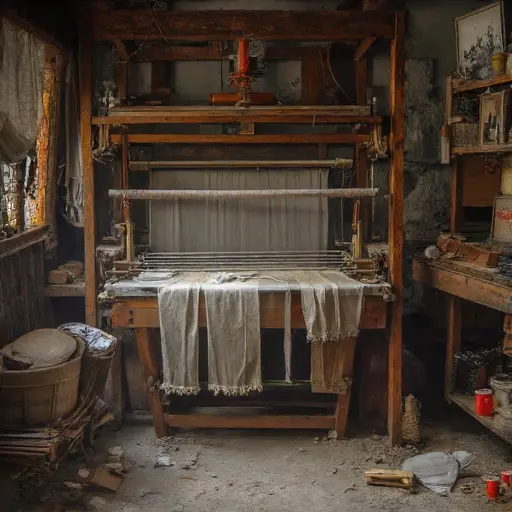
The Weaving Chamber resonates with frozen rhythm. Here, the loom commanded the artisan’s day: threads drawn, patterns aligned, shuttle guided. Tools rest mid-use; half-finished silks await completion.
The absence of movement leaves a quiet tension, as if the room remembers hands no longer present, every fabric fold preserving the memory of interrupted labor. Even the edge of a partially woven panel shows a slight curl where fingers last pressed the threads.
Threads of Discipline
This chamber belonged to Haruto Nakamura, master weaver (b. 1876, Kyoto), trained in traditional Japanese weaving schools and through private mentorships. His skill is evident in precise patterning, careful alignment of warp and weft, and subtle color gradations. A small note references his mother, Aya Nakamura, reminding him to “prepare indigo threads for the next panel.” Haruto’s temperament was meticulous, patient, and disciplined; ambition lay in producing ceremonial textiles and refined household silks for affluent patrons. Every folded skein, every bobbin, and every design sketch reflects restrained, deliberate artistry.
Patterns Suspended
On the loom, a partially woven loom panel reveals intricate geometric and floral designs, halted mid-section. Spools of silk remain threaded and ready, some slightly frayed. Dust has settled into grooves and crevices, preserving the exact moment weaving ceased. Bobbins and shuttles lie beside the frame, threads taut, awaiting fingers that never returned to complete their passage. Small scraps of dyed thread cling to the warp, evidence of repeated adjustments abandoned in mid-motion.
Signs of Decline
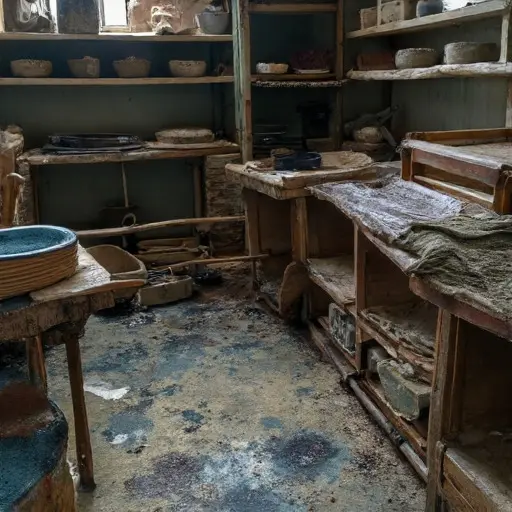
Pattern books and design sketches show repeated adjustments; motifs erased and redrawn. Haruto’s decline was physical: worsening arthritis and stiffening joints hindered his capacity to manipulate fine threads. Each unfinished loom panel embodies halted intention, delicate craftsmanship interrupted by bodily limitation, leaving exquisite work suspended indefinitely. Even the tension of the warp threads hints at careful practice left incomplete.
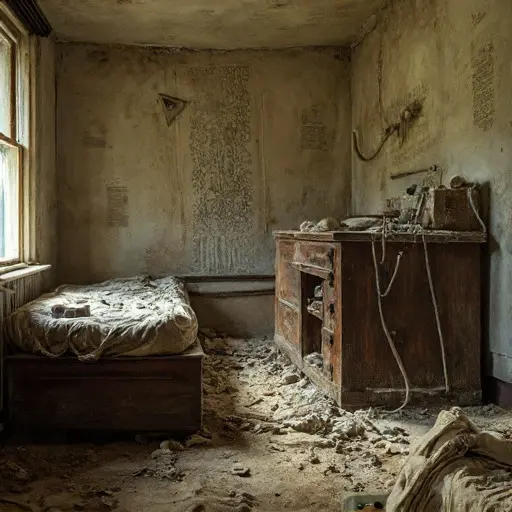
In a drawer beneath the loom, Haruto’s final loom remains threaded, threads aligned yet unfinished.
No explanation exists for his disappearance. No apprentice returned to continue the weaving.
The house remains abandoned, its looms, threads, and loom a quiet testament to interrupted textile artistry and unresolved devotion.