The Eerie Ledger of Tharnleigh House
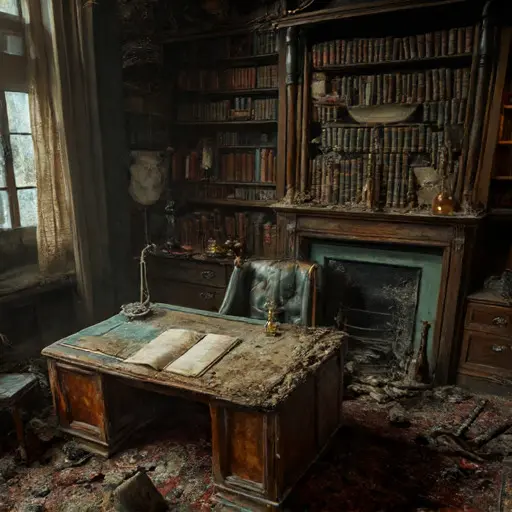
The stillness inside Tharnleigh House is not one of peace, but of calculation suspended mid-thought. Here, the last decisions of Ambrose F. Whitgrove sit fossilized in their ledgers, as though awaiting an answer that never came.
No dust has been disturbed. No windows opened. The house smells of ledger ink, mold, and wood oil long congealed. The eerie quiet gathers in corners like pooled time.
The Eerie Chair Beside the Tax Bureau Shelf
Ambrose Whitgrove, born 1856, was a railway procurement broker whose fortunes rose sharply in the 1880s and fell with equal speed by 1912. He was said to spend more time in his private study than in the company of his wife Henrietta or their three children. Surviving documents reveal his obsession with maintaining control — daily account tallies, invoices filed by hour, even a “parlour expenditure register” noting purchases like lace doilies and matches.
A surviving journal entry from 1911, penned in a tight, slanted script, reads: “The brass costs have doubled. They think I’m blind to the gouging. They forget who built this wing.”
After a failed venture in iron contracts and a quiet lawsuit settled out of court, Ambrose’s paper trail abruptly ends in mid-1914. No obituary. No funeral notice. The family ceased appearing in city records. A final receipt for a child’s school uniform is dated October 2, 1914.

Dining Room Debts and a Child’s Forgotten Plate
In the dining room, the table is set for four. The chairs are misaligned. One plate—a child’s—is painted with a faded blue rabbit, its edge chipped. A fork lies on the floor beside it, half buried in dust. At the table’s end, a porcelain gravy boat is stained with a rust-colored ring.
A satchel left on the sideboard contains ledgers marked “Personal Holdings” and “Final Assets.” In one, a list of names—presumably creditors—is scratched out in a shaking hand. Beside it: a single train schedule, destination circled in pencil: “Rochdale, 6:40am.”
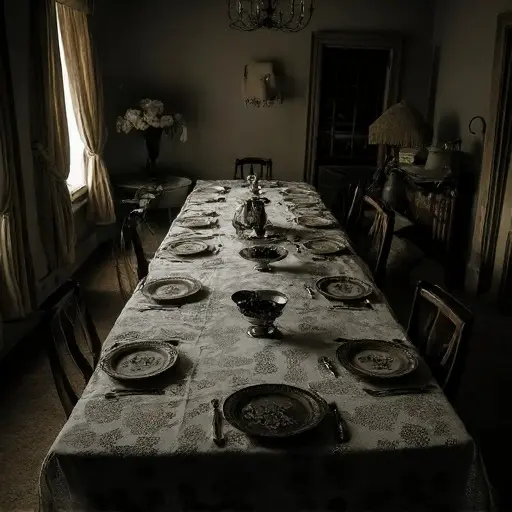
Tharnleigh House has never been reopened. The furniture remains arranged. The accounts unbalanced.
It remains abandoned.
