The Eerie Kowalski Clock-Cleaning Cellar Where the Gears Slowed Wrong
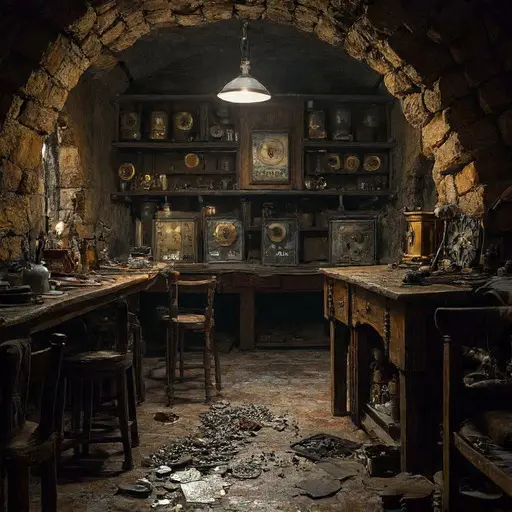
The cellar feels suspended between ticks—no sound, only the impression of time once tended with devotion. A half-polished gear leans against a bottle of oil, its rim smudged by an interrupted touch. Dust mottles the glass face of a mantel clock whose hands sit forever at 11:42.
Nothing is overturned violently; instead, the room holds the quiet collapse of a routine meant to be exact, reliable, unwavering—until it wasn’t.
A Horologist’s Days Set to Quiet Precision
This clock-cleaning cellar preserves the meticulous craft of Wiktor Jan Kowalski, clock cleaner and mechanism refurbisher, born 1872 outside Kraków. Raised among modest blacksmiths, he trained with a traveling repairman who taught him the delicate art of coaxing worn gears back into harmony. His sister, Magdalena Kowalski, is present only in a tiny cloth pouch embroidered with folk flowers, tucked among gear trays.
Wiktor’s workdays began early: removing clockworks from their cases, brushing dust from escapements, flushing pivots with alcohol, then reassembling each mechanism with measured breaths. His tools remain arranged by rhythm—pegwood bundles tied with twine, oils sorted by viscosity, cleaning solutions labeled in Polish. Merchants from nearby districts brought clocks to him because his hands never rushed, never trembled.
Routines Once Steady, Edges Quietly Shifting
In his brighter years, the cellar hummed softly with pendulum bobs tested on hooks along the wall. Wooden drawers held bushings in neat rows. A shipment crate from Gdańsk sits in the corner, filled with brass wheels wrapped in newspaper printed in Polish columns. The polished surfaces of several mantel clocks still gleam beneath thin dust.
But faint disruptions creep in. A clock’s escapement is disassembled incorrectly, one lever placed aside in the wrong direction. A bottle of cleaning fluid sits uncorked, its contents evaporating in uneven rings. A balance wheel on the bench wobbles when spun—an imperfection Wiktor never allowed. His service ledger shows crossed-out notes, then rewritten timings, the intervals uncertain. Someone or something disturbed the balance of his method.
Rumors later spoke of a disgruntled patron claiming Wiktor misadjusted a family heirloom, causing it to lose minutes each day. Others suggested a merchant accused him of replacing genuine brass gears with cheaper alloys. Nothing in the cellar resolves these claims—only the tension dissolving from once-perfect order.
The TURNING POINT That Stalled His Hands
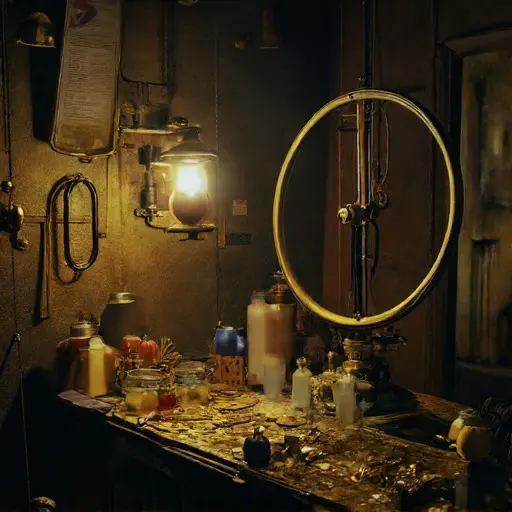
One lamplit night left unmistakable signs. A carriage clock lies dismantled on the bench, its platform escapement bent. A pendulum bob sits on the floor, dented as if dropped from height. The timing chart pinned above the table shows erratic notations—long pauses, abrupt recalculations, ink blotted where his hand pressed too hard.
A torn scrap near the workbench reads in wavering Polish: “Not my fault—the gear was flawed.” Some believed the merchant accused him publicly, demanding repayment he could not produce. Others whispered that he was blamed for a cracked verge he insisted was damaged before it arrived. The cellar floor bears a ring-shaped stain from spilled solution, its outline trembling like a failed attempt to restore control.
Even his favorite polishing chamois sits stiff with dried fluid. A pivot file lies snapped in two. The lantern wick is trimmed unevenly, soot streaking the stone ceiling. Every sign points not to catastrophe, but to slow, unbearable unraveling.
A Hidden Shelf Behind the Old Furnace
Behind the rusted furnace pipe, a short wooden panel shifts outward. Inside the cavity rests a single wrapped movement—its gears cleaned to a honeyed glow, its balance spring coiled in perfect symmetry. Yet the clock face attached to it is blank: no numbers, no hands, only empty enamel.
A folded note beneath it bears Wiktor’s careful script: “For Magdalena—when I find the true beat again.” But the last words dwindle, as though written during doubt rather than resolve. The movement itself shows one oddity: a pivot filed narrower than standard, a precision error he would never have made unless shaken.
What the Last Mechanism Reveals
In a shallow drawer near the metronome lies a final note on a service card. It reads simply: “Beat unstable. Source unclear.” No name, no date.
The cellar settles again into its unbroken quiet, a place where lost seconds gather and remain.
And the house, holding its abandoned clock-cleaning cellar, remains abandoned.
