The Eerie Fontaine Clockwork-Ornament Salon Where the Springs Slipped Awry
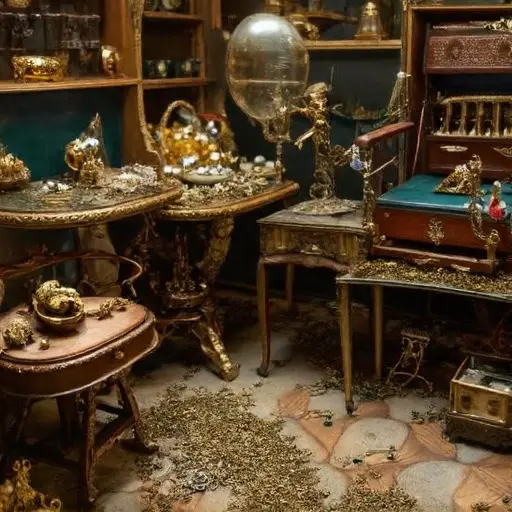
Stillness thickens the air, heavy with the pause before a delicate mechanism should breathe again. A gold-plated ornament—an unfinished automaton dragonfly—rests on the central table, its wings misaligned, one gear too tight against its axle. A winding key lies not quite where it should, angled toward the edge as if dropped mid-turn.
Every surface holds the hush of concentration interrupted, of clockwork halted between two intentions.
A Maker’s Life Guided by Delicate Mechanisms
This clockwork-ornament salon preserves the painstaking artistry of Éloise Mariette Fontaine, automaton designer and ornamental clockworker, born 1876 in Lyon. Raised among modest metal engravers, she trained with a traveling horologist who taught her the fragile balance of tension versus release. Her brother, Laurent Fontaine, lingers in a small blue ribbon tucked beneath a domed bird display.
Once-Consistent Craft Beset by Small Misalignments
At her best, the salon glittered with moving tableaux—flowering automata, singing birds, miniature dancers turning under jeweled lanterns. Parcels from Paris merchants delivered ruby-tipped bearings and filigree wings etched with French botanical motifs. Completed ornaments glimmered beneath glass domes, each a small theatre of gears.
Some whispered a patron accused Éloise of delivering ornaments with faulty timing—accusing her of cutting corners or substituting flawed components. Others murmured she refused to copy foreign mechanical trends, angering a prominent collector.
A Hidden Compartment Behind the Velvet Cabinet
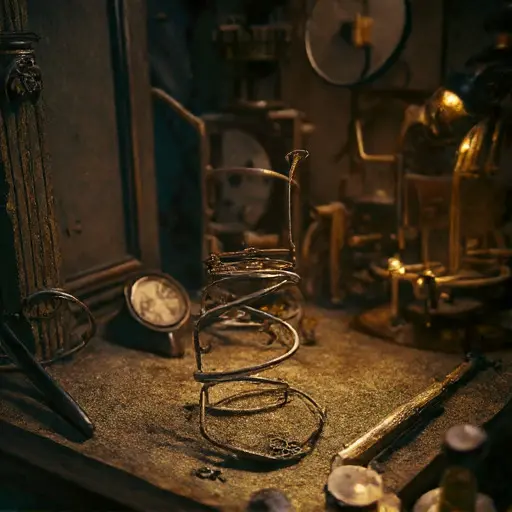
Behind the tall cabinet of filigree domes, a narrow wooden panel shifts with a soft rasp. Within lies a silk-wrapped automaton bird, exquisitely crafted—its brass wings feathered with silver filaments. Yet the mechanism is incomplete: the final regulating spring has not been installed.
A folded note is tied around its base: “For Laurent—when the balance returns.” The letters thin toward the end, fading like a winding that never reached tension. The bird’s beak, meant to open in a tiny song, remains sealed.
Next to it rests a pristine set of matched gears—unused, perfect, waiting for a repair or creation that never arrived.
The Last Unwound Trace
Inside a drawer beneath the assembly stand lies a final fragment: a small timing wheel, its teeth sharp and clean at first, then abruptly worn at one edge as if tested under conflicting pressures. Beneath it, Éloise wrote: “Harmony slips when certainty fractures.”
The clockwork salon exhales its quiet, gears frozen in fragile expectation.
And the house, holding its abandoned automaton-maker’s chamber, remains abandoned.
