The Eerie Duarte Ceramic-Kiln Room Where the Glazes Turned Strange
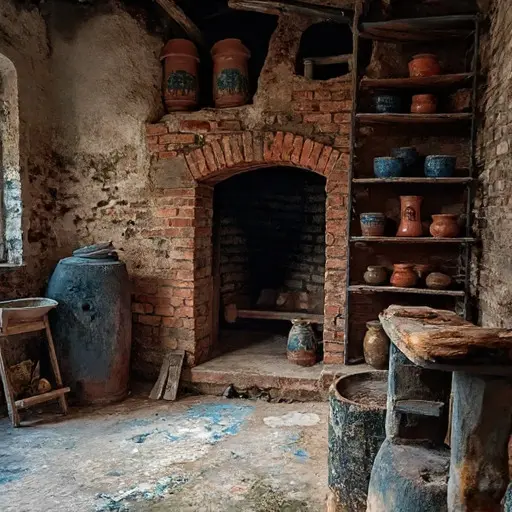
A faint mineral tang rides the still air—burnt clay mixed with cobalt, lime, and soot. Bats of unglazed earthenware lean against the walls, waiting for the next firing that never came. The kiln door’s hinge squeaks softly in the draft.
A bowl on the central bench bears an unsteady swirl of pigment, as if someone’s hand faltered while circling the rim. Nothing screams of disaster, yet each object feels parted from its rightful continuation.
A Potter’s Life Ceremonially Bound to Fire and Patience
This ceramic-kiln room holds traces of Tomás António Duarte, potter and tile-painter, born 1870 near Sintra. Raised among modest craftsmen, he learned shaping and glazing from traveling artisans who favored azulejo traditions. His sister, Helena Duarte, appears only in a tiny woven bracelet tied around a drying-rack pole.
Tomás lived by cycles of water and heat: dawn kneading of clay, midday trimming, dusk painting with oxides under dim lamps. His tools—banding wheels, slip brushes, rib knives—remain arranged in steady order. Merchants prized his tiles depicting ships, sea beasts, and saints, and his bowls were said to ring with a clear, bright tone when tapped.
Craft in Full Glow, and Then a Quiet Shift
During prosperous seasons, racks brimmed with cobalt-brushed tiles destined for coastal villas. Crates from Porto merchants delivered tin glaze and rare green oxides. A row of finished bowls—each painted with wave motifs—once sat in graduated sizes along the shelf.
Yet cracks in routine show themselves. A tile on the lowest rack bears a warped corner from uneven drying. A bowl’s underglaze smudges into an unintended spiral. His ledger shows a patron’s commission crossed out twice. A slip of Portuguese notes reads, “They say the color clouds,” the ink wavering near the edge. Some whispered a prominent buyer accused him of inconsistent glaze quality; others said he refused to copy a fashionable foreign style.
Nothing conclusive remains—only small disturbances layered over once-sure technique.
The TURNING POINT That Shifted the Heat’s Will
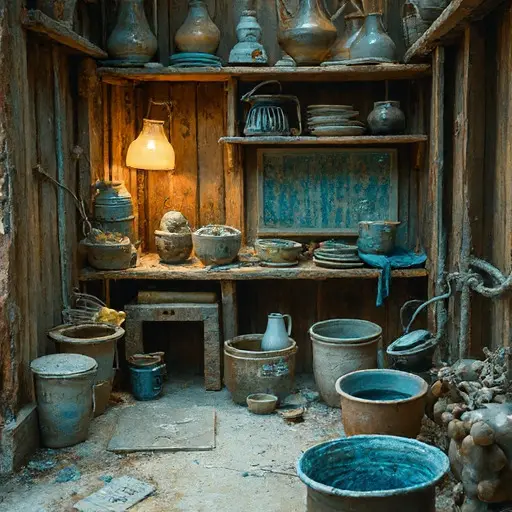
One evening left unmistakable disruptions. A test tile rests on the kiln lip, its glaze bubbled sharply—sign of a firing pulled too fast. A bowl painted with a ship motif sits half-finished, hull complete but sails abandoned. A glazing paddle lies wedged beneath the bench, its handle cracked.
Rumor said a valuable set of tiles fired blotchy, prompting a patron to demand restitution. Others claimed Tomás altered the proportions of his tin glaze, causing hairline lines to form on pieces soon after cooling. A crumpled note near the basin reads: “They insist I rushed—no proof.” The words press deep into the paper as though written under strain.
Clay trimmings scatter unevenly across the floor. The kiln’s damper lever is stuck, hardened by a sudden surge of heat. Even the brushes in the jar stand rigid in dried pigment, abandoned mid-stir.
A Narrow Cavity Behind the Kiln’s Firebrick
Behind the main kiln, one firebrick panel shifts with a hollow tap. Inside, wrapped in linen, lies a small platter—beautifully thrown, its glaze a delicate pale aqua. But the motif at its center stops short: the final line of the compass rose unpainted. Beneath it rests a folded note in careful Portuguese: “For Helena—when the color returns true.” The last word trails off, as if the brush stuttered.
Next to the platter sits a sealed jar of cobalt oxide—untouched for weeks—its deep blue shimmering under the dim lamp. It appears prepared for a project Tomás never began.
Last Fired Evidence
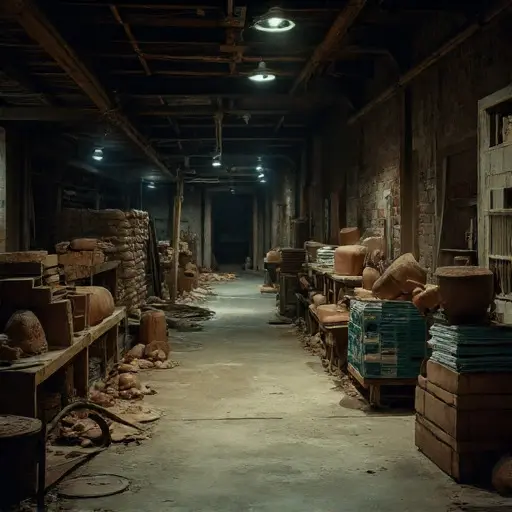
Inside a shallow crate near the cooling shelf lies one final fragment: a tile whose glaze fractured into a spiderweb across its face. On its unpainted back, Tomás etched faintly: “Heat behaved, but trust did not.” No further explanation.
The kiln room exhales its mineral hush, shaped vessels awaiting fires that will never come.
And the house, guarding its abandoned pottery chamber, remains abandoned.
