The Eerie Archive of Sablewood Crest
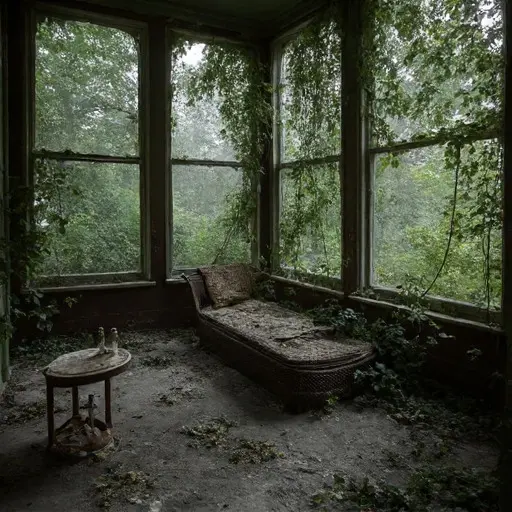
The atmosphere inside Sablewood Crest was a museum of forgotten air—cold, still, and tasting faintly of dry rot and old paper. Upon entering the Main Hall, the overwhelming impression was not of space, but of confinement. Every surface, from the towering grandfather clock that had long since stopped at quarter past midnight, to the heavy, moth-eaten velvet drapes, was cloaked in an unbroken, velvety layer of dust, suggesting decades of absolute stillness.
The house’s silence was heavy, a profound weight that pressed down on the few remaining objects, making every artifact feel like a painful secret preserved.
Graham Vardon: The Cartographer of Memory
The heart of Sablewood Crest belonged to Graham Vardon, a meticulous and successful civil engineer in the late 1880s, whose wealth stemmed from mapping and designing municipal water systems. His temperament was obsessive, defined by a need to catalog and measure everything around him. His social role was one of respected order and precision, but privately, he was consumed by the irrational fear of losing his memory—a fear rooted in his father’s slow decline from dementia. He married Lydia, a sweet, practical woman, and they had one son, Hugh.
Graham’s pathology expressed itself in the Second-Floor Study. This room is entirely lined with built-in drawers and narrow shelving units, far surpassing any normal storage needs. Here, amidst stacks of intricate topographical maps and engineering blueprints, we find the true obsession: dozens of small, numbered boxes, each containing a single, trivial object—a ticket stub, a dried leaf, a ribbon—meticulously cross-referenced in a master Memory Ledger. This ledger was his attempt to physically externalize his memory, to prevent it from dissolving like his father’s.
The Hidden Box in the Music Room
Lydia Vardon found her life constricted by Graham’s rigid routines and fear. She was an artist, a watercolorist who longed for fluid expression, stifled by the house’s unyielding order. Her primary refuge was the Music Room, a space Graham rarely used. Here, near the large, dust-covered harpsichord, stands a magnificent mahogany Cabinet of Curiosities.
The turning point of her personal struggle is subtly hidden within this cabinet. While the shelves are filled with her collection of sea glass and dried botanical samples, the bottom drawer contains a flat, unmarked wooden box. Inside this box are not her watercolors, but a complete, chronological archive of Hugh’s childhood letters to her, written during his years away at boarding school. The letters, filled with typical boyish woes and joys, show her attempt to cling to the emotional reality of her son, a life entirely separate from Graham’s cold metrics. The letters abruptly cease in 1904. It was in that year that Hugh, aged eighteen, ran away from school and enlisted to fight overseas, a final act of rebellion against his father’s suffocating control.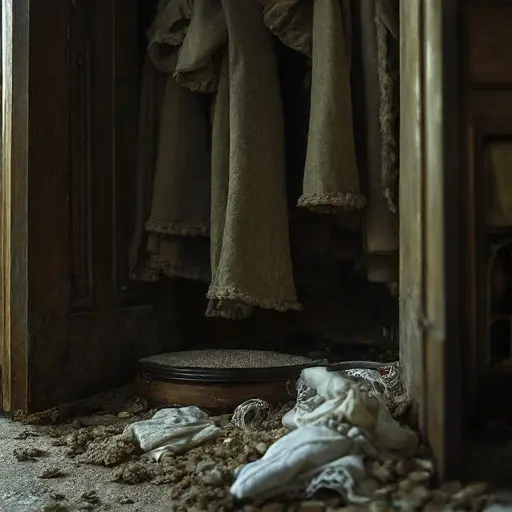
The Last Entry in the Observation Deck
Graham was utterly broken by Hugh’s disappearance—it was the ultimate, uncatalogable loss. His carefully constructed world of ordered facts was meaningless. He did not chase after his son or reveal the family crisis; he simply retreated further into his obsession with archiving.
The final, heartbreaking turning point is found in the small, glass-enclosed Observation Deck at the very top of the house, which Graham had built to survey the town. Here, amidst his astronomical instruments and cartographer’s tools, lies the Memory Ledger. The final pages are not filled with catalog numbers but with frantic, looping, handwritten script repeating the single, devastating question: “Where is Hugh?” The writing abruptly stops mid-sentence.
The record shows that Graham Vardon suffered a complete mental breakdown and was quietly taken away by his sister to a distant sanatorium in 1905, never to return. Lydia, refusing to re-enter the house that had consumed her husband and driven away her son, simply surrendered the keys to the property agent and disappeared from public record. Sablewood Crest was never sold or cleared. It stands as a monument to a lifetime spent trying to catalogue life, only to find the most important parts were the ones that could never be measured, now utterly forgotten in the dust of his archived despair.
