The Eerie Alchemy Journals of the Lefèvre Apothecary Room
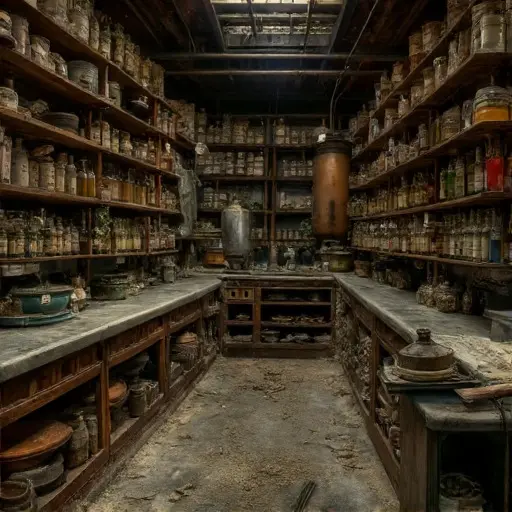
The Apothecary Room hangs in quiet, vials and flasks frozen mid-use. A partially mixed tincture rests in a small beaker, its dose unrecorded.
The Life of a Chemist
These implements belonged to Henri Lefèvre, apothecary and amateur chemist (b.
1876, Lyon), trained in a provincial pharmacy yet providing remedies to local households. His handwritten French notes document compounding processes, tincture strengths, and preparation schedules. A slip referencing his cousin, Madeleine Lefèvre, “collect syrups Tuesday,” implies meticulous daily routines shaped by careful measurement and observation.
Tools of Measurement and Mixture
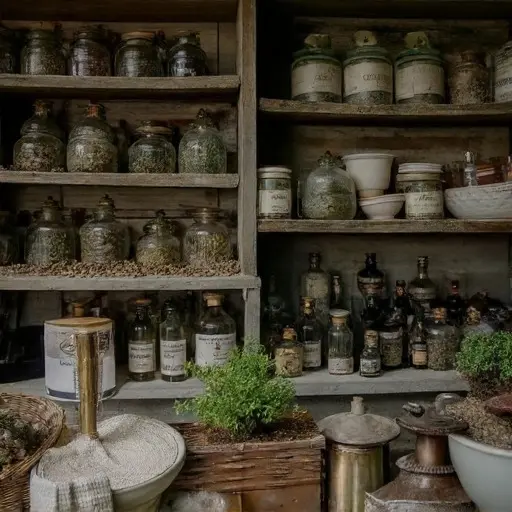
On the central table, glass stirring rods, small funnels, and pestles lie arranged by size. Mortars and flasks, some stained with tinctures, remain in their designated positions. A ledger beneath a folded cloth lists client names, remedy types, and quantities. A small scale, with weights aligned beside it, shows precise dose markings, abandoned mid-weighing.
Evidence of Decline
Later entries in Lefèvre’s journals show inconsistent measurements and smudged notations. Some tinctures are overconcentrated; a margin note—“client complaints pending”—lies folded under a broken flask. Fatigue and trembling hands caused his careful compounding to falter, leaving mixtures incomplete and unrecorded.
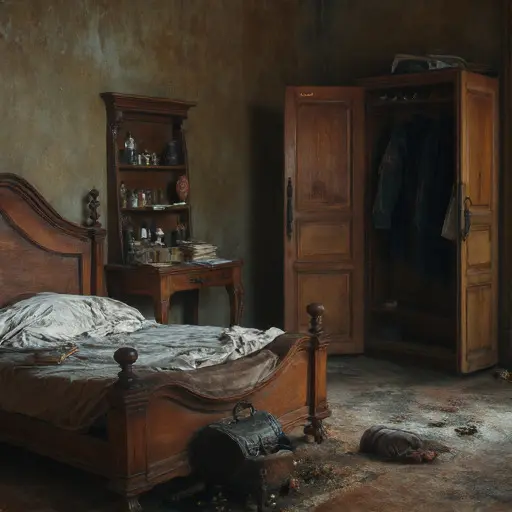
In the Apothecary Room’s final drawer, Lefèvre’s last dose calculations end mid-entry. A penciled note—“finish for Madeleine”—cuts off abruptly.
No evidence explains why he ceased his work, nor why Madeleine never collected the remedies.
The house remains abandoned, vials, scales, and journals frozen in quiet incompletion, tinctures left mid-pour and experiments forever unfinished.