The Eddingley Hill House Left Quiet After Greenhouse Work Ended
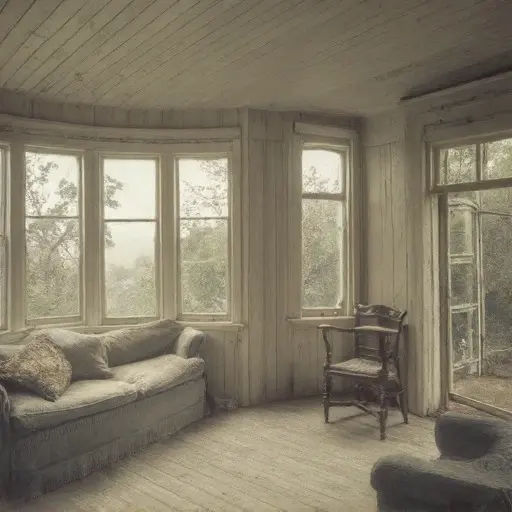
The Eddingley Hill House was constructed in 1880 on a small rural plateau overlooking open farmland and scattered tree lines as a compact Victorian family residence designed to integrate domestic life with light agricultural experimentation The original structure consisted of a two-story house placed carefully on the hilltop with its front façade slightly rotated from the natural contour of the land to maximize exposure to prevailing weather and light conditions A greenhouse workshop was later added along the rear slope, partially embedded into the hillside and supported by stone retaining walls that stabilized its downward angle into the terrain The result was a layered architectural composition where domestic and working spaces followed the natural geometry of the hill rather than strict orthogonal alignment
For several decades the Whitmore family maintained the property as both a residence and a modest horticultural workshop, using the greenhouse for seasonal cultivation and plant propagation supported by consistent overcast growing conditions The iron framing of the greenhouse developed a light rust patina over time, while the large glass panels remained slightly wavy and fogged from humidity but structurally intact The stone retaining walls held firm against the hillside, darkened by damp staining that accumulated slowly where water runoff met the foundation The surrounding environment remained calm and open, with low grass and soft farmland stretching outward under uniform gray skies
Early Decline of Greenhouse Activity and Reduced Maintenance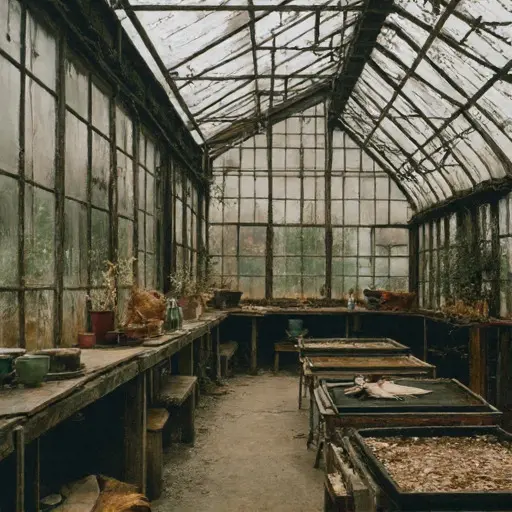
By the early 1930s, the Whitmore family began to reduce active use of the greenhouse workshop as agricultural experimentation became less central to their livelihood and external economic pressures encouraged relocation toward nearby towns The greenhouse saw increasingly intermittent use, while the main house remained occupied but shifted toward a quieter domestic role Maintenance of the iron frame and glass panels declined gradually, resulting in slow accumulation of humidity fogging and minor structural wear at connection points between the greenhouse and retaining slope
Despite reduced activity, the structure remained stable and functional The hillside support system continued to bear the greenhouse load without signs of collapse, and the main house retained its structural integrity despite minor roofline unevenness and long-term settling The surrounding farmland remained unchanged, with muted green fields and scattered trees maintaining the quiet isolation of the property
Final Stillness on the Hilltop
<img src=”https://beyondvisit.
com/wp-content/imagecontent/uploads/abandoned victorian house 77789139.webp” alt=”” />
By 1940 the Whitmore descendants had fully vacated the Eddingley Hill House as rural horticultural work declined and urban economic opportunities became more central Wartime constraints further reduced the feasibility of maintaining hillside properties with integrated workshop structures, and no coordinated effort was made to preserve full habitation The house remained physically stable but functionally empty, with no further greenhouse activity recorded
In the following decades the structure aged slowly under uniform overcast conditions The hillside remained calm and unchanged, with low grass and distant farmland continuing to frame the isolated home without encroachment The greenhouse retained its form despite minor sagging in older beams, and the main house showed only gentle weathering in paint and wood surfaces
By 1950 the Eddingley Hill House stood completely empty on its plateau, its greenhouse descending silently into the slope No restoration was initiated, no demolition occurred, and no return was recorded The house remained suspended in quiet rural isolation, a Victorian hilltop residence and workshop left behind under a flat gray sky