The Eberwald Swiss Gothic Château Left Above the Forest
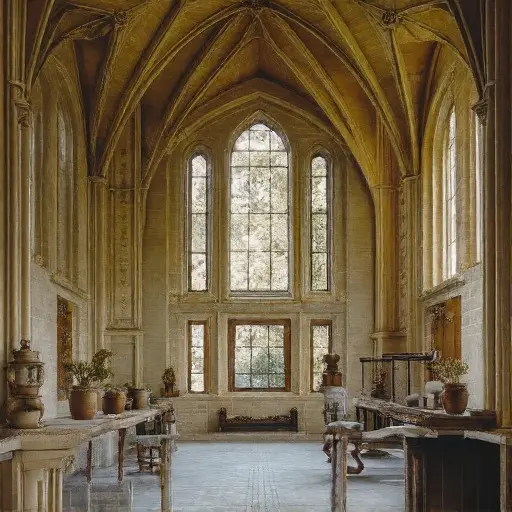
The Eberwald Château was constructed on a coastal-forest ridge in the early 1900s by a Swiss patrician family seeking to merge alpine Gothic tradition with modern structural ambition. The estate was designed as a vertically layered composition, with interconnected cloisters, elevated stone bridges, and crenellated towers rising above dense woodland. The household included several generations of the founding lineage supported by clerical stewards responsible for forestry rights, alpine agricultural management, and regional trade documentation.
Early operations were highly disciplined, with administrative governance centralized in the cloister hall and distributed through connected towers. The surrounding alpine gardens were engineered as terraced extensions of the architecture, reinforcing the estate’s vertical rhythm and controlled relationship between built form and landscape.
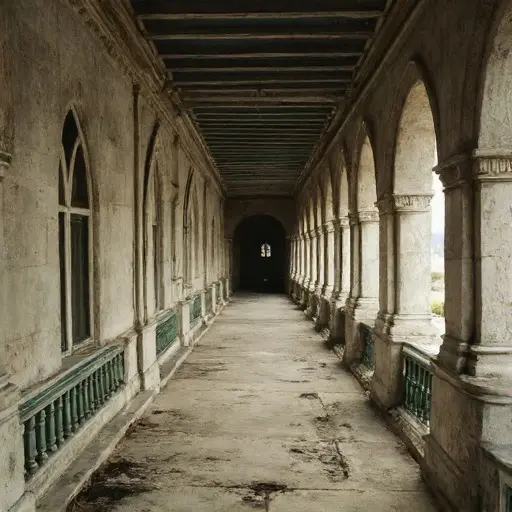
By the late 1920s, the Eberwald estate began to experience financial strain as alpine trade routes and forestry revenues declined under changing regional economic conditions. The complexity of maintaining its Gothic Revival architecture across multiple connected structures required continuous specialized upkeep, which became increasingly difficult under reduced funding. Portions of the château were closed off to conserve heating and operational resources, leading to uneven use across towers and cloisters. Administrative correspondence accumulated without timely response, particularly regarding land use rights and forestry taxation. Moisture from coastal winds and forest humidity began infiltrating stone joints and tracery work, subtly eroding the crisp contrast between ivory limestone, sapphire slate, and emerald patinated metalwork. The estate gradually shifted from active governance center to partially maintained, fragmented residence.
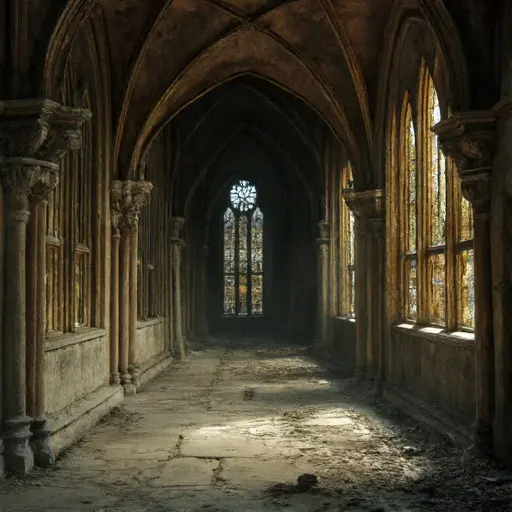
By the early 1940s, following prolonged financial collapse and unresolved inheritance fragmentation, the Eberwald Château was fully abandoned. No restoration efforts were undertaken, and legal disputes prevented any unified stewardship or redevelopment of the estate. The structure remained perched above the forest canopy but deteriorated steadily under seasonal weathering, coastal winds, and vegetation encroachment from the alpine terraces. Interior spaces were left in their final operational states, preserving furnishings and records beneath layers of dust and moisture. Over time, the once vertically disciplined Gothic system dissolved into silent decay, leaving the château as an uninhabited architectural relic slowly reclaimed by forest growth, alpine erosion, and time.