The Eastlake Mansion That Refused to Be Forgotten
On a quiet residential street lined with modest American homes, an abandoned three-story Victorian mansion still commands attention despite decades of neglect. Inspired by the elaborate Eastlake style, the residence once stood as one of the neighborhood’s proudest homes, admired for its craftsmanship, intricate woodwork, and elegant proportions. Today, it remains behind a low wrought-iron fence, weathered but remarkably dignified, quietly preserving the character of a forgotten era.
The mansion’s most striking feature is its tall octagonal tower, rising above the asymmetrical roofline with a graceful confidence that has survived generations of changing seasons. The upper structure leans ever so slightly, shaped by decades of settling and exposure, giving the house a uniquely organic appearance without diminishing its architectural beauty.
Every angle of the roof reveals thoughtful Victorian design, while the dark terracotta roofing provides a rich contrast against the weathered cream-painted clapboard walls.
Pale green trim frames decorative window hoods, carved galleries, and intricate porch lacework that showcase the remarkable attention to detail characteristic of Eastlake craftsmanship. Stained glass panels remain tucked within several windows, their muted colors still visible beneath layers of dust and weathering. Warm sandstone foundation blocks anchor the mansion firmly to the property, their aged surfaces carrying the marks of more than a century of quiet endurance.
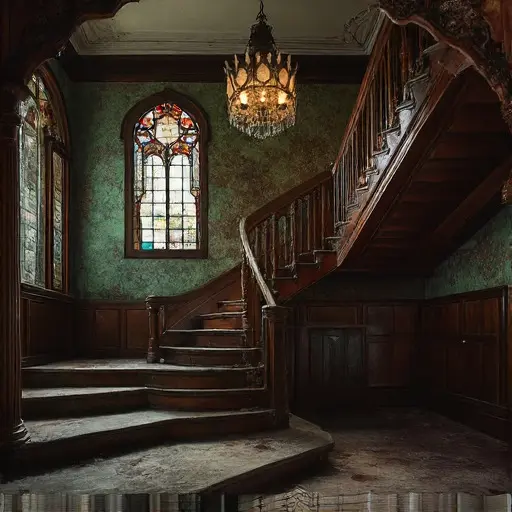
Stepping inside reveals a home that has remained largely untouched. The entrance hall still reflects the elegance of its original design, with elaborate carved woodwork climbing the staircase, decorative newel posts, and richly detailed trim surrounding every doorway. Dust blankets every surface, yet the craftsmanship remains remarkably intact, allowing visitors to imagine the mansion during its years of prosperity.
The formal rooms surrounding the entrance hall retain much of their original character. Decorative fireplaces, high ceilings, and tall windows create generous spaces that once welcomed family gatherings and social occasions. Time has faded wallpaper, worn polished wood floors, and softened once-vibrant finishes, but the graceful proportions of the rooms continue to convey quiet sophistication.
Outside, the compact front garden has slowly surrendered to nature. A cracked brick walkway leads from the wrought-iron gate toward the broad front porch, weaving between overgrown lilac bushes that bloom freely without careful tending. Grass has spread beyond its original borders, softening the once-orderly landscape.
Beneath the shelter of the porch, a forgotten wicker chair remains exactly where it was left many years ago. Nearby, partially hidden beneath tall grass, a rusted metal sandbox hints at childhood afternoons once spent beneath the towering Victorian home. These simple objects bring a deeply personal feeling to an otherwise grand architectural setting.
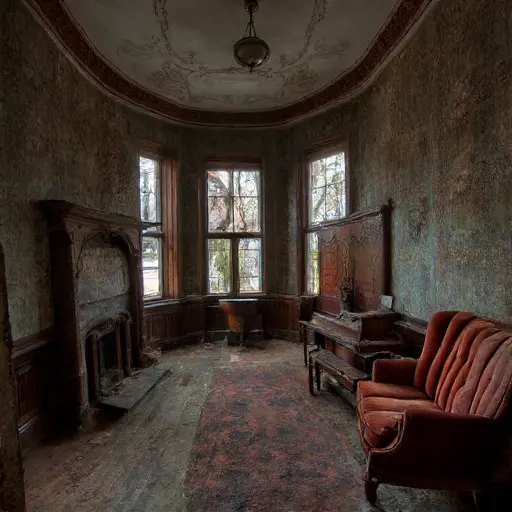
The main parlor remains one of the mansion’s finest surviving spaces. Rich carved wood panels surround the fireplace, while stained glass windows filter soft daylight across faded rugs and dust-covered furniture. An old upright piano sits silently against one wall, surrounded by decorative moldings that still display extraordinary craftsmanship despite decades of abandonment.
Throughout the exterior, the effects of time appear naturally rather than dramatically. Peeling paint exposes older layers beneath, faded shutters hang unevenly beside tall windows, and porch railings show the gentle wear of countless seasons. The house feels less ruined than patiently aging, preserving its dignity through quiet neglect.
Beyond the property, everyday neighborhood life continues uninterrupted. An old mailbox stands beside the cracked curb, utility poles stretch overhead, and neighboring houses blur softly into the background. Their continued occupation makes the abandoned mansion seem even more extraordinary, as though it exists within a different passage of time.
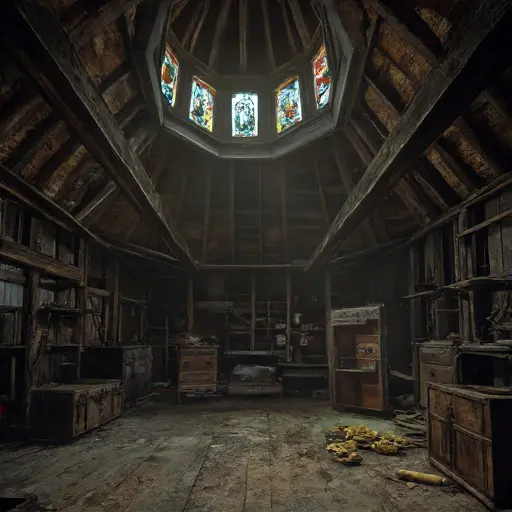
The upper floors lead to the quietest part of the mansion beneath the octagonal tower. Here, forgotten trunks, aging family portraits, and exposed timber framing remain undisturbed beneath the steep roof. Small stained glass tower windows admit soft natural light that gently illuminates decades of untouched history.
Under soft uniform overcast daylight, every architectural detail becomes beautifully visible. The even illumination reveals the textures of clapboard, sandstone, terracotta, copper, and weathered wood without harsh shadows, emphasizing the authenticity of the mansion’s long, quiet decline.
Once celebrated as one of the neighborhood’s finest Eastlake residences, the mansion now stands as a graceful monument to craftsmanship, family history, and the passage of time. Its leaning tower, carved galleries, stained glass, and overgrown garden continue to tell the story of a remarkable home whose beauty has endured long after its voices fell silent.