The Duskwhitt House Logbook and the Abandoned Aviary-Engineer’s Desk
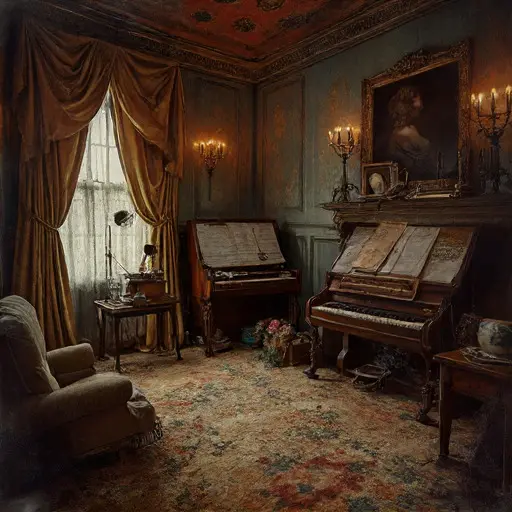
The Precise, Soft-Spoken Life of Alderion Vale Duskwhitt
Alderion Vale Duskwhitt, a Victorian “aviary engineer” who designed mechanical wings and gliding apparatuses for early experimental aeronautics, lived here with his sister, Merale, and her young daughter, Thessa. Alderion’s notebooks brim with sketches: hinged feather arrays, skeletal wing spines, torque calculations, tensile tests. His work was delicate, hopeful, and deeply personal—often inspired by the movements of birds he studied from memory rather than field notes.
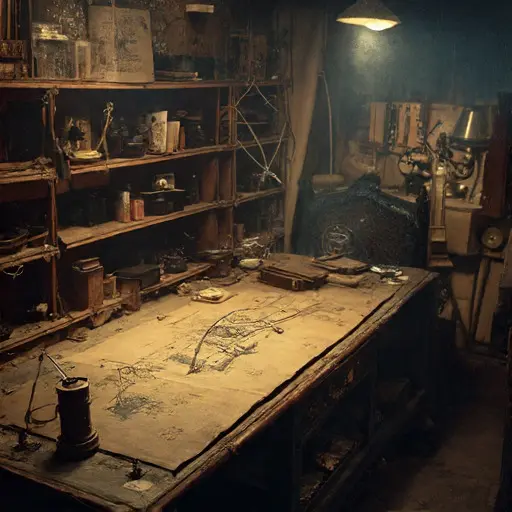
In the Aerial Mechanics Study, copper ribs rest sorted by size, thin wires are coiled into tarnished loops, and vellum sheets curl beneath iron drafting weights. Merale’s quiet presence persists in the room’s softened edges—her neatly folded linens, labeled herb jars, and carefully stacked mending. Thessa’s traces remain faint but present: a wooden bird toy carved by Alderion, chalk letters scattered across a slate, and a folded drawing of a human with wings labeled “Uncle Ald.”
As commissions and experiments intensified, Alderion’s notation compressed. Margins filled with recalculations. Sketches overlapped. Drafts became dense forests of lines and corrections. When Merale fell ill, domestic equilibrium slipped. After her passing, Thessa was taken in by relatives. Alderion’s final diagrams show trembling strokes, incomplete wing joints, and equations left mid-line. One evening, he stepped away from the drafting table and never resumed. Duskwhitt House remains frozen in that moment of quiet departure.
A Corridor Bent by Quiet Retreat
Upstairs, the corridor’s runner rug sags into soft, dusty folds, its pattern nearly erased by time. A hall table holds a broken spectacles arm, a snapped tension spring, and a personal note ending mid-phrase. Pale outlines on the wallpaper reveal where wing diagrams once hung before Alderion removed them with resigned care.
A Sewing Room Paused in Its Last Gesture
In the Sewing Room, Merale’s tenderness survives in muted form. A partly hemmed sleeve rests pinned beneath the treadle machine’s presser foot. Thread spools toppled from order have faded into chalk-pale tones. Pincushions hardened by age bristle with rusted needles. Folded muslin stiffened at the edges sits exactly where she last placed it, unmoving through the years.
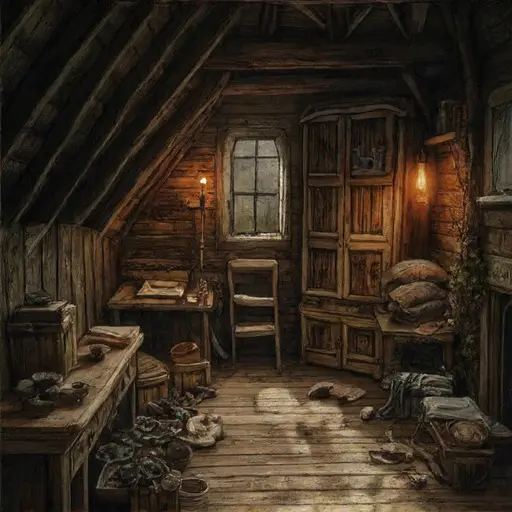
Behind the smallest crate lies a slip in Alderion’s thinning script: “Refine wing joint — tomorrow.” Tomorrow never returned to Duskwhitt House.
