The Driftwood Shingle House Lost in Pine Clearing
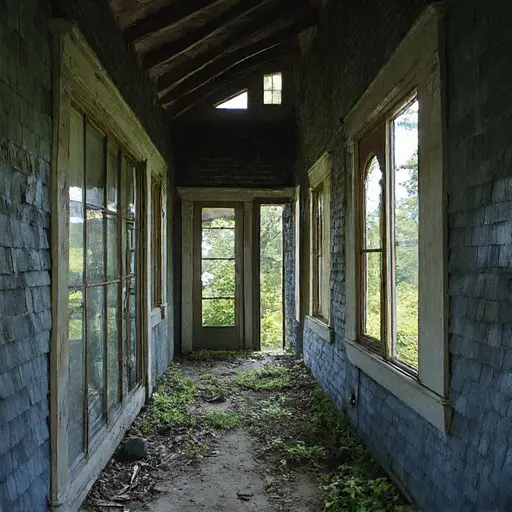
The Driftwood House was built in the late nineteenth century as a seasonal coastal residence for a family involved in small-scale timber shipping and inland trade between forest settlements. Designed in the Shingle Style tradition, the house emphasized organic massing and continuity with its environment, using weathered blue-grey wooden shingles, a complex irregular roofline of dark charcoal cedar shakes, and softly curved façades that responded to wind and terrain. The household consisted of a maritime trader, his family, and occasional seasonal workers who assisted with loading goods during calmer months.
Life in the house followed a cyclical rhythm tied to both forest growth and coastal shipping schedules, with the clearing serving as a staging point between land and sea routes.
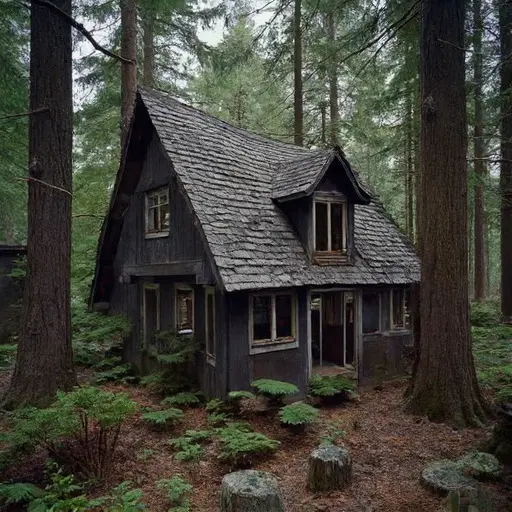
As the decades progressed, the decline of small coastal trade routes reduced the house’s original function as a staging residence. Timber operations shifted toward larger centralized ports, and the clearing lost its logistical importance. Maintenance of the complex roof and irregular dormers became increasingly difficult, and sections of the house were left unrepaired. The wooden fence gate at the entrance began to sag and eventually remained permanently ajar, marking the end of controlled access. The overgrown sandbox, once part of a family garden space, became partially buried in moss and forest grass as the clearing softened into natural woodland again. Seasonal occupancy ceased entirely, and the house slowly transitioned from working residence to abandoned structure.
By the early 1950s, after the collapse of remaining trade activity and full departure of the last occupants, the Driftwood Shingle House was permanently abandoned. No restoration was attempted due to its remote forest location and progressive structural deformation. Interior possessions were left behind or gradually overtaken by forest intrusion, while the building continued to subtly bulge and settle under environmental pressure. Over time, the house became increasingly indistinguishable from its surroundings as shingles weathered and vegetation pressed inward. The structure still stands today in the pine clearing, its blue-grey silhouette softened by forest growth and silence, with no resolved future.