The Driftwatch Keeper’s Cottage Left Vacant After Signal Automation

The Driftwatch Keeper’s Cottage was constructed in 1902 on a rugged coastal slope overlooking a volatile stretch of shoreline. It was originally assigned to the Bennett family—Arthur Bennett, a lighthouse maintenance keeper employed by the coastal signal service, his wife Margaret, and their daughter Lillian. Though not a full lighthouse station, the cottage functioned as a support residence for nearby navigation beacons and weather observation points.
Built directly into stone and slope, the house was designed to withstand constant wind pressure and salt exposure. Its lantern room, positioned on the roof, served as a minor visual signal point and weather observation enclosure rather than a full maritime beacon. For several decades, Arthur Bennett recorded sea conditions, maintained nearby lights, and coordinated with passing coastal vessels.
The home was never luxurious, but it was stable, shaped by necessity and endurance rather than comfort.
EARLY SIGNS OF TECHNOLOGICAL REPLACEMENT AND COASTAL DECLINE
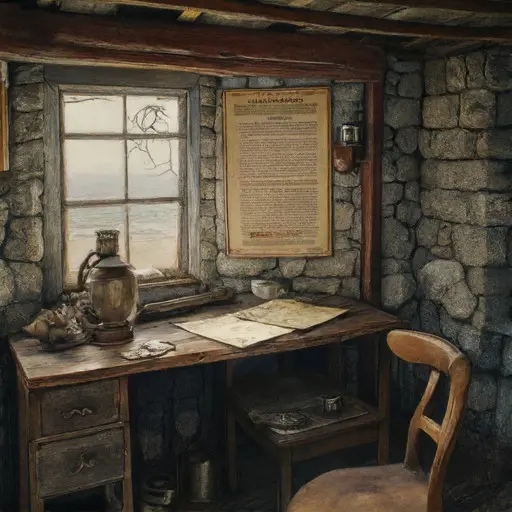
By 1929, advancements in automated lighthouse technology began reducing the need for on-site keepers along this section of the coast. The Driftwatch station was gradually downgraded, and Arthur Bennett’s responsibilities were reduced to intermittent inspections rather than constant maintenance.
The emotional and financial impact on the household was slow but unavoidable. Margaret Bennett attempted to maintain the cottage as a functioning home, but supply deliveries became irregular as coastal routes were rerouted to larger, fully automated stations.
The structure itself began to show the cumulative effects of decades of salt exposure. Timber joints loosened slightly, and exterior paint weathered into uneven tones of drift-white and gray-green. Inside, moisture penetrated the lower stone foundation during storm surges, leaving faint damp marks along baseboards.
By the early 1930s, Arthur’s role had been entirely phased out. The lantern room on the roof was decommissioned, its purpose replaced by remote signal systems further down the coast.
FINAL OCCUPATION AND COASTAL ABANDONMENT
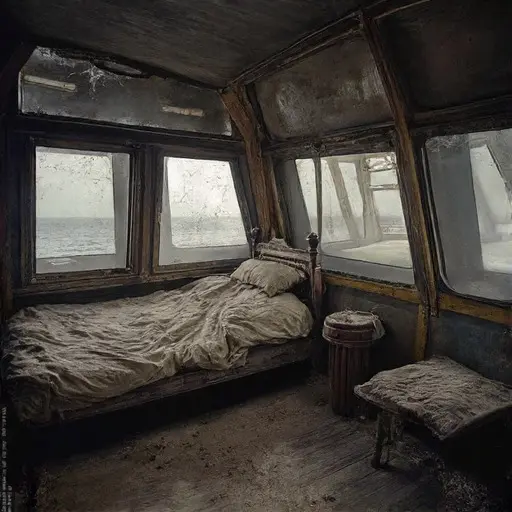
By 1942, the Bennett family had fully left the Driftwatch Cottage. Arthur Bennett passed away shortly after decommissioning, while Margaret relocated inland to live with relatives. Lillian had already moved to a coastal city for industrial work and never returned to the isolated slope.
With automated systems fully replacing manual coastal observation, the cottage lost all operational relevance. Supply lines ceased, and official oversight of the property was quietly withdrawn. The structure remained physically intact due to its robust construction, but it was no longer part of any functional network.
No repurposing was pursued, as the location was too exposed and the building too specialized for conversion. Gradually, it slipped into administrative neglect while the shoreline around it continued its slow, constant motion.
By 1949, the Driftwatch Keeper’s Cottage was formally recorded as vacant. It was never restored or reused. The house remains anchored into the coastal slope, its lantern room clouded, its interior empty, and its purpose dissolved into the steady sound of wind and tide without human return.