The Detached Slate-Lilac Terrace House
An abandoned Victorian family house sits tucked into a gentle hillside neighborhood where similar homes once formed a continuous residential row, though this one now feels subtly separated from the rhythm of its neighbors due to gradual shifts in ground level and long-term patterns of neglect. The structure is a narrow three-story urban Victorian terrace, built with a disciplined vertical emphasis that prioritizes stacking, repetition, and proportion over decorative expression. It belongs to a coherent architectural system, yet now reads as slightly out of sync with it—like a phrase left half a beat behind the rest of the street.
The exterior is clad in narrow vertical timber boards painted in a desaturated slate-lilac tone. Over time, the surface has softened into layered gradients of pale lavender gray, dusty mauve, and faint bluish undertones.
Weathering has thinned the paint along edges and joints, occasionally revealing aged timber beneath, but the façade retains an overall coherence that preserves its original compositional clarity. The result is not decay in fragments, but a slow atmospheric fading that respects the structure’s underlying order.
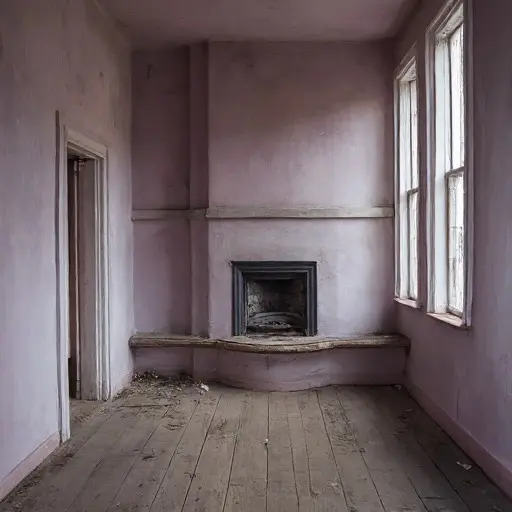
The façade is organized around a strict vertical grid of window openings that align precisely across all three floors. Each window is framed in thin charcoal-painted timber, producing a restrained graphic contrast against the lighter siding. The glazing is mostly clear but slightly undulating, causing the outside world to distort gently into softened vertical smears of light and shadow. In a few openings, faint remnants of interior blinds or curtains remain, appearing as subdued tonal shifts rather than distinct objects.
The entrance is compact and recessed, positioned slightly below street level due to the hillside slope. It is framed within a shallow plaster arch, smooth and minimally articulated, emphasizing functional clarity over ornament. The front door is a solid panel painted deep slate green, worn smooth at handle height where repeated contact has subtly polished the surface. The threshold feels compressed and intimate, reinforcing the narrow proportions of the house above.
The roof is a tight gabled structure clad in small slate tiles arranged in precise horizontal rows. The tiles have weathered into a muted palette of charcoal, blue-gray, and softened graphite, with slight irregularities suggesting long-term settling rather than structural failure. A single unadorned brick chimney rises along one edge of the roofline, maintaining the building’s restrained and utilitarian character.
A narrow side passage runs along one edge of the house, separating it from its adjacent neighbor and leading toward a shared rear courtyard. The passage is paved with simple stone slabs, uneven in places, with thin moss lines forming between joints. At the rear, glimpses of a shared courtyard space hint at communal Victorian urban living patterns, where individual houses were designed as part of a larger interconnected domestic system rather than isolated units.
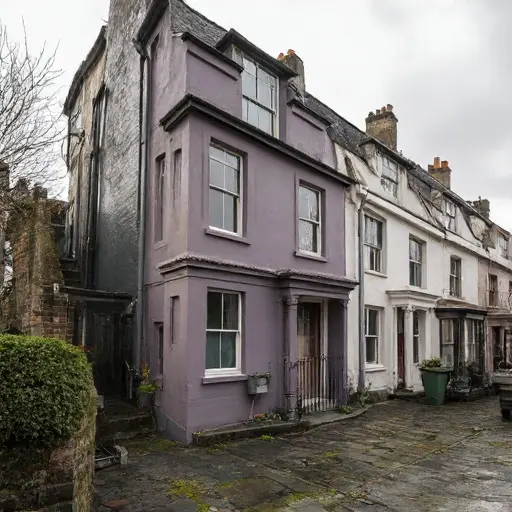
The surrounding neighborhood maintains a quiet architectural continuity, with similar terrace houses forming a subtle but persistent rhythmic fabric along the hillside. Vegetation is minimal and contained, appearing only in small front patches and along cracks in paving stones. The atmosphere is still and evenly lit, emphasizing repetition, order, and the understated logic of Victorian urban domestic design.
The result is a grounded Victorian terrace house that feels gently detached yet structurally coherent—an architecture of disciplined repetition slowly dissolving into atmospheric variation without breaking its fundamental spatial or material grammar.