The Cursed Silence of Ashworth Manor
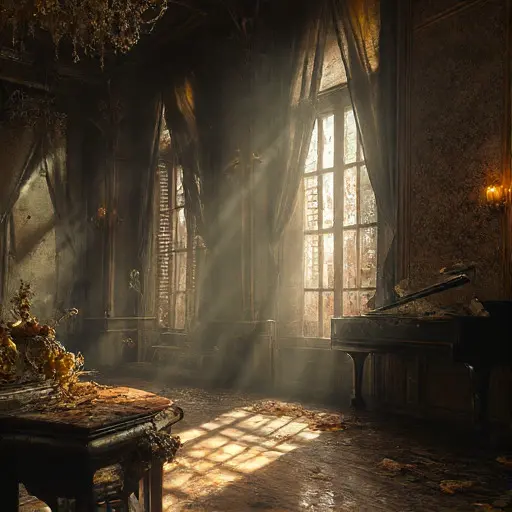
The silence inside Ashworth Manor was not the absence of sound, but the sound of all things refusing to speak. It was a quiet that pressed in on the eardrums, smelling faintly of ancient cedar and powdered decay. When you stepped across the threshold, the air, thick with a thousand suspended dust motes, seemed to solidify around you. The floorboards beneath your boots—heavy, dark oak—didn’t just creak; they sighed a tired, old-world lament. Sunlight, strained through decades of grime on the bay windows, didn’t illuminate the entry hall so much as cast it in a sickly, jaundiced amber, turning the peeling crimson wallpaper into a study in quiet, unsettling rot. The house, immense and sprawling, felt less like an empty structure and more like a massive, forgotten creature, its cold, still eyes watching the intrusion.
The Architect’s Last Project
The manor was the final, obsessive project of Silas Ashworth, a celebrated but deeply reclusive architect known for his haunted sense of geometry. Silas built Ashworth Manor not as a family home, but as a monument to his despair following the passing of his young wife, Elara, in 1888. He lived in the house for only five years after its completion, entirely alone, measuring the distance from one empty room to the next, sketching improvements and additions that would never be realized. His profession was evident in the perfect, unsettling symmetry of the drawing-room and the grand, impractical staircase that wound up to the empty third floor, leading nowhere but shadow. His personality was etched into the home’s very bones: precise, beautiful, and profoundly melancholic.
An Unfinished Conversation
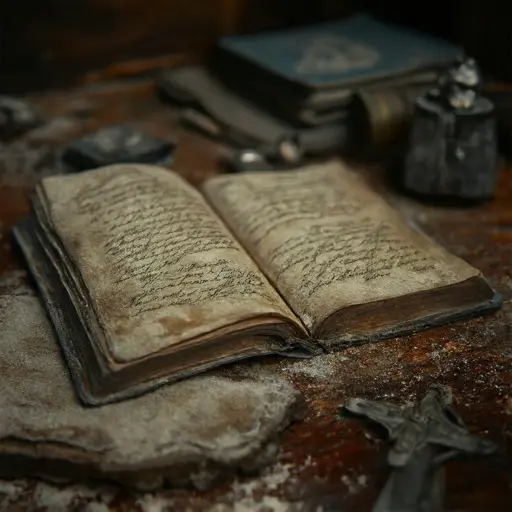
Silas’s presence lingered most acutely in his study. Here, behind the massive mahogany desk, a leather-bound journal lay open, its spine cracked, the ink brittle and brown. It was not a diary, but a ledger of measurements, materials, and maddeningly detailed philosophical musings on the nature of permanence and memory.
One entry, dated October 12, 1893, was underlined three times: “The weight of the walls is nothing compared to the burden of their silence. I have built a fortress against the world, yet I am not safe from the things stored within myself. When I am gone, the house will speak my failure.”
It was through these pages that his fate was slowly revealed. Silas didn’t leave the manor; he simply stopped. The last entry was incomplete, ending mid-sentence, the pen stroke trailing off into a smear on the page, suggesting a final, sudden resignation.
The Gallery of Lingering Light
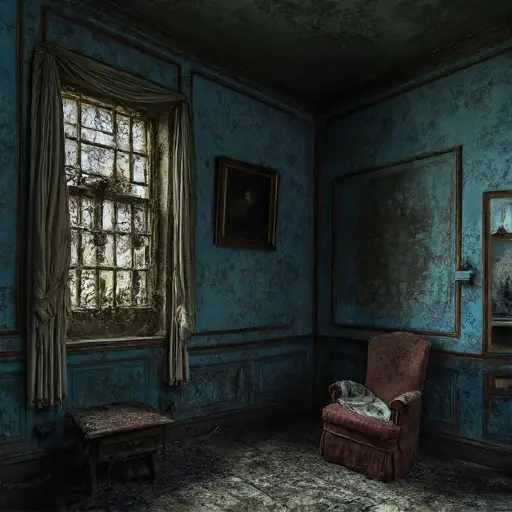
The upper floor contained the mansion’s strangest feature: a long, narrow gallery lined with dozens of tall, arched windows, built by Silas specifically to study the shifting patterns of light throughout the day. This room, ironically, was the darkest. One window, near the end, was shattered, letting in a draft that carried a constant, faint whisper.
Across the worn velvet chaise lounge lay a single, embroidered shawl—Elara’s. It was the only item in the house not covered in a deep layer of dust, as if it had been placed there yesterday. The house had preserved Elara’s memory for Silas, and now, long after he too had vanished, it preserved the evidence of his final, heartbreaking vigil.
The air in this part of Ashworth Manor was cold, not from the draft, but with an immense, unspoken grief. It felt like the room was perpetually waiting for a door to open that had been sealed forever, a memory of a life that was perfect only in its brief, agonizing span. The silence was Silas Ashworth’s final, enduring structure, holding tight to a pain that the decades had never managed to wipe clean.
