The Cursed Canvas: The Mad Artist of Veridian Gloom
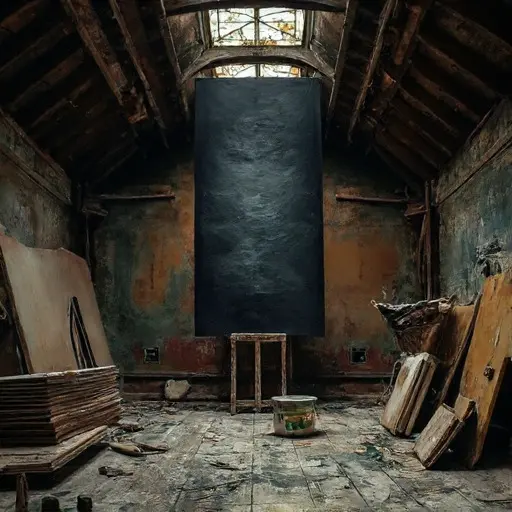
Veridian Gloom is a sprawling, strange house distinguished by its irregular, almost frantic architecture—a mass of turrets, gables, and randomly placed windows that seem to have sprung up organically rather than by careful design. This abandoned Victorian house perches on the highest point of the coastal moors, perpetually shrouded in a cold, damp mist that clings to its dark stone facade. The atmosphere inside is intensely sensory, smelling strongly of aged linseed oil, mildew, and something metallic and sharp, like old blood or dried pigment. The silence here is not empty; it is a heavy, expectant silence, as if waiting for a brushstroke or a scream. The house, painted in the darkest shades of green and black by its owner, feels like a physical manifestation of a tortured creative mind.
Augustus Reed: The Reclusive Colorist
The solitary figure who shaped and occupied Veridian Gloom was Augustus Reed, a gifted but profoundly unstable painter. Augustus was obsessed with color, specifically the emotional weight of shadows and darkness. His early work was hailed for its vibrancy, but after a personal tragedy—the death of his fiancée—he retreated to the estate he built in 1885, dedicating himself to a single, increasingly morbid series of canvases he termed “The Descent.” He became completely reclusive, his only communication being the infrequent, dark shipments of his supplies.
Augustus’s fate remains an unsolved mystery. He was last seen in the local village ordering a bizarre amount of black and crimson pigments, then he vanished, leaving behind his life’s work. The official verdict was suicide, but no body was ever found. The house, designed with poor insulation and high, north-facing windows for optimal light, now preserves the exact eerie moment his creative life ended.
The Pigment Room’s Vivid Stain
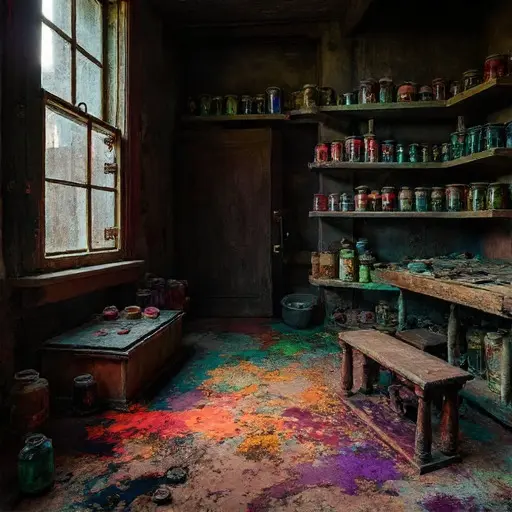
Descending into the basement reveals a small, reinforced room that served as Augustus’s pigment laboratory. This chamber is cold and intensely dry, and the scent of raw mineral color is overwhelming. The floor is permanently stained with every shade imaginable, creating a macabre, accidental mosaic. This room holds the key to Augustus’s final mental state. His research ledger, lying open on a low bench, details his chemical attempts to create “True Black”—a pigment so dark it would absorb all light and emotion.
The final, frantic entry is written in crimson ink, detailing his failure and his growing belief that the only way to achieve true darkness was to paint not with color, but with the absence of life. The words are heavy and unsettling: “The Black requires a sacrifice. The canvas must be fed with silence, and the shadow must become the substance.”
The Final Portrait
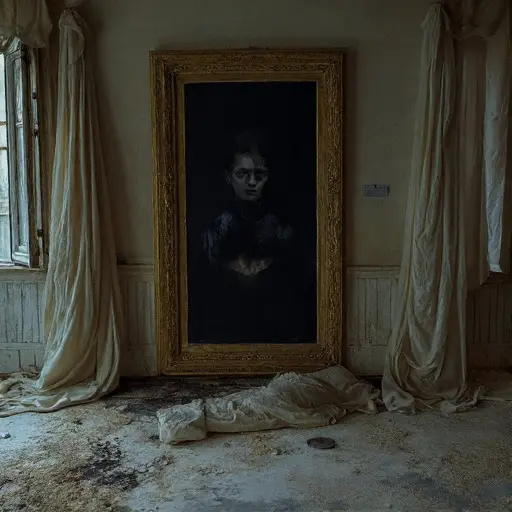
The only room on the main floor that shows signs of domestic life is the main parlor, now draped in sheets. But presiding over the mantelpiece is one finished, uncovered work: the portrait of his fiancée. It is a technically flawless painting of a beautiful woman in a pale dress—except for her face. Her features have been completely obliterated by a violent application of his “True Black” pigment, layered on in rough, panicked strokes.
Directly beneath this cursed canvas is a small, tarnished silver locket, lying on the floor as if dropped in a moment of utter distraction. It contains two tiny, faded photographs: one of a younger Augustus, and one of the woman whose face he destroyed. Veridian Gloom is the physical embodiment of Augustus Reed’s creative and emotional collapse, a space where art and insanity converged, forever preserving the haunting silence and profound melancholy of his final, black masterpiece.
