The Cryptic Villa Along the Lotus Reservoir Still Holds Minh’s Unfinished Sky
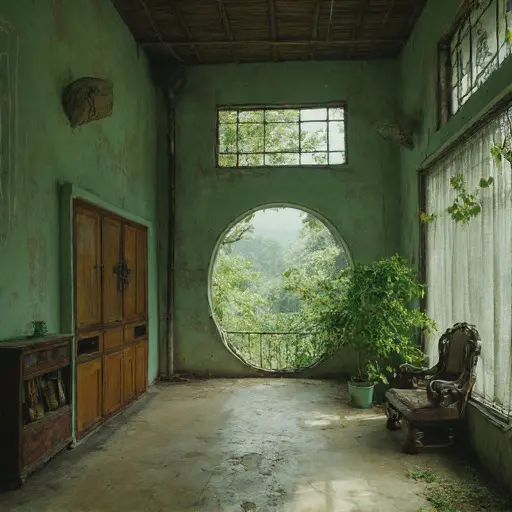
The ceiling opens before the room does.
Visitors notice that first.
Wooden panels built into the roof remain partially folded toward the sky, exposing a pale square of weather and cloud that still changes with the hour.
Minh left it that way.
The villa beside the reservoir belonged to him for more than three decades.
He lived there alone and practiced a profession tied to prediction, patience, and disappearing traditions.
Minh was a cloud silhouette registrar.
His work involved cataloguing recognizable cloud formations associated with seasonal farming guidance, local weather folklore, and ceremonial calendars. Communities once commissioned specialists like him to preserve visual cloud records before monsoon shifts, planting cycles, or festival periods.
He did not forecast storms scientifically.
He documented how people understood them.
The observatory room still preserves his routine.
Rice-paper sketches remain clipped beside bamboo rods. Viewing lenses rest near low tables. Stacks of cloud journals lean beneath cabinets carrying years of classification notes and carefully dated horizon studies.
The room feels suspended between sky and memory.
Under the Sky Frame Gallery
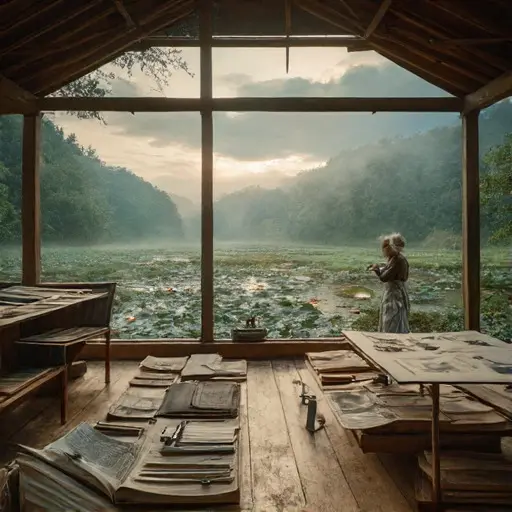
Minh organized everything around the Sky Frame Gallery.
The gallery occupied the center of the observatory beneath the retractable roof where clouds could be traced without distortion from window glass.
One unfinished registry still lies there.
The date recorded.
The formation unnamed.
Minh had once traveled between farming villages carrying folded screens and observation books tied with silk cord.
People remembered his quietness more than his speech.
For decades the work survived.
Planting customs and seasonal festivals still relied partly on inherited sky-reading traditions preserved through observers like him.
Then forecasting became instantaneous.
Mobile weather services, satellite prediction, and real-time climate applications steadily replaced communal cloud interpretation. Traditional registries lost practical value and younger generations rarely learned their meanings.
Minh adapted poorly.
He respected science but mourned the loss of watching.
Then the birds vanished from the reservoir.
Water contamination and agricultural runoff disrupted migratory patterns and damaged ecosystems surrounding the lotus wetlands. Without familiar migration behavior, many seasonal sky traditions lost ecological reference points that once guided interpretation.
The clouds remained.
Their stories thinned.
Already living with untreated neurological tremors and worsening fatigue, Minh continued climbing to the observatory each dawn.
One humid morning he suffered a fatal stroke while preparing sketches beneath the open roof.
The funeral brought farmers, teachers, and elderly neighbors who still remembered asking him whether certain clouds meant rain.
The villa remained afterward.
The roof panels remain partly open.
The journals still lean beneath the cabinet.
And inside the Sky Frame Gallery, Minh’s unfinished cloud registry continues waiting beneath a piece of sky he never returned to name.