The Crumbling Echo of Hearthstone Weft
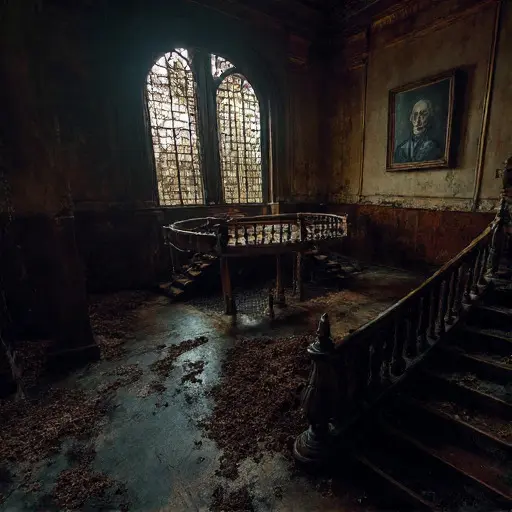
Hearthstone Weft was a study in contradictions—a sprawling, imposing Victorian structure built not of solid stone, but of ornate, intricately patterned brickwork meant to mimic tapestries. The house sat in a perpetually sheltered, windless grove, where the silence was so profound it pressed against the ears. The entrance hall was a suffocating space, dimly lit by a fanlight obscured by decades of grime. The air here was heavy, smelling sharply of dried plaster, old paper, and a faint, metallic tang. Every detail, from the patterned tiles to the carved wainscoting, felt excessive, as if the builder had tried to weave permanence into the temporary nature of brick and mortar. This abandoned Victorian house felt like a suffocated masterpiece, its intricate beauty slowly being consumed by darkness and dust.
The Engineer’s Failure of Form
Hearthstone Weft was commissioned and occupied by Benedict Albright, a brilliant but pathologically anxious civil engineer of the late 19th century. His professional life was characterized by an obsessive need for structural perfection, precision, and permanence; he designed massive bridges and unyielding foundations. Personally, however, Benedict was tortured by the belief that all human structures—and human lives—were inherently flawed and destined for collapse. He built the Weft as his final experiment, an attempt to construct a living space so structurally complex and over-engineered that it would defy decay and endure forever. His connection to the mansion was his final, failing monument to immortality.
The Blueprints Chamber
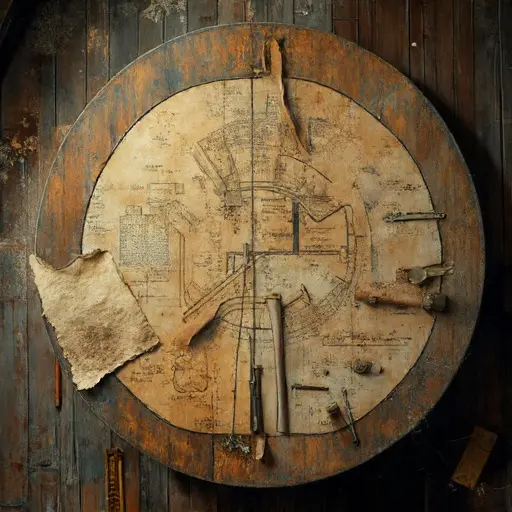
Benedict’s Blueprints Chamber was a cylindrical room built into one of the main turrets. It was dominated by his work. On his heavy drafting table, we found the final, chilling set of blueprints. They were not for the house itself, but for a complex system of internal supports—hidden iron columns and concealed brick buttresses added years after the house was “finished.” His journal, found beneath the blueprints, revealed his spiraling obsession: he believed the original house was subtly, imperceptibly failing, and he had spent his last years frantically reinforcing it from the inside out, turning the structure into a literal cage. His final note, scrawled across a structural diagram, simply read: “The weakness is me, not the brick.”
The Hidden Sub-Basement
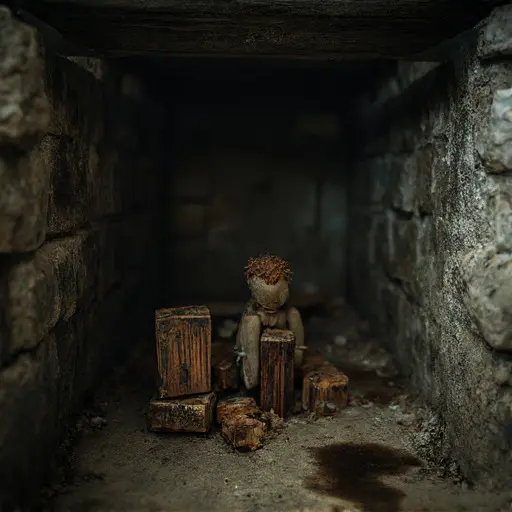
The heart of the engineer’s paranoia lay not on the surface, but deep underground. Beneath the main kitchen pantry, accessible only by a hidden, narrow iron ladder, lay a vast, crude sub-basement he had excavated himself. This space was entirely different from the rest of the house: rough, uneven walls, and a damp, oppressive atmosphere. It contained nothing but tools and raw materials—sacks of cement, rebar, and piles of broken bricks. However, in the center, we found a single, small, hand-carved wooden doll, clearly made by a child. A small, water-stained tag around its neck bore the name “Edith.” Benedict’s journal, when cross-referenced, never mentioned a daughter. Local archives eventually confirmed that Edith was his younger sister, who had died tragically when a seemingly “perfect” bridge designed by Benedict in his early career suddenly collapsed. The crumbling echo of the Weft is the sound of an engineer who failed to save one life, and spent the rest of his trying to build a fortress that could defy death, only to entomb his guilt within the silence of the abandoned Victorian house.