The Courtyard Manor Left Empty After Quiet Decline
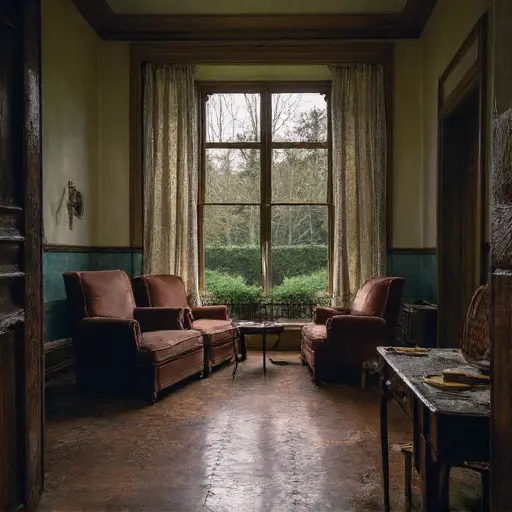
The manor was built at the turn of the century as a contained aristocratic residence, designed not to impress outwardly but to organize life around its inward-facing courtyard. The U-shaped structure enclosed a small garden pocket that functioned as its emotional center: a geometric green space framed by two balanced wings and a central block. For decades, it housed a single extended family whose routines followed the quiet discipline of the architecture itself.
Meals were taken in rooms that opened directly onto the courtyard, and seasonal changes were observed through the shifting light that filled the enclosure rather than through any outward view of the surrounding countryside.
Early signs of decline were not dramatic, but administrative and financial. The estate’s maintenance logs began to thin, then stop entirely. Repair crews came less frequently, and small damages—cracked stucco near the northern balcony, a loosened iron rail along the dusk-amethyst filigree—were left unresolved. The courtyard garden, once carefully trimmed into formal symmetry, started to grow unevenly as the groundskeeper’s visits became sporadic. Grass thickened in the center, creeping outward over stone edging that had once clearly defined walking paths.
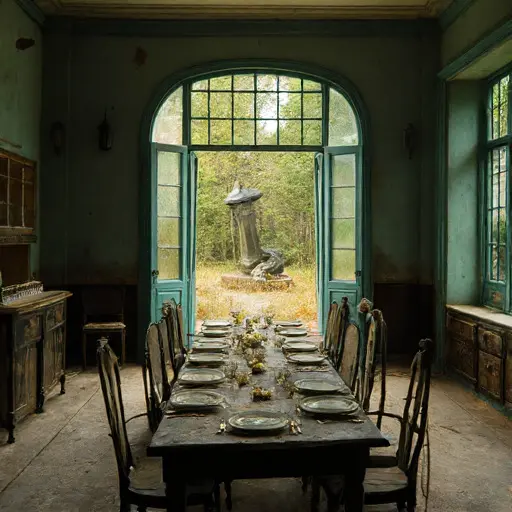
As the years passed, the decline accelerated in quieter ways. One wing of the manor was vacated first, not due to disaster but due to inconvenience: heating inefficiencies in winter, then water seepage along the foundation where the soil retained moisture near the courtyard. Rooms were closed off one by one, their doors left shut but never locked. Curtains faded in place behind glass panes that were no longer cleaned regularly. The symmetry of the house—once its defining strength—became a record of absence, as each empty room mirrored a still-occupied counterpart across the courtyard axis.
Eventually, the family itself dispersed without ceremony. There was no final gathering, no documented sale, no dramatic departure. Objects remained exactly where they had been left, but human presence gradually stopped renewing them. The courtyard garden, no longer managed, rose unevenly until it obscured the lower view lines between the two wings. The sundial at its center cracked along its granite face, its shadow no longer readable against the encroaching grass.
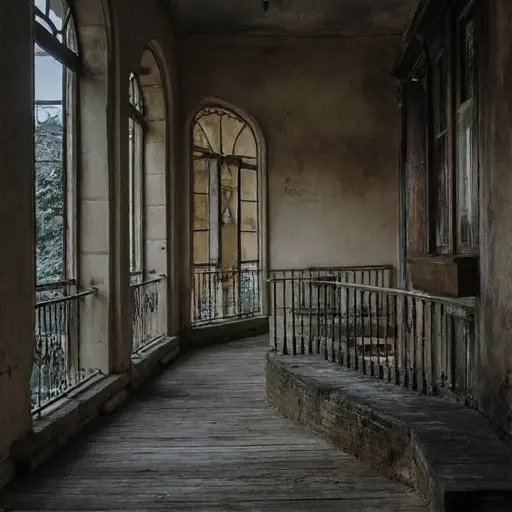
In its final state, the manor did not collapse or dramatically deteriorate. It simply stopped participating in maintenance. The roof remained intact, the walls held their discipline, and the courtyard continued to exist as a contained, self-referential space slowly filling with unmanaged growth. Weather continued to pass over it in soft cycles of overcast light, revealing no single moment of ruin—only accumulation of neglect across time.
Today the house stands sealed in its own geometry. The wings remain balanced around the courtyard, but the life that once defined their purpose has fully withdrawn. Grass grows through the cracked stone perimeter, ivy traces the balcony rails without guidance, and the sundial remains tilted in silence at the center of the enclosure. No restoration has been attempted, no new ownership established, and no return recorded. The manor persists as an empty architectural memory, held in place by structure alone, quietly fading into the surrounding stillness without conclusion.