The Cottage Beside the Rails That Never Returned
An abandoned surreal Victorian railway-side cottage sits beside a quiet rural rail line under bright, calm afternoon daylight. The atmosphere is still and nostalgic, with soft warm sun casting long shadows across overgrown tracks and weathered siding. There are no storms, no wind gusts, and no movement—only a peaceful silence stretching across the railway corridor and the small home that once served it.
The architecture is modest and intimate in scale, originally built as a Victorian railway worker’s cottage and gradually adapted over time into a slightly irregular but believable family residence. The main structure is a simple rectangular form with a steep slate roof, anchored close to the railway line. A modest bay window faces the tracks, positioned as a quiet observational point over passing trains that no longer come. Later additions include a side kitchen extension with a lower roof pitch and a small enclosed porch added in a different era, its proportions subtly mismatched yet harmoniously integrated. The entire structure shows a gentle lean toward the track side, a slow settling that suggests decades of environmental influence without structural failure.
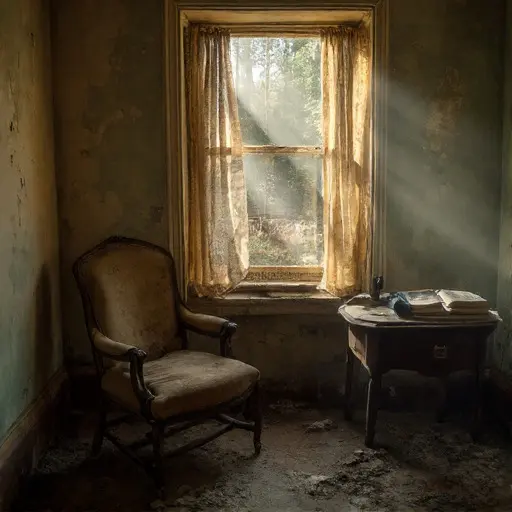
Materials across the cottage reflect long exposure to sun and rural weather. The siding is sun-faded cream wood, softened by age into pale, chalky tones. Trim paint in pale blue and muted green has worn into gentle gradients where layers overlap. The slate roof is light gray, with uneven replacement tiles that subtly shift in tone. Oak window frames are slightly warped but intact, while iron railings show a light rust patina. Brass door fixtures are dulled and matte. Through the glass windows, warm interior wood tones remain visible—chairs, tables, shelves, and fabric curtains in muted domestic colors.
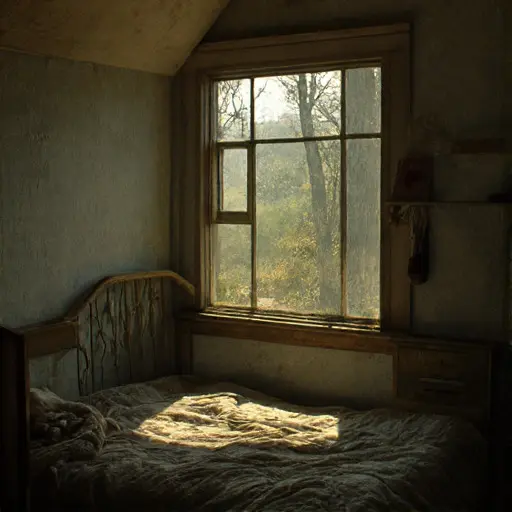
The state of decay is long-term but peaceful. The interior remains fully furnished and carefully preserved. In the kitchen, a table is still set with simple domestic arrangements, chairs remain in place, and shelves hold quietly aged objects. Upstairs, beds are faintly visible through windows, made and undisturbed. Dust is present but light, drifting through sunbeams rather than accumulating in heaviness. Curtains hang naturally without movement, and wallpaper shows only subtle signs of peeling. Near the porch and foundation, wood weathering is slightly more pronounced due to proximity to the ground, but there is no collapse, no vandalism, and no structural damage.
Outside, the railway environment is overgrown and silent. Tracks are partially obscured by tall grass and wildflowers growing between the rails. A rusted signal post stands motionless in the distance, and a nearby platform edge has begun to be reclaimed by vegetation. The treeline beyond frames the horizon in soft green tones, unmoving in the warm air. The entire landscape feels paused, as if the railway itself has forgotten its purpose.
The camera perspective is a cinematic wide shot from a slightly low angle positioned along the railway tracks. Strong leading lines draw the eye directly toward the cottage, emphasizing its isolation and alignment with the abandoned rail corridor. A 35mm lens captures fine architectural detail while maintaining soft depth of field toward the distant trees. Warm nostalgic filmic color grading enhances the feeling of memory and quiet rural stillness.
The overall impression is one of complete, undisturbed abandonment. The cottage has not collapsed or decayed—it has simply remained in place beside the railway, fully furnished and softly illuminated, holding its quiet domestic life in suspended stillness while the tracks beside it slowly disappear into grass and time.