The Coral Quarry House of Silent Extraction
Abandoned Victorian house, pale fired coral-stone masonry with subtle fossil inclusions visible in close texture, deep sun-washed ebony timber framing softened into warm gray-brown gradients, and forged ironwork in oxidized iron-black with faint silvery abrasion where wind has carried mineral dust for decades. A compact Victorian cliff quarry residence sits carved into the edge of an old extraction site, where vertical stone faces and terraced cuts define both the landscape and the architecture’s geometry.
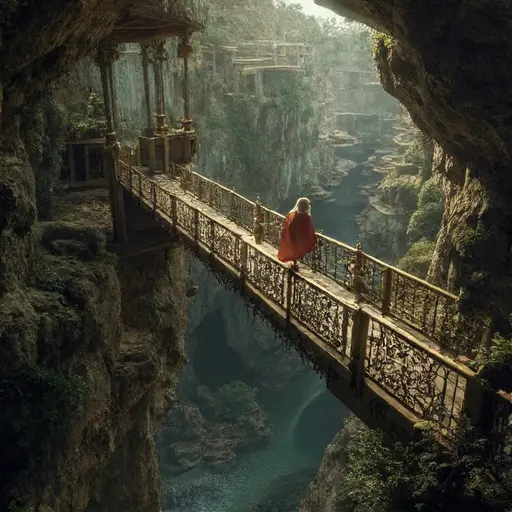
The structure is partially embedded into the quarry wall, with one side built directly against exposed stratified rock and the other opening toward a vast stepped basin below. Its form is compact but heavily reinforced: a central living block anchored into bedrock, a narrow cantilevered balcony corridor projecting over the quarry void, and a lower workshop level integrated into the rock face where stone once was processed. The roof is steep slate, but unusually reinforced with layered stone slabs, showing uneven weathering from dust, wind, and long-term exposure to open excavation conditions.
Copper elements have oxidized into muted verdigris streaks that follow vertical runoff paths down the cliff-facing walls.
The façade is fully exterior and materially grounded. Coral-stone blocks show distinct layering from ancient sediment compression, with chipped edges and softened corners where windborne grit has gradually eroded surfaces. Timber elements are structural and weathered, showing compression marks, uneven staining, and localized fading where sunlight reaches through quarry openings. Iron fixtures—crane mounts, balcony supports, and safety rails—display realistic fatigue patterns, with corrosion concentrated at joints and load-bearing points.
The surrounding environment is a vast abandoned quarry basin with stepped geological terraces descending in irregular tiers. Each level shows different stages of reclamation by nature and time: upper tiers are dry and wind-scoured, middle levels are partially vegetated, and lower levels collect shallow rainwater pools that reflect cliff walls and sky. The rock surfaces reveal clear stratification lines, tool marks from historical extraction, and natural fracture patterns caused by long-term erosion.
Vegetation is sparse but persistent, growing in accordance with soil accumulation on quarry steps. Hardy grasses cling to thin soil layers on ledges, while moss spreads across shaded rock faces where moisture lingers. Small wildflowers appear in isolated clusters: pale white cliff blossoms, muted violet rock flowers, and faint yellow blooms emerging in sediment pockets where organic material has gathered.
A rusted iron hoist system remains partially mounted along the quarry wall near the residence, its pulley wheels frozen and cables long since removed. Below it, fragments of old stone-cutting platforms remain embedded in the basin, their geometry partially broken by collapse and sediment shift. A narrow access stair carved directly into the rock ascends toward the main structure, but sections are missing or eroded, creating discontinuity in the path.
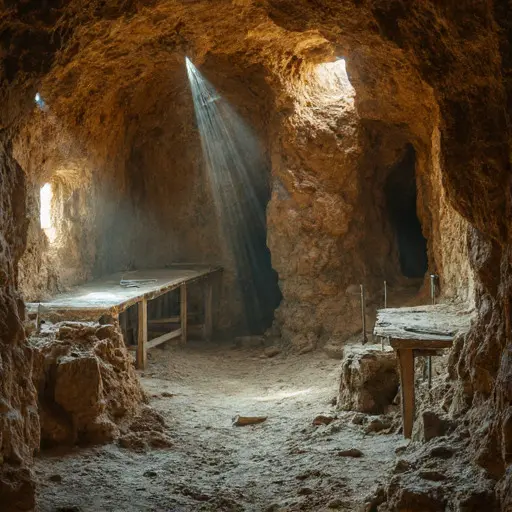
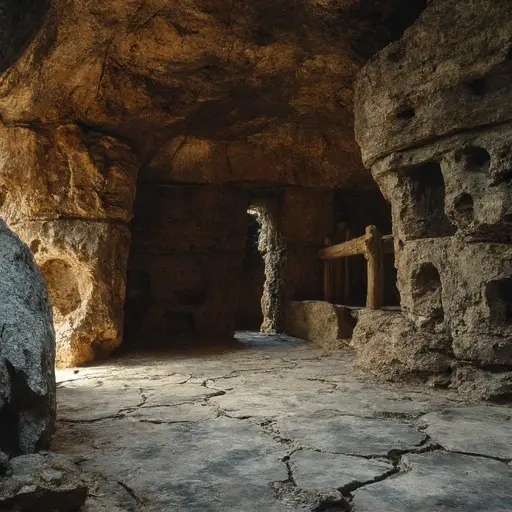
Window openings are deep and irregular due to rock integration, with thick, aged glass that slightly distorts reflections of quarry walls and sky. Some openings are unglazed, revealing interior spaces composed only of structural frames, empty work surfaces, and support beams used for stone processing and observation.
Lighting is realistic open-quarry daylight with strong vertical contrast between cliff shadows and exposed terraces. Diffuse sky illumination softens harsh geological edges while maintaining clear material definition. Subtle dust haze in the air reduces distant contrast, enhancing depth without artificial atmosphere effects.
The entire scene reads like a precise architectural field photograph of a Victorian quarry residence—industrial in origin, geological in integration, and shaped by extraction history, erosion, and long-term abandonment rather than decorative intent. A place defined by stone, void, and layered human intervention across deep time.