The Chateau on Ash Street
Among the quiet homes of an old American residential neighborhood stands an abandoned three-story Chateauesque Victorian mansion that still possesses an unmistakable sense of grandeur. Once regarded as the unrivaled jewel of the district, the residence dominates its modest corner lot with towering proportions, elaborate stonework, and the quiet confidence of an estate built to impress generations rather than decades. Though abandoned, the mansion remains an extraordinary survivor of Victorian craftsmanship, its weathered beauty preserved beneath soft overcast skies.
The architecture immediately commands attention. Soaring conical corner towers frame the massive structure, their verdigris copper roofs rising above sculpted dormers and an immense slate roof adorned with decorative cresting.
Time has gently reshaped the mansion, causing subtle ripples through the walls and roofline where more than a century of natural settling has softened the once-perfect geometry. Rather than diminishing the design, these graceful distortions lend the estate a remarkable sense of age and authenticity.
Its luminous ash-white granite façade glows softly beneath the cloud-filtered daylight, contrasted by delicate blush sandstone carvings surrounding windows, balconies, and entrances. Monumental arched entry doors stand beneath richly carved limestone balconies, while elaborate stone balustrades wrap around sweeping verandas that curve elegantly around the mansion’s rounded corners. Massive leaded-glass bay windows still reflect the muted sky, hinting at the lavish interiors hidden beyond their dusty panes.
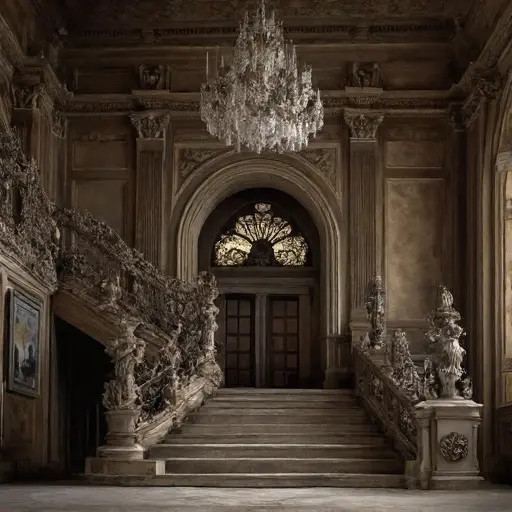
Crossing the threshold reveals an entrance hall built on an astonishing scale. A sweeping marble staircase rises beneath towering ceilings supported by intricately carved woodwork and decorative stone columns. Dust now blankets every polished surface, while a magnificent crystal chandelier hangs silently overhead, its brilliance replaced by a soft layer of age. Even untouched for decades, the craftsmanship remains breathtaking.
Throughout the main level, elegant reception rooms preserve the mansion’s former prestige. Grand fireplaces carved from limestone anchor spacious parlors filled with faded furnishings, worn rugs, and tall leaded-glass windows overlooking the garden. Decorative ceiling plaster, carved moldings, and rich hardwood floors survive beneath layers of dust, allowing the original elegance of each room to remain unmistakably visible.
Outside, the carefully planned grounds have slowly surrendered to nature. Behind an ornate wrought-iron fence, formal hedges have grown into untamed walls of greenery, surrounding a fractured flagstone walkway that leads toward the marble terraces. Moss now softens the edges of every stone, blending the estate gently into its surroundings.
Near the entrance, a marble lion statue continues its silent watch beside a dry reflecting basin whose still surface disappeared long ago. Fine moss has spread across the sculpture, softening its once-sharp features while preserving its quiet dignity. Together, the forgotten fountain and patient guardian create one of the property’s most memorable scenes.
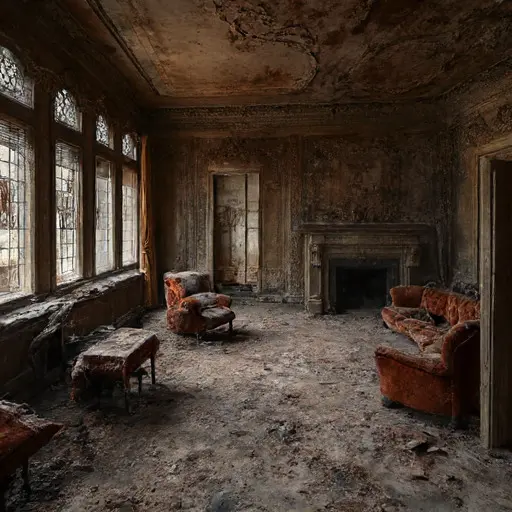
The mansion’s grand salon remains one of its most spectacular spaces. Sunlight filtered through leaded glass gently illuminates faded velvet seating, elaborate ceiling moldings, and a forgotten grand piano resting beneath towering windows. The room feels suspended in time, preserving the atmosphere of formal gatherings that ended generations ago without erasing the beauty that once filled the estate.
Every exterior detail tells the story of graceful decline rather than destruction. Weathered marble terraces show fine cracks from countless seasons, copper roofing has matured into soft shades of green, and carved sandstone ornaments have slowly rounded beneath decades of rain. The mansion has not collapsed into ruin; instead, it has quietly aged with remarkable dignity.
Beyond the wrought-iron fence, ordinary neighborhood life continues. A rusted curbside mailbox stands beside the cracked asphalt street, while a weathered wooden utility pole carries drooping wires overhead. Historic neighboring homes remain occupied in the distance, their softened outlines emphasizing how extraordinary the abandoned mansion has become among everyday surroundings.
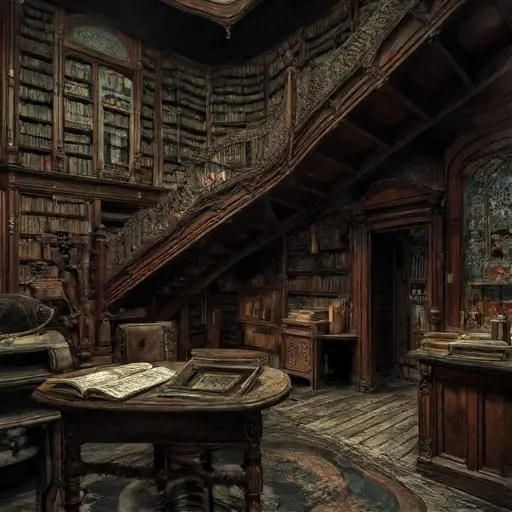
Hidden within the upper floors, the mansion’s library offers perhaps the most intimate glimpse into its past. Towering wooden bookshelves line the walls from floor to ceiling, connected by a narrow spiral staircase. Forgotten volumes remain neatly arranged beside a carved reading desk, while stained glass windows cast muted colors across worn hardwood floors. The room feels less abandoned than patiently waiting for its owner to return.
Under bright cloud-diffused overcast daylight, the mansion appears almost timeless. The soft illumination reveals every subtle texture within the granite, sandstone, marble, copper, and slate while preserving the calm atmosphere that surrounds the estate. Documentary-style realism captures not only the architecture itself but also the quiet dignity earned through more than a century of endurance.
Once celebrated as the finest residence in the neighborhood, the Chateauesque mansion now stands as a magnificent monument to Victorian ambition, craftsmanship, and memory. Its soaring towers, carved stonework, weathered gardens, and silent rooms remain a remarkable testament to a home whose grandeur continues long after the voices that once filled it have faded away.