The Chalkstone Railcut House of the Silent Canyon Line
Abandoned Victorian house, pale fired chalkstone rendered in layered limewash that has naturally worn into soft gradients of ivory, sand, and ash-gray, deep weather-aged sycamore timber framing that has faded into muted honey-brown and smoke-gray tones, and wrought iron detailing in oxidized iron-black with fine granular corrosion from long-term airborne mineral dust. A compact Victorian canyon-rail residence sits carved into a narrow railcut pass where an old elevated railway once passed through a deep stone corridor between two natural ridgelines.
The structure is linear and tightly integrated with the rail geometry. A central dwelling block sits directly beside the former track alignment, with a long enclosed corridor parallel to the rail line that once served as a signal observation and waiting passage, and a small cantilevered platform room extending toward the canyon opening for train visibility. The roof is steep slate, heavily weathered with uneven tonal layering from charcoal gray to pale stone-blue, shaped by wind funneling through the canyon.
Copper drainage elements have oxidized into dull green streaks that follow strict vertical runoff lines along the façade.
The façade is fully exterior and materially precise. Chalkstone render shows fine erosion channels carved by wind-driven rain, with subtle stratification where limewash layers have peeled and reformed over time. Timber framing is structural, revealing grain compression, micro-splitting, and uneven fading caused by alternating shade and direct canyon light. Iron fixtures—rail brackets, signal mounts, and structural anchors—show realistic fatigue patterns, with corrosion concentrated in load-bearing joints and exposed canyon-facing surfaces.
The surrounding environment is a deep railcut canyon, with steep stone walls rising on both sides of the structure. These walls are not smooth but stratified, showing geological layers, old drilling marks, and erosion channels formed by wind and intermittent water flow. The abandoned railway line runs through the center, partially buried under gravel displacement and moss intrusion, yet still structurally legible.
Vegetation is sparse and highly localized due to canyon shading and limited soil accumulation. Moss dominates shaded stone surfaces, forming dense green patches along moisture-retaining cracks. Thin grasses grow along the railbed edges, bending slightly in air currents moving through the canyon corridor. Small wildflowers appear in protected niches: pale white cliff blooms, muted violet canyon flowers, and faint yellow blossoms emerging where light reaches the canyon floor.
A collapsed signal gantry spans partially across the canyon above the structure, its metal frame twisted and incomplete, with missing sections that reveal sky through irregular gaps. Below it, a broken maintenance walkway clings to the canyon wall, with several sections missing due to long-term structural decay and rock shifting. A rusted inspection winch remains embedded near the dwelling entrance, its cable long gone but mechanical housing still intact.
Window openings are deep-set due to canyon wall thickness, producing strong shadow gradients and limited direct visibility. Glass is aged and uneven, slightly warped, creating subtle distortion of reflected canyon walls and sky. Interior spaces are barely visible—only structural silhouettes of beams, narrow passageways, and empty observation stations designed for railway monitoring.
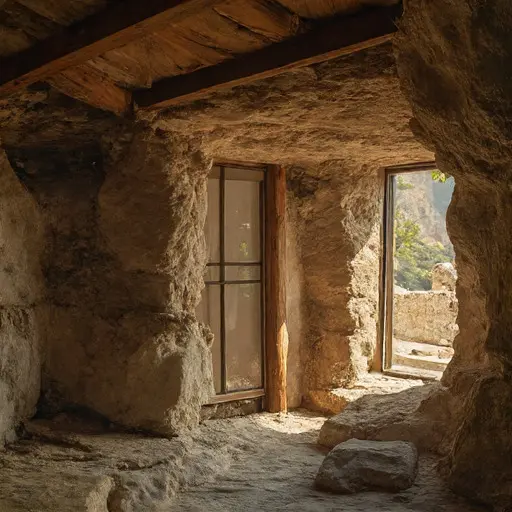
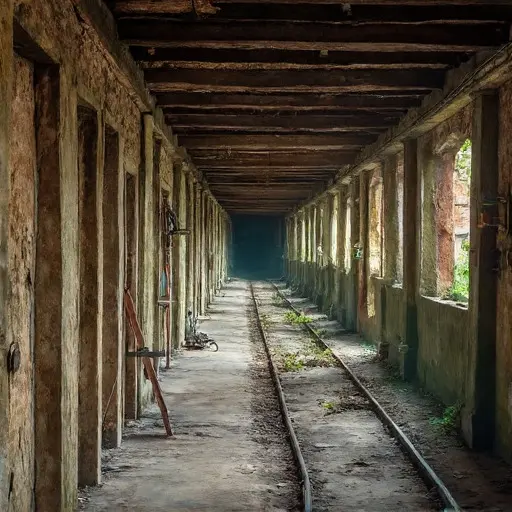
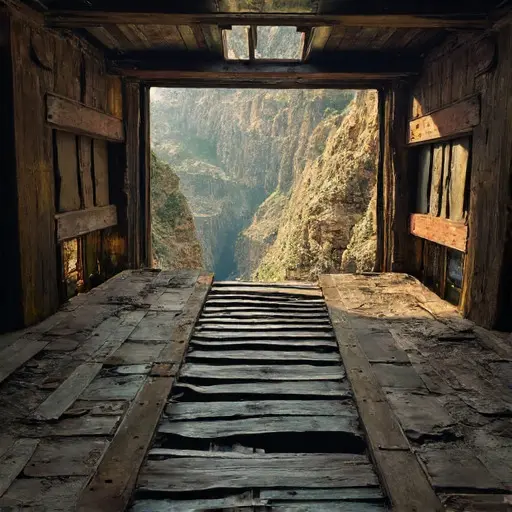
Lighting is realistic canyon-filtered daylight, with strong directional contrast caused by narrow sky visibility above. Light enters in soft vertical shafts that shift with cloud movement, producing natural variation across stone, wood, and metal surfaces. Atmospheric depth is enhanced by canyon haze and dust particles, but remains physically accurate and restrained.
The entire scene reads like a precise architectural field photograph of a Victorian canyon railway residence—engineered for rail observation, embedded in geological constraints, and shaped by wind, stone, and abandoned infrastructure rather than ornament or narrative styling. A place defined by passage, echo, and slow structural reclamation over time.