The Chalkfeld Moorland Wind Refuge
Abandoned Victorian house, pale chalkfeld stone embedded with fossil-like mineral speckling and natural stratified grain, deep ink-stained mahogany timber beams weathered into softened umber gradients through prolonged wind and moisture exposure, and hand-wrought iron details in aged slate-black with uneven oxidation bloom shaped by decades of coastal humidity and high-altitude weathering. A compact Victorian moorland refuge stands alone on an exposed plateau, far from settlement, where wind functions as a continuous shaping force acting upon both architecture and landscape. The structure is low, sturdy, and slightly elongated horizontally, prioritizing resilience over ornament. A central two-room core anchors the building, flanked by minimal utility wings and a narrow enclosed vestibule designed as a wind buffer before entry.
The roof is steep slate, structurally robust yet heavily textured by time and exposure.
Individual tiles vary naturally from deep graphite to weather-bleached blue-gray, with irregular edge lift in places where wind has gradually worked beneath older fixings. Thick stone chimneys rise with functional mass and slight asymmetry, their mortar joints reflecting multiple historical repair phases with subtly mismatched stone batches. Copper flashing is almost entirely oxidized into muted green-brown tones, tracing natural water runoff paths that follow realistic erosion logic across roof planes.
The façade is fully exterior and materially precise in its aging behavior. Chalkfeld stone exhibits granular texture and faint mineral inclusions, with wind-polished faces on exposed elevations and rougher, more eroded surfaces in sheltered recesses. Timber beams remain structurally honest, showing tool marks, uneven grain direction, and layered stain remnants where protective coatings have worn unevenly over time. Iron hardware—brackets, hinges, anchors, and exterior fixings—shows functional design clarity with realistic corrosion gradients, most pronounced in joints, lower surfaces, and wind-shadowed recesses.
The surrounding moorland is vast, open, and uninterrupted, with no distinct boundary between ground and sky at the horizon. Vegetation is low and wind-combed, forming directional flow patterns that continuously shift with atmospheric conditions. Heather spreads in muted purple and desaturated green patches, interspersed with exposed stone outcrops shaped by freeze-thaw cycles and long-term erosion. The environment feels exposed and physically harsh, yet ecologically complete rather than barren.
Vegetation density is sparse and strictly environmental rather than ornamental. Moss appears only in moisture-retaining depressions near foundation stones and sheltered ground pockets. Hardy plant species survive in isolated clusters: pale lichens, thin grass tufts, and low flowering forms in subdued tones—soft violet, pale cream, and muted yellow. Growth is entirely governed by wind exposure, soil retention, and microclimate protection.
A collapsed timber windbreak structure sits near the rear elevation, its planks partially buried and misaligned, indicating gradual structural failure under sustained environmental stress rather than sudden collapse. Nearby, a rusted iron cistern remains partially embedded in the ground, its surface dulled and uneven with faint mineral streaking from historical rain collection. A narrow stone path extends from the entrance toward a distant ridge, but it is fragmented and intermittently reclaimed by grass and erosion.
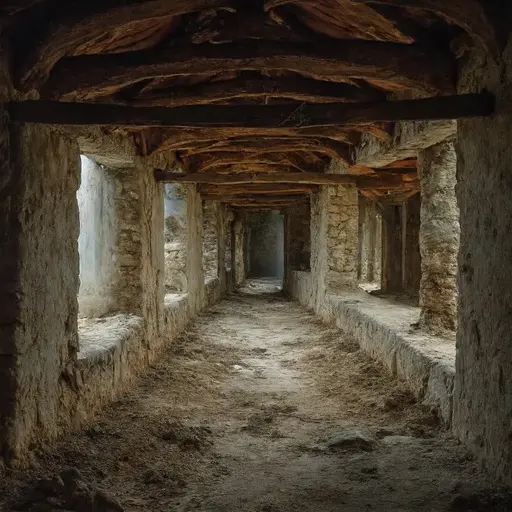
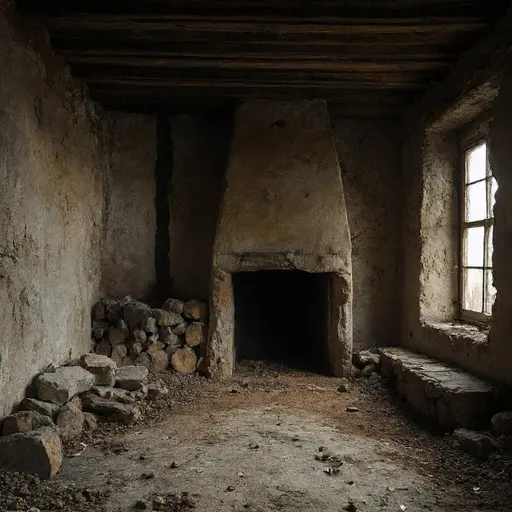
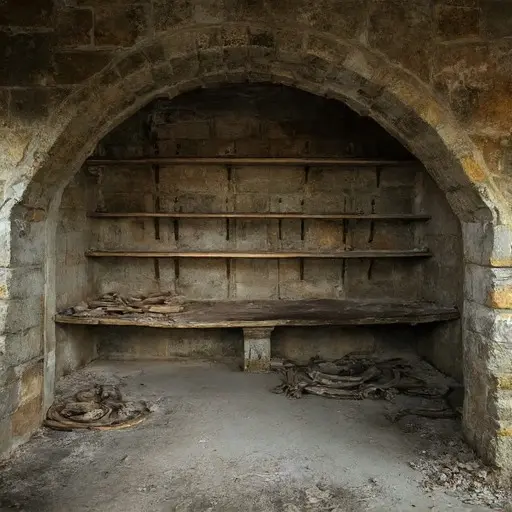
Window glazing is thick and slightly distorted, originally designed for insulation rather than optical clarity. Some panes remain intact but clouded with age; others are missing entirely, revealing dim interior volumes where only structural outlines—doorframes, beams, and hearth recesses—are faintly visible under ambient light. No interior lighting exists; visibility is entirely dependent on diffuse external illumination.
Lighting is cold, high-altitude overcast with diffuse sky brightness and subtle wind-shaped shadow gradients across terrain. The lack of direct sun produces even, documentary clarity of surface detail across stone, wood, and grass. Atmospheric moisture slightly softens distant forms while preserving sharp foreground material definition.
Interior Image Descriptions (for flux dev generation):
The entire scene reads like a high-resolution architectural survey photograph of a Victorian moorland refuge—strictly realistic, materially grounded, and defined entirely by wind exposure, altitude, and long-term environmental pressure rather than ornament or romanticized decay.