The Cedar-Shingled House Beneath the Silent Spruce Trees
Deep within a peaceful forest neighborhood, where winding footpaths disappear between spruce trees and birch groves, an abandoned Shingle Style Victorian residence rests quietly among moss-covered boulders and forgotten gardens. The three-story family house remains surrounded by nature, its weathered surfaces preserving the character of a home shaped by decades of changing seasons.
The exterior is wrapped entirely in white cedar shingles, creating a textured surface that blends naturally with the surrounding woodland. Deep navy-blue painted trim outlines the windows, porch details, and architectural accents, while the warm red clay tile roof adds a faded richness above the cool tones of the aging façade.
The house follows the flowing principles of Shingle Style architecture, with broad curved bays and rounded corners replacing rigid symmetry.
A prominent corner tower rises gently above the structure, softened by years of exposure and gradual settling. Decorative wooden brackets remain beneath the eaves, though many have faded and weathered into the surrounding tones of moss, bark, and stone.

The roofline creates one of the most distinctive features of the residence. Warm red clay tiles form broad uneven slopes interrupted by tall irregular dormers that emerge at different heights. The roof has developed a natural unevenness over time, with softened angles and gentle dips that give the house a settled, organic appearance.
The building’s age is visible through its subtle imperfections. Walls bow gently outward, window placements vary slightly, and the porch curves around the front façade in a graceful flowing arc. The faded railings and climbing vines that surround the veranda suggest a home that has slowly merged with its landscape rather than simply fallen into neglect.
Inside, the abandoned rooms retain traces of the craftsmanship that defined the Victorian era. Wooden details, large windows, and carefully shaped spaces reveal the original warmth of the family home, now replaced by silence and layers of dust.
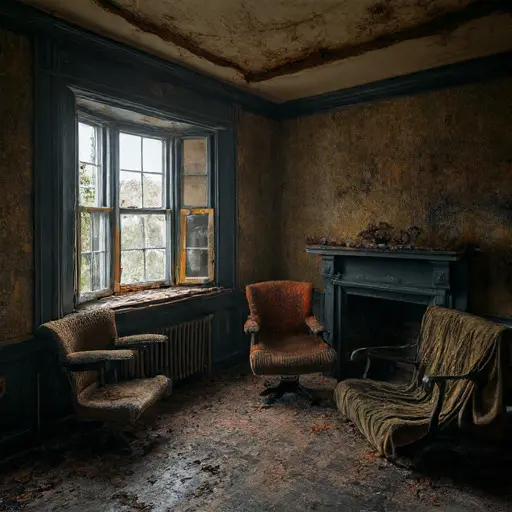
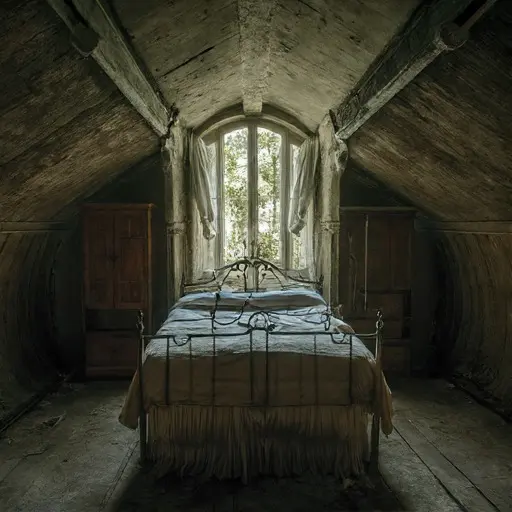
Upper floors beneath the irregular dormers contain quiet forgotten spaces where the unusual roof geometry creates intimate corners and changing ceiling heights. The natural curves of the exterior continue inside through rounded walls and carefully crafted transitions between rooms.
Around the property, the forest has gradually reclaimed the edges of the old residence. Spruce trees and birches surround the house like a protective wall, while moss-covered rocks and narrow woodland paths lead through the overgrown grounds.
A rusted bicycle rests against the white cedar shingle wall, its frame slowly blending into the textures of the forgotten property. Nearby, a weathered wooden birdhouse hangs from a crooked branch beside a broken garden fence, creating a quiet scene of abandonment and gentle decay.
The Shingle Style Victorian house remains a peaceful relic hidden among the trees. With its navy trim, red clay roof, curved bays, and cedar-covered walls, it stands as a portrait of Victorian craftsmanship slowly transformed by the surrounding forest.