The Cathedral That Grew From Frozen Earth
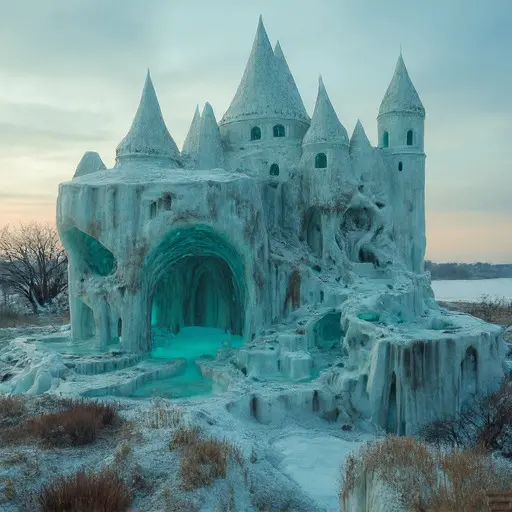
A Structure Born From Stone That Forgot It Was Alive
The mansion rises from the meadow basin like a cathedral carved not by hands, but by pressure, time, and memory. It does not sit upon the land—it emerges from it, as though the earth itself exhaled and froze mid-breath.
Its form is a colossal iceberg rendered in architecture: translucent frozen-blue stone walls threaded with deep emerald mineral light suspended within the mass like trapped auroras.
Nothing in its structure feels constructed in the conventional sense. Instead, it appears grown, as if geology briefly learned the language of Victorian design and then stopped speaking it.
Towering fractured arches open into chapel-like residential halls, each one angled and irregular yet strangely reverent in composition.
The meadow around it bends in slow circular patterns, as though responding to the invisible gravity of its presence.
Frozen Halls and Hollow Silence
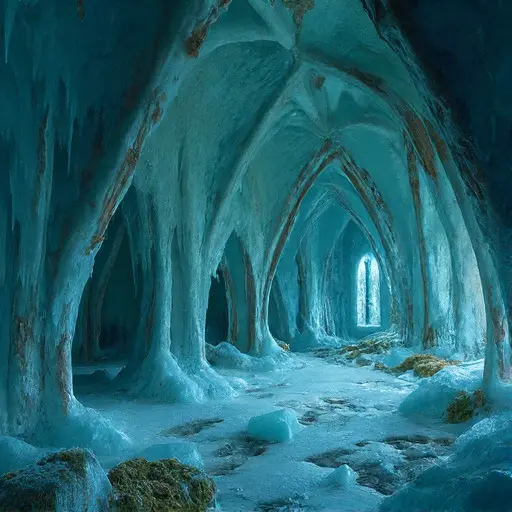
Inside, the mansion becomes a cathedral of absence.
The halls stretch upward in fractured vaults of frozen stone, each arch irregular yet deliberate, like a memory that crystallized unevenly. Light does not enter so much as dissolve against the translucent blue surfaces, revealing faint emerald mineral veins trapped within the walls like dormant constellations.
Window cavities are carved directly through the ice-stone mass—completely hollow, completely dark. They do not frame the outside world; they negate it.
Along the floors and walls, weather-smoothed brass anchoring rings remain embedded in the frozen structure, joined by Victorian ironwork that has fused seamlessly into the stone over time. It no longer supports the building. It simply belongs to it.
Nothing moves here.
Not even dust.
The Reliquaries Scattered in the Grass
Outside, the meadow carries the remnants of what this place once might have been.
Broken aurora-glass reliquary fragments lie scattered among the grass like fallen artifacts from a forgotten ritual. Their surfaces once held color, but now only catch the muted sky in dull reflections. Around them, grasses bend in slow arcs, forming circular patterns that echo the cathedral’s internal geometry.
Beyond the basin, a distant frozen river reflects the pale tones of the sky—slate-turquoise dissolving into a faint peach glow near the horizon. The water appears less like liquid and more like a paused memory of motion.
Alpine vines and moss thread through fissures in the iceberg structure, softening its impossible rigidity without weakening it.
A Cathedral That Chose Stillness
From a wide cinematic perspective, the mansion feels like a geological miracle mistaken for architecture. Jagged yet elegant, monumental yet silent, it exists in a state that defies both ruin and preservation.
The natural matte lighting removes all illusion of artificial glow. There is no warmth, no electricity, no internal illumination of any kind. Only environmental stillness rendered in color and stone.
The cathedral does not collapse.
It does not erode.
It simply persists.
And as the wind moves across the meadow basin and the sky fades into a quiet slate-peach horizon, the structure exhales like a dethroned emperor remembering the garden it was carved out of ice to overlook.