The Carrickshore Cliff House Left Quiet After Coastal Watch Ended
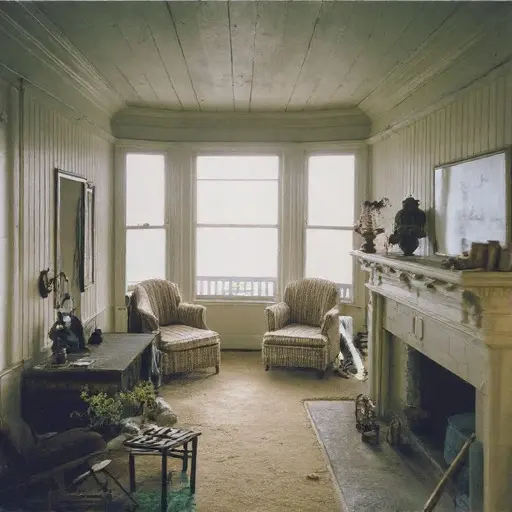
The Carrickshore Cliff House was constructed in 1879 on a rugged coastal cliff overlooking the gray-blue Atlantic shoreline as a compact Victorian family residence designed to withstand persistent wind and salt exposure The original structure consisted of a two-story main house anchored directly into the cliff face, with stone foundations embedded into the rock and aligned to distribute load away from the exposed edge A small studio annex was added in the early 1890s, extending toward the sea in a partially cantilevered form supported by iron and steel reinforcement The house evolved gradually over decades, with minor expansions and repairs shaping a slightly irregular but stable architectural profile, including a gently uneven roofline formed through repeated wind repair cycles and an offset window grid adapted to structural constraints
For most of its early life, the house was occupied by the Lorne family, who maintained a quiet coastal existence dependent on fishing, small trade routes, and occasional maritime observation from the cliffside The studio annex was used for navigation sketches, weather recording, and quiet domestic work, benefiting from its elevated position above the sea The environment remained consistently overcast, with flat natural light and constant wind shaping both daily life and the gradual weathering of materials Salt staining accumulated slowly along the brick chimney and lower stone sections, while iron balcony railings developed a light rust patina that did not compromise structural stability
Early Reduction in Use and Coastal Isolation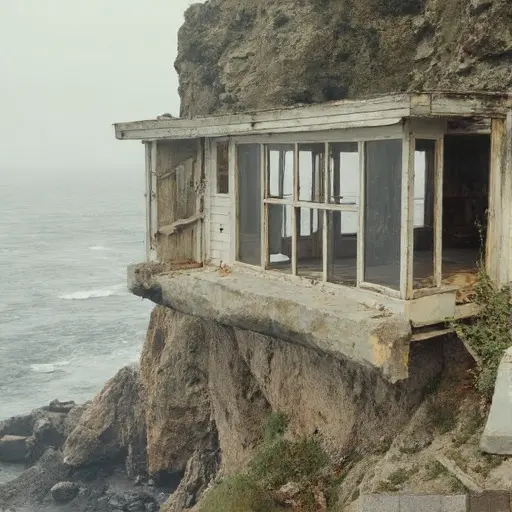
By the early 1930s, the Lorne family began to reduce their permanent residence at the Carrickshore house as younger members relocated inland due to changing economic conditions and limited coastal opportunities The studio annex, once used for observation and recording, saw the most significant reduction in activity, while the main residence remained intermittently occupied Seasonal visits became more common than continuous habitation, and maintenance cycles began to slow as structural wear from salt exposure increased The house remained stable, but its role as a functioning family residence gradually diminished
Despite reduced use, the structure continued to withstand coastal conditions without major degradation The steel reinforcement beneath the studio remained intact, and the cliff foundation showed no signs of erosion severe enough to threaten stability Minor weathering became more visible in the form of paint peeling, salt streaks across stone surfaces, and slight warping of wooden panels exposed to persistent wind The surrounding cliff environment remained unchanged, with wind-swept grass and scattered rocks framing the structure against the open sea
Final Quiet Abandonment Above the Ocean
<img src=”https://beyondvisit.
com/wp-content/imagecontent/uploads/abandoned victorian house 61426589.webp” alt=”” />
By 1940 the remaining Lorne descendants had fully vacated the Carrickshore Cliff House as coastal livelihoods declined and inland urban centers became the primary source of employment Wartime restrictions further reduced the feasibility of maintaining remote cliffside properties, and no organized effort was made to preserve continuous habitation of the structure The house remained physically stable, requiring only minimal maintenance to prevent corrosion of metal elements and further weather-related wear
In the following years, the house continued to age slowly under constant exposure to salt air and wind without structural failure The cliff remained stable, and the ocean continued its quiet rhythm below, preserving the house’s relationship to the horizon even in absence No collapse occurred, and no restoration was initiated
By 1950 the Carrickshore Cliff House stood entirely empty above the sea, its studio annex still suspended over rock and its rooms untouched No return was recorded, no demolition occurred, and no new use was assigned The house remained in calm overcast light, quietly preserved against the cliff face, a Victorian coastal residence left behind between stone, wind, and ocean silence