The Canyon House of Slow Stone Memory
A House Formed Within the Canyon
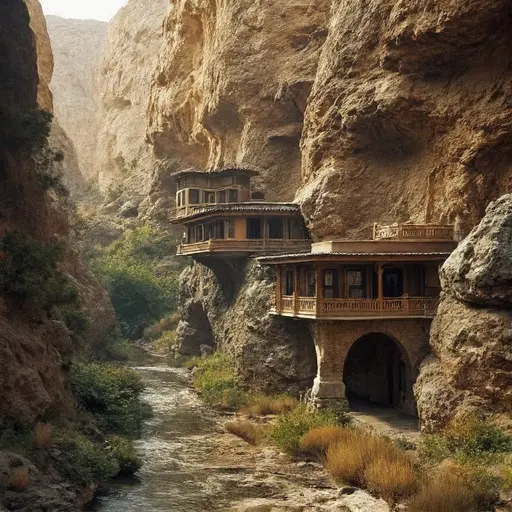
Deep within a quiet inland canyon, where smooth sandstone rises in layered curves and a shallow river threads through pale reeds below, a solitary Victorian house emerges not as a structure placed upon the land, but as something grown from it. The architecture appears inseparable from the canyon wall, as though it crystallized from stone over an uncountable span of time.
There is no clear moment where geology ends and construction begins.
Instead, the house reads as a continuation of the canyon’s own slow movement—an extension of erosion, compression, and patient formation rendered in habitable form.
Terraces Carved From Time
The exterior unfolds as a sequence of stepped terraces that follow the canyon’s natural contours. Each level descends or rises with the rock itself, creating a cascading rhythm that feels less designed than discovered.
Within these terraces, Victorian detailing persists in softened form. Arched supports curve along stone edges, balustrades trace delicate lines across ledges, and ornamental cornices appear gently worn, as if smoothed by wind and mineral dust. These elements do not interrupt the canyon—they echo it.
Cedarwood and carved limestone blend into the surrounding geology, their textures softened into a unified palette of warm earth tones and pale mineral grays.
Windows Embedded in Stone
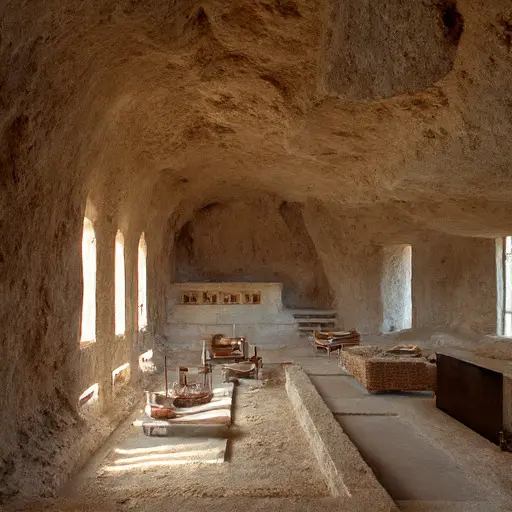
Windows are irregular in height and placement, embedded directly into the canyon face rather than mounted upon it. Their glass is subtly curved and weathered, catching reflections of stone, sky, and drifting canyon light rather than offering clear views inward or outward.
Some openings are framed by natural rock formations that have been gently shaped into arch-like forms. This blending of architecture and erosion makes each window feel like a naturally occurring aperture, refined but never fully separated from its geological origin.
The result is a façade that behaves more like a mineral surface than a constructed wall—layered, porous, and responsive to light.
Vertical Paths Through Rock and Structure
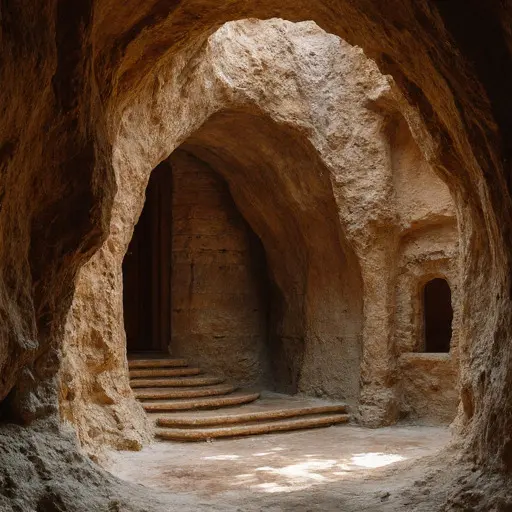
A narrow exterior stairway winds upward along the canyon wall, sometimes exposed, sometimes disappearing into carved tunnels before emerging again on higher terraces. Movement through the house becomes a gradual ascent through both architecture and stone.
Small balconies project unexpectedly from the cliffside, opening onto views of the river far below. Mist gathers in quiet pockets between boulders, softening the canyon floor into shifting layers of gray and pale green.
Vegetation appears sparingly but deliberately—tufts of hardy grasses and pale flowering plants rooted in rock crevices. They do not overtake the structure, but instead accent its quiet integration with the canyon.
A Structure Shaped by Geological Time
Inside, the atmosphere is cool and diffused. Light filters from the canyon above, entering through carved openings and embedded windows, spreading gently across stone floors and timber surfaces. Rooms feel less constructed than excavated, as though they were revealed rather than built.
Every surface carries the impression of long coexistence between human craftsmanship and geological pressure. Stone curves subtly where walls meet canyon rock, and wooden elements follow those curves rather than resisting them.
Where Architecture Becomes Erosion
As the river flows silently through the canyon below, the house remains still above it, neither dominating nor retreating from its environment. Instead, it participates in the canyon’s slow logic—an architecture that feels less constructed and more inevitable.
In this place, Victorian craftsmanship does not oppose nature. It dissolves into it, becoming part of a continuous process of formation that belongs equally to stone, water, and time.