The Caldwell Forest House Left to Woodland Decay
The Caldwell Forest House was completed in 1902 as a retreat for railway surveyor Henry Caldwell, who sought isolation after years of expanding rail lines through increasingly remote terrain. He moved there with his wife Louise and their daughter Miriam, intending the residence to serve as both a family home and a private planning office. Built in the Victorian Stick Style, the house was designed to blend into the surrounding pines, its dark cedar exterior and timber framing reflecting the dense woodland environment that surrounded it on all sides. In its early years, lantern light glowed from its narrow windows each evening as maps and engineering documents covered the study tables inside.
<img src=”https://beyondvisit.
com/wp-content/imagecontent/uploads/abandoned victorian house 17056088.webp” alt=”” />
The study reflected the disciplined rhythm of Caldwell’s profession, yet by the 1910s, his work became increasingly uncertain. Rail expansion slowed, government contracts were reduced, and competition from newer transport routes weakened his income. Maintenance of the house began to suffer first in small ways: delayed repainting of timber beams, unpolished railings on the veranda, and minor roof leaks that went unrepaired through winter seasons. Although the family remained in residence, the house gradually shifted from a place of careful order to one of quiet financial concern.
First Signs of Withdrawal
By the early 1920s, Henry Caldwell had been forced into partial retirement due to declining commissions and failing health. Income dwindled, and the household began reducing expenses wherever possible. Servants were dismissed, and several upper rooms were closed off entirely to conserve heating fuel. The once-regular maintenance of the cedar siding stopped, allowing weathering to deepen into visible decay. Ivy began creeping over veranda railings, while the sound of repairs—once frequent and routine—became rare and eventually absent altogether.
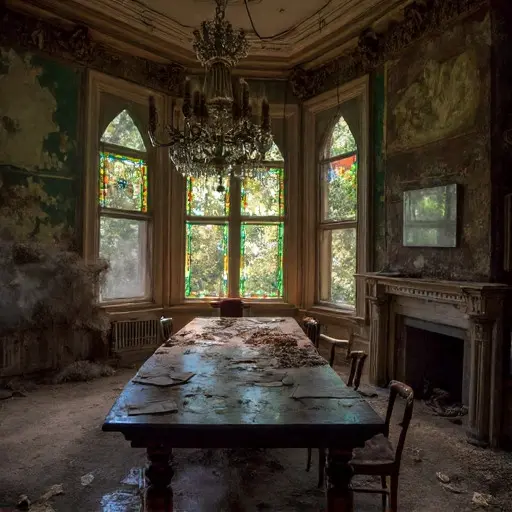
After Henry’s death in 1928, inheritance complications divided the estate among distant relatives who never agreed on its upkeep. Legal disputes consumed remaining funds, while taxes on the property accumulated faster than they could be paid. The family’s daughter, Miriam, briefly attempted to maintain occupancy but eventually left due to the cost and isolation. The house was left intermittently empty, its silence broken only by wind passing through broken seals and shifting floorboards.
Final Abandonment
By the late 1930s, the Caldwell Forest House had entered complete abandonment. No legal resolution ever restored ownership to a single caretaker, and the property remained suspended in unresolved inheritance proceedings. Without heat or repair, moisture spread through cedar beams and granite foundations, accelerating structural weakening. Window glass cracked and remained unreplaced, allowing forest air and debris to settle inside rooms that once held daily family life. The house became increasingly indistinguishable from the surrounding woodland, as vegetation slowly reclaimed its edges.
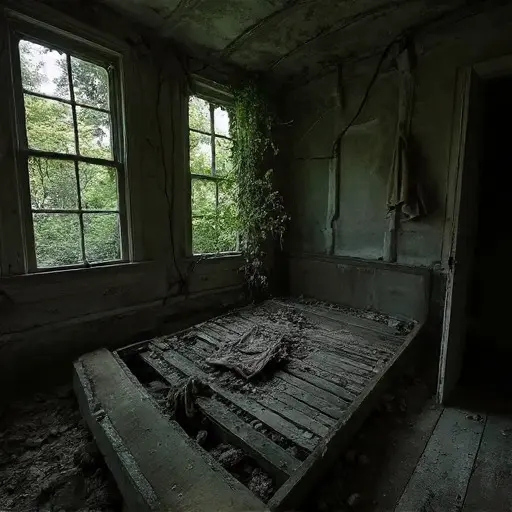
No restoration efforts ever followed, and no descendants returned to reclaim the property. The Caldwell Forest House remains standing within the pines, slowly deteriorating under continuous exposure to weather and time. Its interiors are now permanently abandoned, with no evidence of future repair or habitation, and its condition remains unchanged in legal and physical neglect.