The Butter-Cream Villa Beneath the Greenwood Canopy
Set within a sunlit forest clearing where tall deciduous trees form a calm, enclosing boundary, the abandoned Victorian Italianate family villa stands as a refined expression of horizontal elegance and domestic grandeur. Unlike more vertical Gothic residences, this 2-story home stretches gracefully across its site, emphasizing proportion, rhythm, and classical balance. Though long uninhabited, it retains a quiet dignity, its softened materials and weathered ornamentation preserving the essence of 19th-century family life.
The exterior is finished in pale butter-cream stucco laid over solid brick, giving the villa a smooth, luminous surface that contrasts beautifully with deep forest-green wooden shutters and burgundy accent trims along cornices and window frames. These color accents, though faded, still define the architectural geometry with clarity.
Wide overhanging eaves extend from the shallow slate roof, supported by ornate carved wooden brackets decorated with floral scrollwork that has softened but not lost its intricate craftsmanship.
The façade is structured around tall, evenly spaced arched windows with rounded tops, each framed in cream stone molding. Many shutters hang loosely or remain half-open, while cracked or missing glass reveals interiors of complete darkness. At the center, a grand recessed entrance sits beneath a rounded arch portico supported by paired Corinthian columns painted ivory. Beyond them, heavy walnut double doors with frosted jade and amber glass panels stand sealed and fractured, offering no hint of light or life within.
Above the roofline rises a modest square belvedere tower, its arched openings open to the forest air on all sides. Capped with a low pyramidal roof of aged copper, the structure has transformed into a deep verdigris green patina that subtly glows against the muted tones of stucco and slate. On one wing, a long arcaded veranda runs the full length of the building, forming a shaded promenade of repeating stone arches and iron railings, some sections collapsed or leaning with time. Two tall brick chimneys bookend the roofline, their decorative stone cornices softened by moss and weather.
The surrounding garden retains the ghost of its original Italianate design. A central gravel axis leads toward a dry marble reflecting basin engraved with faint laurel patterns, its surface now filled with leaves and wild grasses. Clipped hedges have grown into irregular sculptural forms, while broken stone benches, toppled urns, and shattered terracotta pots rest among tall lilies, purple irises, wild roses, and untrimmed grasses. The formal structure of the landscape remains visible beneath nature’s gentle reclamation.
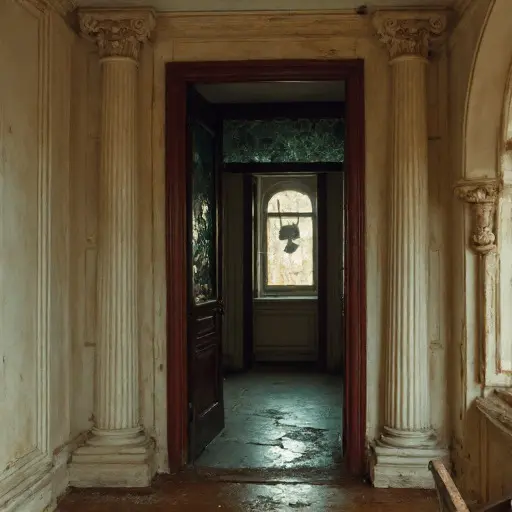
The forest surrounding the villa is tranquil and balanced, with tall oaks, beeches, and maples filtering soft neutral daylight evenly across the clearing. No fog, mist, or dramatic atmospheric effects are present. The composition remains cinematic and wide, with lush foreground vegetation blending into the structured villa at midground, and layered woodland depth beyond.
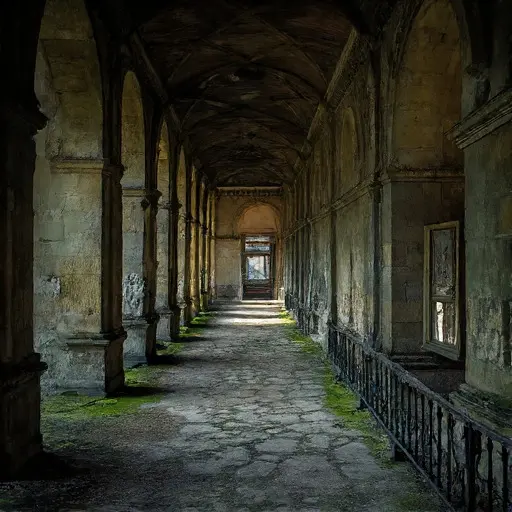
Every material in the scene remains tactile and believable: butter-cream stucco, carved wood, brick, slate, copper, marble, and wrought iron. Together they form a distinct Victorian family residence shaped by Italianate refinement—now silent, but still elegantly composed within its peaceful forest setting.